SECON & eGISEC 2026: Korea’s Blueprint for Trust in the Age of AI
With a market exceeding $7 billion, South Korea’s security ecosystem marked the show’s 25th anniversary by demonstrating full convergence between physical and cybersecurity, redefining the role of AI in protecting critical infrastructure and future smart cities
By: Dženana Bulbul
E-mail: redakcija@asadria.com
As the global security industry faces the fastest technological changes in its history, one theme dominates every conversation: how to build trust in the age of artificial intelligence. That exact question was at the center of SECON & eGISEC 2026, which opened on March 18 in South Korea and became a focal point for addressing the challenges of the modern security landscape.
“Building Trust in the Age of AI” was not just a convenient event slogan. It articulated the fundamental dilemma the entire industry is currently confronting. On the occasion of its 25th anniversary, the exhibition positioned South Korea as a meeting point of theory and concrete application, where solutions that will define the coming years are already being tested and deployed.
The event’s importance on the global stage is also confirmed by Trevor Clarke, Chief Analyst at Omdia, who sees SECON as an excellent platform for establishing relationships with South Korean companies in both cybersecurity and physical security. According to him, as one of the largest events in the region, it provides an outstanding environment for learning about market trends and technological developments.
A global hub
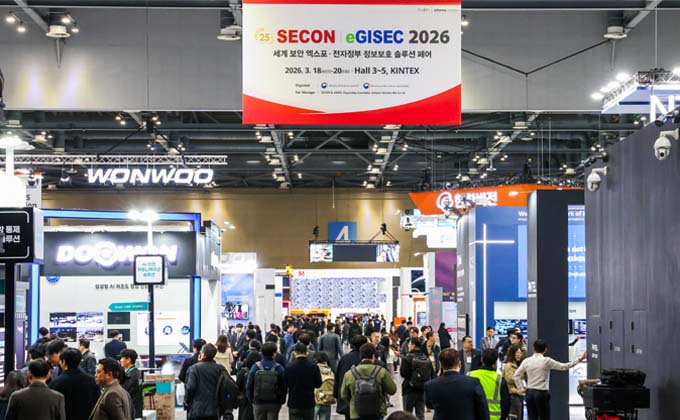
Across 28,000 square meters of exhibition space at KINTEX, SECON & eGISEC brought together 412 companies and institutions from 19 countries, with a total of 1,770 booths. The exhibition welcomed 26,389 visitors from 31 countries and regions, including security professionals, managers, decision-makers, procurement leaders, and government officials, as well as more than 100 hosted buyers.
The event also holds the status of “International Certified Exhibition+”, the highest certification awarded by the Association of Korean Exhibition Industry.
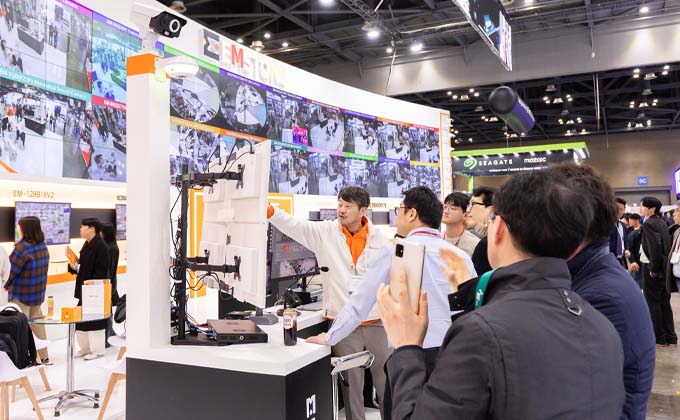
The exhibition welcomed 26,389 visitors from 31 countries and regions, including security professionals, managers, decision-makers, procurement leaders, and government officials, as well as more than 100 hosted buyers.
At SECON & eGISEC 2026, the boundaries between physical and digital security effectively disappeared. The exhibition showcased a comprehensive range of security solutions, from AI-based video surveillance and access control to critical infrastructure protection, smart city security, and protection for autonomous vehicles and maritime traffic.
From detection to prevention
In the field of physical security, the emphasis was placed on harmonizing video surveillance and biometric access control within advanced cyber monitoring platforms. At the same time, the industry is shifting from detection to prevention. Sophisticated solutions are now capable of identifying anomalies in real time, including falling, loitering, concealment, and possession of weapons.
Particular attention was given to next-generation artificial intelligence. This primarily refers to Explainable AI, which enables systems to explain why a certain decision was made. At the same time, proactive AI was presented as a model that does not wait for incidents to occur, but instead predicts threats and acts preventively before situations escalate.
Technology in action
This approach was best illustrated by Hanwha Vision, a key player not only in the Korean but also in the global market, which demonstrated how AI theory is being translated into practical security infrastructure. According to the company, the exhibition proved highly productive, with a noticeable increase in enterprise-level clients seeking concrete solutions, as well as industry professionals looking for deployable security infrastructure.
“Interest in AI analytics and workplace safety has never been higher. That was clearly reflected in the response to our key product lines, such as the Wisenet 9 chipset, T AI PTZ ruggedized cameras, and AI-based industrial and traffic solutions. We deliberately designed our booth to focus on live demonstrations. Seeing our cameras and AI systems operating in real time allowed visitors to validate the technology on the spot,” says ManGeun Cho, Head of Business in Korea.
Engagement exceeded expectations, with visitors moving from general inquiries to in-depth discussions about how AI video surveillance can address specific operational challenges.
“Our presence this year focused on our latest camera lines powered by the next-generation Wisenet 9 chipset. By integrating two neural processing units for AI analytics and image enhancement, this chipset sets a new industry standard in both image quality and intelligence. The response has been outstanding,” Cho adds.
For demanding environments, Hanwha’s AI PTZ ruggedized cameras attracted strong interest from infrastructure and energy sectors due to their reliability under extreme conditions. By combining highly durable hardware with advanced AI analytics, these cameras enable precise object detection and automated monitoring even in the harshest environments, from intense heat to industrial locations with high vibration.
“By showcasing real-time AI capabilities, such as forklift detection, we demonstrated how Hanwha Vision now delivers proactive security solutions that actively protect both critical assets and personnel,” Cho explains.
The company’s strategy is focused on evolving into a comprehensive visual solutions provider, supported by significant investments in AI research and development and the strengthening of its global supply chain.
“Our goal is to expand our international presence by delivering localized solutions tailored to specific industries, such as smart cities and automated logistics, and to strengthen our position in key markets by building long-term ecosystem partnerships,” Cho concludes.
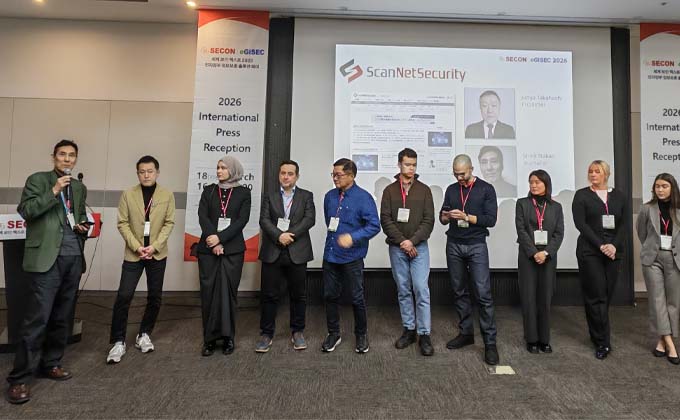
Held across 28,000 square meters at KINTEX, SECON & eGISEC 2026 brought together 412 companies and institutions from 19 countries, featuring 1,770 exhibition booths.
Focus on the Middle East
Hanwha Vision places particular strategic importance on the Middle East, which it sees as a key growth hub due to rapid digital transformation and ambitious infrastructure projects. “Our Wisenet 9-powered cameras and AI ruggedized PTZ cameras are primary growth drivers, as they directly reflect our deep understanding of this environment. Our Wisenet 9 SoC delivers a new level of image clarity and AI precision required for intense lighting conditions and demanding environments typical of the region.
At the same time, our ruggedized PTZ cameras are engineered to meet the high durability requirements needed to operate in extreme heat. By combining our specialized regional expertise with these advanced technologies, we aim to remain a key partner in the Middle East’s ongoing transition toward a smarter and safer future across multiple sectors,” Cho says.
Precision down to the detail
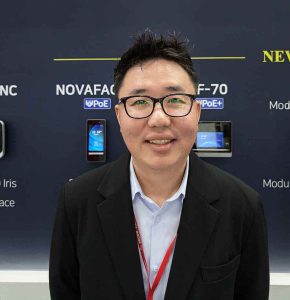
Deputy CEO at CMITech Jay Jeong: “Our technologies are currently deployed globally in government, airport, and corporate environments where a high level of security and reliability is required”.
Among the companies present at SECON & eGISEC 2026 was CMITech, a Korean manufacturer specializing in advanced biometric technologies, particularly iris and facial recognition systems.
In an interview, Deputy CEO Jay Jeong reflected on the key trends shaping the biometric market. Since its founding, the company has focused on developing high-precision, contactless biometric solutions for identity authentication, border control, access control, and attendance tracking across various sectors.
“Our technologies are currently deployed globally in government, airport, and corporate environments where a high level of security and reliability is required. What sets CMITech apart is our long-standing expertise in iris recognition technology, which is considered one of the most accurate contactless methods of identity verification,” Jeong explains.
Trends and challenges
In recent years, CMITech has expanded its portfolio by introducing advanced facial recognition with Novaface-3 and multimodal biometric systems EF-70 and EFM-70. These solutions allow users to choose the most appropriate authentication method depending on the application and required security level. “One of the biggest changes in the biometric market is the rapid adoption of contactless authentication technologies. After the pandemic, users increasingly demand solutions that are both secure and hygienic, which has accelerated the adoption of iris and facial recognition,” Jeong notes.
Another key trend is the rapid advancement of AI-based facial recognition technologies. Modern systems can now achieve highly accurate and reliable results even in challenging conditions, such as outdoor environments and low-light scenarios.
“We are also seeing growing demand from government and border control sectors, especially at airports and within national identity programs where large-scale biometric identification is required. Given the current situation in the Middle East and future prospects for the region, the security market leveraging biometric technologies is expected to continue growing,” Jeong adds.
Contactless biometrics
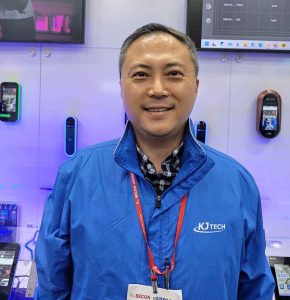
JJ Kim KJTECH, Smart Systems Sales Manager
A similar direction is evident in the approach of KJTech, another Korean manufacturer whose solutions further confirm that contactless biometrics are becoming the global standard. In recent years, the company has increasingly focused on palm vein recognition, which is gaining importance due to its higher level of security and hygienic advantages compared to traditional methods. KJTech has experience across multiple international markets, including Asia and parts of Europe, and has established partnerships abroad.
The company continues to expand its international presence by participating in global industry events, with a particular focus on building partnerships in the European market.
Interactive zone
The KINTEX exhibition space also enabled direct testing of future technologies. MONITORAPP used interactive reflex-based activities to educate visitors about Zero Trust architecture, while SAENUN demonstrated real-time smart city security through intelligent kiosks. IDIS attracted significant attention with its Safety CINEMA tour, which simulated fire detection scenarios. The power of AI was further demonstrated by INNODEP and HUNESION, whose systems enable operators to manage surveillance through natural-language interaction. CATIS presented advanced hidden-object scanning technologies, while Cudo Communication combined technological innovation with artistic performances and influencer engagement.
Strategic evolution
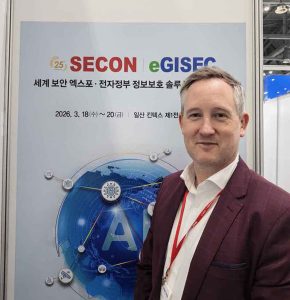
Trevor Clarke, Chief Analyst at Omdia: “SECON is an excellent platform for establishing relationships with South Korean companies in both cybersecurity and physical security”.
One of the exhibition’s key strategic focuses was cybersecurity, which is no surprise given that global spending in this sector is expected to reach $311 billion in 2026, with growth of 12 percent, according to Trevor Clarke of Omdia.
This figure does not reflect only the increase in threats. It signals a structural transformation of the industry in the age of AI, defined by five key trends. For starters, platformization is accelerating. Clients are overwhelmed by fragmented systems, which is why as many as 70 percent of companies plan to consolidate their security solutions to reduce training and maintenance burdens.
Next, sovereignty is becoming a design principle. Geopolitics and regulations such as NIS2 and DORA are reshaping how companies manage data, with data residency becoming a central risk management factor. At the same time, ecosystem economics are evolving. Every dollar invested in technology now generates up to two dollars in services, while within platform ecosystems, this multiplier can reach four.
Speaking of new technologies, artificial intelligence is becoming the operational model. AI-driven service delivery is replacing traditional labor-based approaches, with the main challenge being the integration of automation and orchestration into core intellectual property. Finally, the surveillance paradox is intensifying. While AI takes over investigative and reactive tasks, human oversight becomes more important than ever, requiring new governance structures to maintain trust and accountability in high-risk environments.
Extensive program
While exhibitors such as Hanwha Vision dominated the exhibition floor, the parallel conference program delivered equally ambitious content, featuring 32 thematic tracks and 159 sessions over three days of intensive knowledge exchange.
More than 100 international buyers and delegates from 18 countries participated in the networking program.
The first day focused on future infrastructure and research and development, the second on artificial intelligence, aviation, and global cooperation, while the third addressed counterterrorism, privacy, and specialized defense.
The program also included specialized sessions by ASIS International and the Asia-Pacific Security Association, linking global trends with regional needs.
In cybersecurity, the focus was on reducing the risks associated with AI misuse, strengthening defenses against phishing, ransomware, and credential stuffing, and developing operational security frameworks tailored to modern organizations.
The value of the South Korean security market in 2026 is estimated at $7.15 billion, of which cybersecurity accounts for $2.72 billion and physical security for $4.43 billion.
Market in numbers
The activities of companies such as Hanwha Vision, CMITech, and KJTech are clear indicators of the momentum with which the Korean security ecosystem is expanding globally, and the figures confirm this.
South Korea’s security market is today one of the most dynamic and technologically advanced ecosystems in the global industry. The exhibition once again confirmed that the country not only follows global trends but actively shapes them, particularly in artificial intelligence, cybersecurity, and integrated security systems.
One of the key messages concerns the continued growth of cyber threats. Despite a high level of digitalization and technological sophistication, the Korean market faces constant and increasingly complex cyber incidents. As a result, companies are investing heavily in AI-based defense solutions. At the same time, AI is increasingly used as a potential attack tool, adding further complexity to the security landscape.
The regulatory framework in South Korea is also evolving rapidly. Strengthening laws and policies in the areas of security and data protection is becoming a key response to growing threats, as well as a means of restoring user trust in digital and security systems.
Trust itself stands out as one of the industry’s central challenges in the coming period. In terms of market size, South Korea’s total security market is projected to reach $7.15 billion in 2026. Of this, cybersecurity accounts for $2.72 billion, while physical security remains dominant at $4.43 billion.
These figures clearly show that, despite the rapid growth of digital threats, traditional segments such as video surveillance, access control, and physical protection continue to play a central role, while increasingly integrating with advanced IT solutions.