Data centers are the foundation of the digital economy, enabling cloud services and powering emerging technologies such as generative AI (GenAI). According to Boston Consulting Group’s 2025 report Breaking Barriers to Data Center Growth, GenAI-driven computing is the fastest-growing demand driver and is expected to account for nearly 60% of growth in data center power consumption between 2023 and 2028. This surge in demand is driving rapid expansion and deployment of data center infrastructure worldwide, with the global data center market projected to grow steadily over the same period.
While digital defenses are advancing, physical security breaches remain a critical vulnerability—responsible for roughly 10% of global data leaks. To ensure trust and compliance with standards such as ISO/IEC 27001, data centers must adopt robust, multi-layered physical protection.
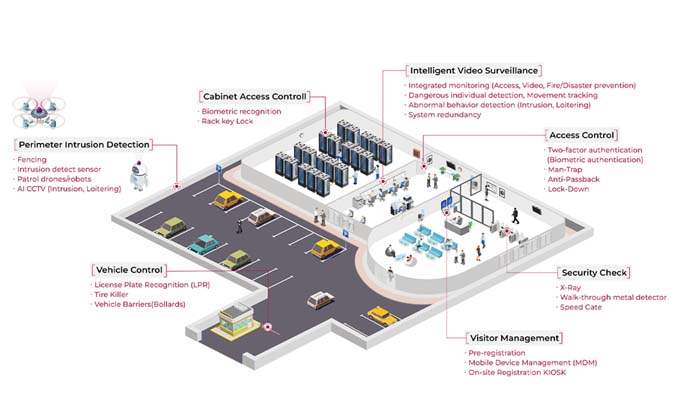
A single security system is not enough. True resilience comes only from a comprehensive, integrated, multi-layer defense strategy. Suprema proposes a 6-layer framework for ensuring complete physical security in data centers.
Layer 1: Site and Surroundings – Establishing the Foundation
Security begins with location. Choosing a site with minimal natural disaster risks (e.g., flooding, earthquakes) and strong public safety conditions sets the foundation for reliable operations.
Layer 2: Perimeter Protection – Building the First Barrier
The outer perimeter must deter and delay intrusion attempts. Effective defenses include vehicle barriers, bollards, high-strength fencing, and well-positioned security lighting. Thermal and infrared cameras, supported by motion and ground sensors, provide 24/7 detection. Advanced tools such as X-ray vehicle inspection systems further strengthen perimeter integrity.
Layer 3: Access Control and Authentication – The Core Security Layer
Access control is the centerpiece of data center protection. Multi-factor authentication (MFA) using RF cards, PINs, fingerprint recognition, or facial authentication ensures only authorized personnel enter. To prevent tailgating, facilities should employ mantraps and speed gates, with anti-passback settings enforcing strict access policies.
Layer 4: Video Surveillance and Intelligent Detection – From Passive to Proactive
AI-powered surveillance elevates video from passive monitoring to proactive defense. Intelligent cameras continuously analyze footage, using facial authentication and behavioral analytics to trigger instant alerts for unauthorized presence or suspicious behavior. This transforms video surveillance into a real-time threat detection system.
Layer 5: Visitor Management – Controlling External Personnel
Visitors for inspections or maintenance are unavoidable. Strong visitor management is therefore essential: advance registration, ID verification, escorted entry, temporary pass issuance and retrieval, and strict one-to-one escort policies all reduce the risk of external breaches.
Layer 6: Environmental and Equipment Protection – Ensuring Continuity
Data centers must be prepared for fire, flooding, and power failures. Disaster prevention systems and redundant infrastructure ensure continuity. When integrated into the broader security platform, these measures enhance resilience across both facility and IT infrastructure.
Integrating the Layers: Why a Unified Approach Matters
A truly secure data center is more than the sum of its parts. Even highly capable individual systems create blind spots if they operate in silos. Security must function as a cohesive, interoperable ecosystem.
Suprema highlights three enabling technologies for achieving this integration:
AI Video Analytics
AI-powered analytics detect intrusions and abnormal behaviors in real time, such as unauthorized access, loitering, violence, or smoke/fire. They also identify potential insider threats—like unauthorized movement in restricted zones during off-hours—enhancing situational awareness.
Advanced Biometrics and Access Control
High-security environments must move beyond cards and passwords, which are vulnerable to loss and duplication. Instead, MFA combined with biometric authentication (fingerprint recognition, facial authentication), mobile credentials, and PIN ensures secure, non-transferable access. Biometrics eliminate the risks associated with stolen or cloned cards, effectively blocking unauthorized entry.
Unified Security Operations and Future Strategy
Modern hyperscale data centers increasingly adopt PSIM (Physical Security Information Management) platforms to centralize monitoring and correlate events across all security systems. Looking forward, open APIs integrated with VMS (Video Management Systems) and MDM (Mobile Device Management) extend capabilities to IoT sensors, autonomous robots, and drones. For example, the Novva Data Center in the U.S. deploys robot dogs for perimeter patrol, thermal detection, visitor guidance, and biometric verification, while unmanned aerial drones provide real-time external surveillance to eliminate blind spots.
Towards Total Confidence in Data Center Security
As data centers scale to meet the demands of AI and cloud services, physical security must evolve beyond basic controls. A 6-layer integrated strategy, powered by AI-driven analytics, biometric authentication, and unified security platforms, delivers complete, future-ready protection. Suprema’s approach ensures that data centers are not only compliant, but resilient—offering operators and customers total confidence in security, continuity, and trust.