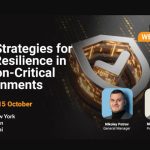
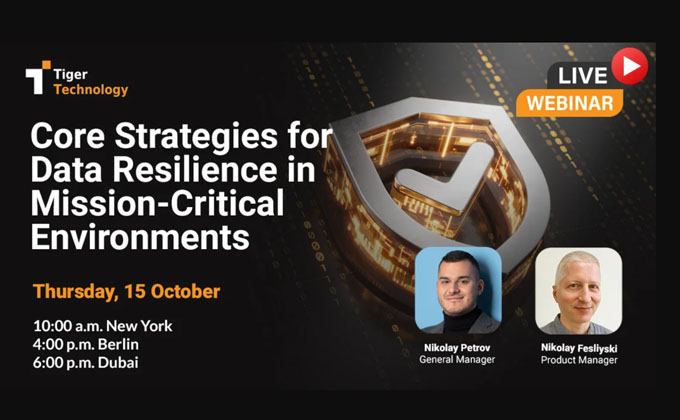
Tiger Technology will host a free webinar titled “Core Strategies for Data Resilience in Mission-Critical Environments” on October 15, focusing on data protection and business continuity in environments where even a few hours of downtime or data loss can pose serious business and regulatory risks. The 30-minute webinar will begin at 4:00 p.m. Berlin time (CEST), 10:00 a.m. in New York, and 6:00 p.m. in Dubai, allowing interested participants from different regions to join the event live. Nikolay Petrov, General Manager, and Nikolay Fesliyski, Product Manager at Tiger Technology, will guide participants through the key topics and practical examples.
Participants will learn how to move from scheduled backups to continuous data protection and how to align hybrid cloud architecture with the actual level of risk their organization faces. Particular attention will be given to mechanisms that can accelerate recovery following an incident and reduce the impact of downtime in mission-critical IT environments. The webinar will conclude with a live demonstration of continuous file-based data replication and recovery following a ransomware attack and hardware failure.
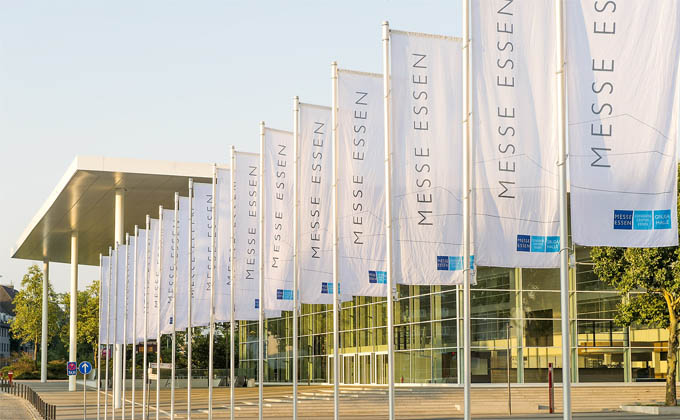
Four days, around 900 exhibitors from 49 countries and 30,000 trade visitors: the very first EURO DEFENCE EXPO (EUDEX) and Security Essen, held at Messe Essen, have ended with excellent results. Trade visitors from 96 countries attended both events to find out about new technologies and solutions for defence and civil security. Exhibitors and visitors alike were highly satisfied with the combination of the new trade fair for the defence industry and the established security trade fair.
“With this dual trade fair event ‘made in Germany’, we have broken new ground in linking civil-military cooperation. This unique platform offered participants visibility and new opportunities,” said Oliver P. Kuhrt, CEO of Messe Essen. He particularly highlighted the calibre of the trade visitors: 83 per cent of EUDEX trade visitors are decision-makers in purchasing and procurement, whilst the figure for Security Essen is 76 per cent.
Drones, AI and connectivity were the defining topics at both trade fairs
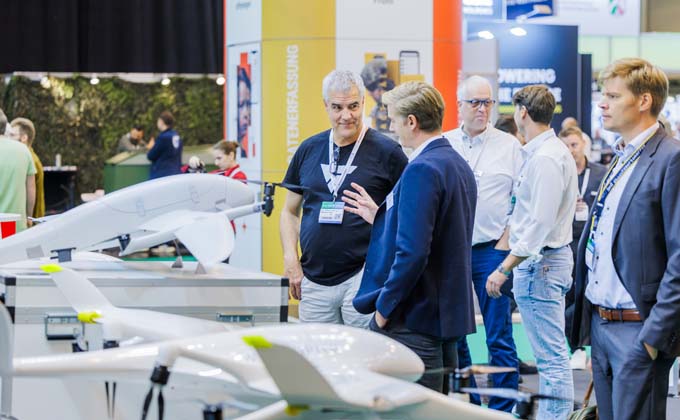
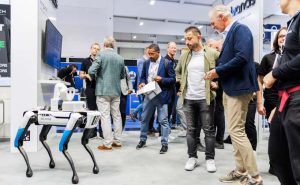
Key topics at both events were AI, the interconnection of systems, robotics and unmanned aerial systems. The overlap in content was particularly evident when it came to drones: at EUDEX, remote-controlled systems for reconnaissance, resupply and other military applications were on display. One exhibitor unveiled its new long-range reconnaissance drone for the first time, with a flight time of up to eight hours.
At Security Essen, companies showcased solutions for surveillance, inspection and the protection of critical infrastructure, as well as for the detection and defence against unauthorised aerial vehicles. One in four trade visitors at Security Essen was particularly interested in the drone sector, whilst at EUDEX, unmanned systems and robotics were the most important topic for 40 per cent of trade visitors.
EUDEX celebrated a successful launch
EUDEX kicked off for the first time with 365 exhibitors from 28 countries. Trade visitors came primarily from industry and the armed forces, but also from government bodies, research, politics and diplomacy. They made the most of the new trade fair format to engage in direct dialogue.
The products and services on offer ranged from unmanned systems and robots, AI and software, through to personal protective equipment, transport containers, mobile protective infrastructure, supply and packaging solutions, right up to command and communication technologies, reconnaissance and surveillance solutions, as well as vehicles and heavy equipment. EUDEX specifically sought to forge links between the defence industry and companies from other industrial sectors.
Dr Jens Bodo Koch, CEO of Heckler & Koch GmbH: “In our view, the inaugural EUDEX was a success. It is good and right that Messe Essen here in Germany took the lead early on in establishing a defence trade fair alongside its Security Essen event. We encountered an international trade audience here and held numerous discussions with end-users, suppliers and decision-makers. Even in its very first edition, EUDEX has thus demonstrated that it can be an interesting platform for professional exchange within the security and defence industry. We were also particularly pleased with the very positive response to our products and solutions.”
Stefan Houben, Key Account Manager for Defence and Public Affairs at SCANIA: “EUDEX provided us with an effective platform to present our transport and mobility solutions for the defence sector to a high-calibre specialist audience. We found the exchange with representatives from industry and politics, as well as with military users from both Germany and abroad, particularly valuable. We held many high-quality discussions and arranged specific meetings to further develop business opportunities. We are very satisfied with the footfall and response at our stand. The organisation and compact structure of the trade fair also contributed to our positive overall assessment of the event.”
Another increase in visitor numbers at Security Essen
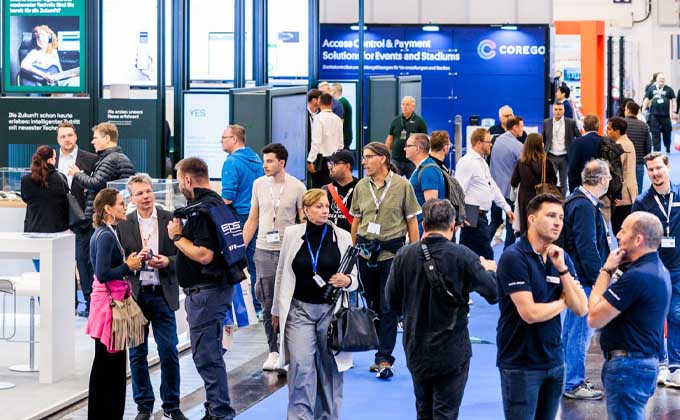
With a rise in visitor numbers of around ten per cent, Security Essen once again underlined its strong position as the leading international trade fair for the civilian security industry. 522 exhibitors from 41 countries presented the full range of modern security technology to trade visitors – from access control, fire and burglary protection, through video and perimeter security, to risk management, services and civil protection.
The exhibitors’ innovations included, for example, AI agents for control centres, solutions for new programming interfaces in hazard management systems and the centralised management of various access technologies, as well as new developments for improved protection of critical infrastructure. To this end, companies presented, amongst other things, enhanced biometric identification options, high-performance photoelectric barriers for perimeter protection and centralised alarm systems.
Dipl.-Ing. Markus Kock, Managing Director of WAGNER Deutschland GmbH: “Security 2026 provided us with an excellent platform for engaging with customers and prospective clients. The attractive stand location and high footfall enabled us to hold numerous meaningful discussions. In particular, the presentation of our new TITANUS REX® aspirating smoke detector attracted a great deal of attention. The response to our solutions for fire prevention, firefighting and risk management showed that these topics are of great relevance to many of the trade fair visitors. Overall, we consider our participation in the trade fair to have been a success.”
Klaus Hirzel, Director Sales DACH, Honeywell Technologies: “Security Essen once again showed how important connected solutions are for our customers. For us, it is a strong signal to bring fire and life safety, security and access solutions, and building automation together as one integrated offering.”
Stefanie Goetz, Director Sales DACH, Honeywell Technologies: “The many positive conversations at Security Essen showed that connected Building Automation solutions continue to play an important role for our customers – from fire detection and alarm systems to access control, video surveillance, intrusion detection and building automation. For us, it is therefore especially important to bring these areas together and present them as integrated solutions.”
Visitors were satisfied with their participation
Nine out of ten visitors to Security Essen were satisfied with their visit, would recommend the trade fair to others and intend to attend the next event as well. Visitors to both trade fairs praised the international character of the events, the presence of market leaders and the range of new products on offer. The combination of the two events was also taken full advantage of: one in two visitors to EUDEX also visited Security Essen. A total of 30,000 trade visitors attended the twin trade fairs. In addition, numerous members of the press, political delegations and guests of honour were in attendance.
The next Security Essen and the next EUDEX will take place from 19 to 22 September 2028 at Messe Essen.
Security Essen 2026 opened its doors today at Messe Essen, bringing together 519 exhibitors from 41 countries at one of the leading international trade fairs for the security industry. This year’s edition, running from September 22 to 25, focuses on the growing convergence of physical and digital security, with artificial intelligence, cybersecurity, and critical infrastructure protection among the key topics. Across 40,000 square metres of exhibition space, solutions are being presented for access control, video surveillance, fire and intrusion protection, perimeter and mechanical security, civil protection and defence, as well as special protection vehicles.
A major trend is the increasing integration of previously separate security systems, with modern platforms combining video surveillance, access control, and intrusion detection, while AI enables faster risk identification and event assessment. Exhibitors include Advancis, Milestone, ASSA ABLOY, dormakaba, Salto, Telenot, Axis Communications, and Dallmeier, alongside numerous other manufacturers and specialist companies from across the security industry. The exhibition is accompanied by an extensive conference programme that includes the DNS – Digital Networking Security Conference, European Drone Conference, Security Experts Forum, and the new KRITIS Forum dedicated to critical infrastructure protection. The protection of energy, water supply, transport, communications, and other essential systems has been given particular attention amid growing cyberattacks, sabotage, hybrid threats, and new regulatory requirements.
EURO DEFENCE EXPO is also taking place alongside Security Essen, further connecting civilian and military security and creating opportunities for cooperation between industry, government institutions, and users of security technologies. Security Essen 2026 runs until Friday, September 25, with the event also being covered on site by the editorial teams of a&s Adria and a&s Middle East.
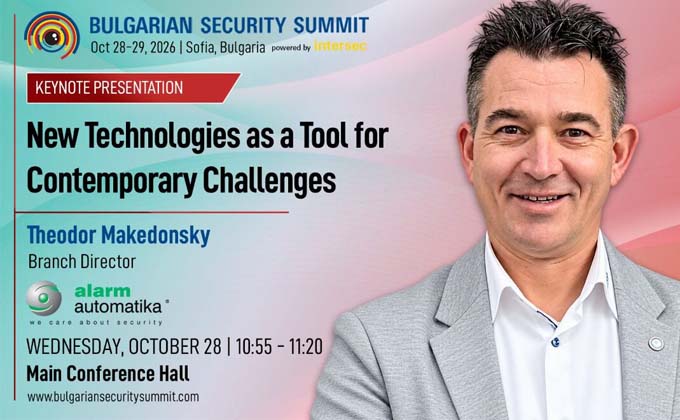
The Bulgarian Security Summit 2026 will host a session titled “New Technologies as a Tool for Contemporary Challenges,” presented by Theodor Makedonsky, Branch Director of Alarm automatika in Bulgaria. The session will take place on October 28, 2026, during the first day of the Summit, in the Main Conference Hall.
Taking place on October 28 and 29, 2026, at Inter Expo Center in Sofia, Bulgaria, the Bulgarian Security Summit will bring together security professionals, technology providers, system integrators, institutional representatives, and end users to discuss the technologies and strategies shaping the future of security in Southeast Europe. As the world faces growing climate, social, and economic challenges, new technologies are becoming increasingly important tools for organizations seeking to adapt to a rapidly changing environment.
In his presentation, Makedonsky will examine how technologies including artificial intelligence, the Internet of Things, cloud platforms, wireless systems, and mobile applications are transforming the security industry. Their growing accessibility is enabling organizations to move beyond traditional passive surveillance toward smarter, interconnected, and more proactive protection systems operating in real time.
The session will explore how these technologies can improve situational awareness, connectivity, and responsiveness while creating new possibilities for the design and operation of modern security systems. It will also highlight the broader role technology can play in helping organizations respond to increasingly complex operational and societal challenges.
Theodor Makedonsky is the Managing Director of Alarm automatika in Bulgaria, a distributor of security and safety systems. With more than 20 years of experience in the security sector, he established Alarm automatika’s Bulgarian branch in 2014 and has since worked to introduce advanced global life-safety technologies to the local market.
During this period, he has developed a network of certified system integrators, installers, and engineering partners while helping build a sales, technical support, and operations team focused on customer service and the continued development of security and safety standards in the Bulgarian market.
The presentation is part of the Bulgarian Security Summit conference program, which brings together regional and international experts to discuss emerging technologies, infrastructure protection, and the evolving operational and security challenges facing organizations across Southeast Europe.
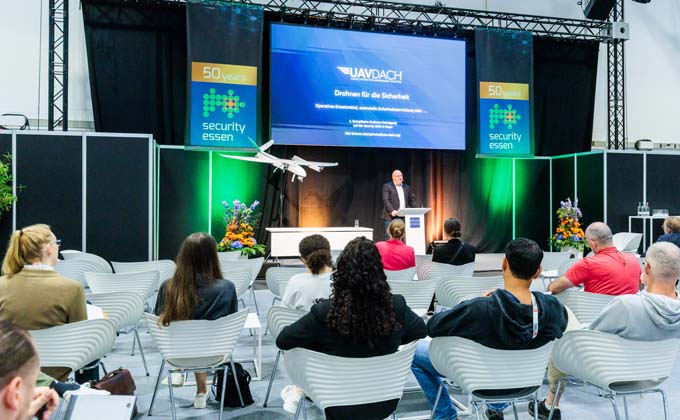
Security requirements for critical infrastructure are changing rapidly. Recent events, such as the discovery of a drone at Leipzig Airport, have once again demonstrated how quickly modern technologies can become a security challenge. This makes dialogue between industry, authorities and emergency services all the more important. Security Essen, which will take place at Messe Essen from 22 to 25 September 2026, is placing precisely this exchange at the heart of two key programme highlights: the European Drone Conference and the Emergency Services Forum.
Unmanned aerial systems open up a wide range of potential applications – from inspecting critical infrastructure to supporting security and emergency services. At the same time, they present new challenges for operators of sensitive facilities. The European Drone Conference on 23 and 24 September will therefore bring together experts from the security industry, public authorities, academia and politics to discuss current developments, the regulatory framework and effective protection strategies. The conference is organised by the Drone Expert Committee of the German Security Industry Association (BDSW), together with Security Essen and the Confederation of European Security Services (CoESS).
Experts discuss drone deployment, detection and countermeasures
Around 20 specialist presentations will examine drone technology from various perspectives – ranging from regulatory issues and the protection of critical infrastructure to detection and counter-drone systems. In his statement, Cornelius Toussaint, Vice-President of the BDSW and Chair of the Drone Expert Committee, will focus on security and drone technology in Germany. Marcus Schermann (DB Sicherheit GmbH) will discuss the protection of critical infrastructure, using multicopteroperations as an example. Drone management, with a particular focus on detection and countermeasures, is the main theme addressed by the two speakers, Ralf Holstein and André Danner (German Business Protection GmbH).
The programme is complemented by presentations on research and development, as well as international keynote speeches from the worlds of politics and the security industry. The central question is how to capitalise on the opportunities offered by the technology whilst effectively managing new risks.
Emergency Services Forum (Blaulichtforum) takes place for the first time
In collaboration with Feuerwehr-Magazin (Fire & Rescue Magazine) and Rettungs-Magazin (Emergency Medical Services Magazine), the Emergency Services Forum 2026 will make its debut at Security Essen. On 22 September, the new forum will bring together public safety authorities and organisations (BOS), the security industry and public authorities, focusing on a key question: How are new threat scenarios and technologies changing security and emergency response?
On stage, experts from the fire service, police, civil protection, the security industry and defence will discuss current challenges: What role will drones and autonomous systems play in future operations? How well is Germany prepared for CBRNE incidents and hybrid threats? And how do control centres, communication technologies and networked systems ensure that a shared situational picture emerges in an emergency? The focus will also be on cooperation between civilian and military actors.
Specialist conferences included in the trade fair admission ticket
Both the European Drone Conference and the Emergency Services Forum will take place directly in Hall 5. Admission is already included in the Security Essen trade fair ticket. Tickets for Security Essen 2026 are available online. A day ticket costs €49. The trade fair is open from 9 am to 6 pm from Tuesday to Thursday and from 9 am to 4 pm on Friday.
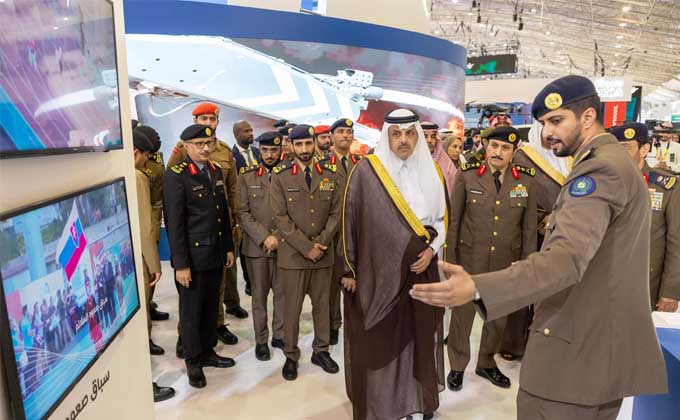
Intersec Saudi Arabia is taking place from 16–18 November 2026 at Riyadh Front Exhibition & Conference Center, with over 25,000 visitors and more than 500 exhibitors expected
The Kingdom’s leading platform for security, safety, and fire protection, returns from 16–18 November 2026 at Riyadh Front Exhibition & Conference Center (RFECC), increasing exhibition space by 40% to meet demand as Saudi Arabia accelerates investment across key industry sectors.
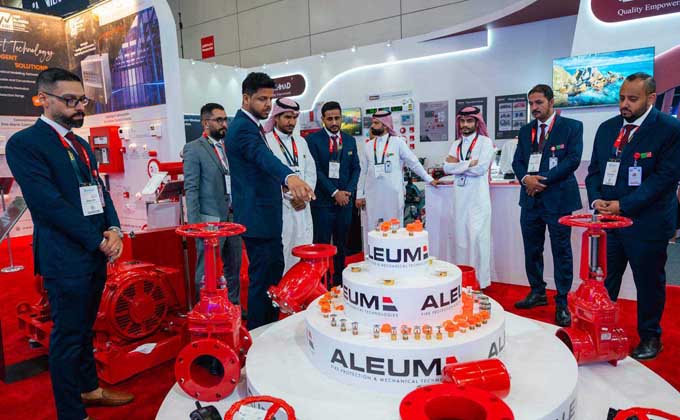
Organised by Messe Frankfurt Saudi Arabia, the 2026 edition is expected to welcome over 25,000 visitors and more than 500 exhibitors, including Bristol, NAFFCO, Axis, Genetic, Saudi Sicli, and Al Alamya, bringing together global suppliers, policymakers, and buyers across commercial and perimeter security, homeland security and policing, fire and rescue, safety and health, and cybersecurity.
This expansion reflects the rapid growth of Saudi Arabia’s fire and security markets, driven by large-scale infrastructure projects including NEOM, Red Sea Global, Qiddiya, and Diriyah Gate, alongside an increasing appetite for a platform that connects advanced technologies and innovation, with talent sourcing, investment opportunities, and international partnerships.
A strategic entry point for global security, safety and fire protection enterprises
The Kingdom’s security market alone is projected to reach USD 3.4 billion by 2030, growing at a CAGR of 9.1%, according to Grand View Horizon research, supported by a surge in demand for integrated physical security, cybersecurity, surveillance, access control, and command-and-control solutions. Furthermore, insights from the market research firm Mobility Foresights indicate that the fire and safety equipment market is projected to grow to USD 7.1 billion by 2032, registering a CAGR of 10.2%.
As Saudi Arabia continues its economic transformation, the tradeshow is positioned as a key gateway for international companies seeking to enter or expand in one of the world’s most dynamic and fast-evolving markets, particularly as public safety upgrades across critical infrastructure services and smart cities have expanded opportunities for private security and technology providers.
Riham Sedik, Exhibition Director, Intersec Saudi Arabia, said: “Intersec Saudi Arabia 2026 marks a defining step in the event’s evolution. The move to Riyadh Front Exhibition & Conference Center allows us to scale the platform in line with market forecasts, elevating the experience and creating stronger avenues for industry stakeholders to engage, collaborate, and do business.
“As the need for advanced security, fire protection, and safety solutions continues to grow, Intersec Saudi Arabia is well placed to support this momentum, bringing international providers together with key public and private sector decision-makers across the Kingdom. As the largest edition in the show’s history, it will play an important role in advancing Saudi Arabia’s transformation agenda and supporting the delivery of the country’s ambitious infrastructure and development pipeline.”
Expert-led conferences to address the future of integrated security and fire protection
Intersec Saudi Arabia 2026 will host two CPD-certified conferences – the Future Security Summit and the Fire Protection & Technology Summit – convening over 110 global experts, policymakers and industry leaders to drive dialogue on protection, resilience and operational continuity.
The programme will explore evolving security and safety challenges across critical infrastructure, including emerging threats, cyber-physical convergence, AI-enabled command and control, crisis response, fire resilience in energy and logistics, and advancements in detection, suppression and integrated protection systems.
“Saudi Arabia is entering a new phase of infrastructure and urban development, and that requires world-class security, fire protection, and resilience systems. Intersec Saudi Arabia is where those solutions meet opportunity,” concluded Sedik.
The Security Essen trade fair, taking place from September 22 to 25 in Essen, Germany, will bring together around 500 exhibitors from 40 countries, focusing on connected security, artificial intelligence, and the protection of critical infrastructure. The organizers emphasize that the growing number of cyber threats and geopolitical challenges requires a unified approach to physical and digital security, giving visitors the opportunity to explore the latest technologies in access control, video surveillance, fire and intrusion protection, perimeter security, as well as civil protection and defense.
A particular focus will be placed on integrated security solutions that combine video surveillance, access control, and intrusion detection on a single platform, leveraging artificial intelligence and cloud technologies to improve security management. Leading companies, including Advancis, Milestone, ASSA ABLOY, dormakaba, Salto, Telenot, Axis Communications, and Dallmeier, will showcase their latest solutions.
“The security industry is more interconnected today than ever before. At Security Essen, we demonstrate how artificial intelligence, digital connectivity, and innovative technologies come together to create comprehensive security solutions, while bringing together the manufacturers, users, planners, and decision-makers who are actively shaping this transformation,” said Julia Jacob, Project Manager of Security Essen.
In addition to the exhibition, the event will feature an extensive conference program covering cybersecurity, digital resilience, drones, the protection of financial institutions, and critical infrastructure. For the first time, Security Essen will be held alongside EUDEX – Euro Defence Expo, creating new opportunities for collaboration between the civilian security and defense sectors.
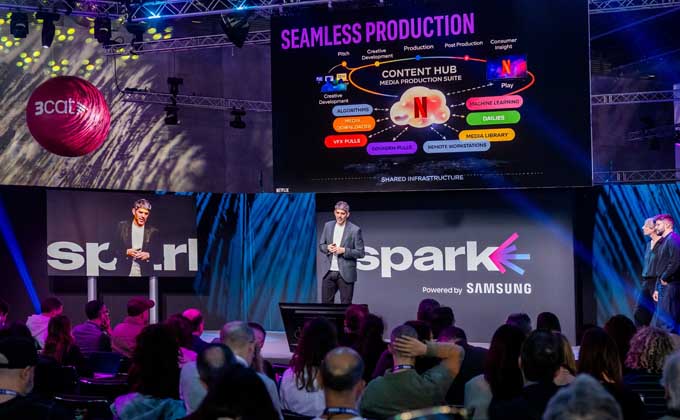
Following its inaugural edition held as part of Integrated Systems Europe (ISE), Spark has confirmed plans to expand and relocate to a new venue in 2027. The new event format brings together content creators, production specialists, broadcasters, agencies, and technology companies, connecting the worlds of production, advertising, gaming, and immersive experiences.
During the four-day programme at Fira Gran Via’s Hall 8.1, thirty conference sessions were held, featuring sixty-three speakers, including representatives from Netflix and 0207 Def Jam. The event’s headline sponsor was Samsung, which showcased its The Wall for Virtual Production platform, while partners MoSys, 3Cat, and Lab of Tomorrow presented a series of interactive demonstrations and installations.
“What’s exciting about Spark is bringing together different manufacturers, speakers, and end users to really show what’s happening in the broadcast space right now and where it’s going next,” said Mark Taylor, Head of Vertical Markets at Samsung Display Solutions Europe. Discussions focused on artificial intelligence, virtual production, immersive media, and new production models that increasingly connect creative and technology teams.
In response to growing demand, Spark will move to the Fira Montjuïc venue in 2027, where it will offer an expanded programme, larger installations, and new experience-driven formats. The next edition of the event will take place in Barcelona on 3–4 February 2027.
As Saudi Arabia builds one of the world’s most ambitious infrastructure pipelines, fire protection is moving beyond compliance to become a cornerstone of resilient, future-ready development. Reflecting this evolution, the Fire Protection & Technology Summit, part of Intersec Saudi Arabia 2026, will bring together the world’s leading engineers, policymakers and technology specialists to explore the innovations, global standards and practical solutions shaping the Kingdom’s next generation of life safety.
Taking place from 16–18 November at the Riyadh Front Exhibition & Conference Center (RFECC), the CPD-certified Summit, which runs on the first two days of the exhibition, will include expert-led discussions and real-world case studies, allowing delegates to explore topics ranging from AI-enhanced fire detection and digital life safety systems to industrial hazard protection, fire resilience, workforce development and the future of fire engineering.
The programme will also see the return of the National Fire Protection Association (NFPA), which will lead a dedicated second day of the Summit under the theme Innovating Fire & Life Safety: Bridging Global Standards with Local Vision.
Bringing together international and regional experts, the partnership will explore how globally recognised standards, professional development and knowledge sharing can strengthen fire resilience while supporting Saudi Arabia’s Vision 2030 ambitions.
According to Sutharson Sathaiah, HSE Director – Six Flags and Aquarabia at Qiddiya City, and Advisory Committee Member for the Fire Protection & Technology Summit, the Kingdom’s rapid transformation is reshaping the role of fire safety across major developments.
“Across Saudi Arabia and the wider GCC, one of the most notable trends is the move towards integrated risk-based approaches. As developments become larger, more complex and more interconnected, fire safety can no longer operate in isolation. It must be considered alongside security, crowd management, emergency preparedness and overall operational risk management.
Sathaiah also added that the latest innovations need to be combined with engineering expertise and operational preparedness. He said: “The organisations that set the benchmark in the years ahead are those that successfully integrate advanced technologies with capable people, robust emergency planning and strong organisational values.” Recognising these priorities, the conference programme combines strategic discussion with practical examples from organisations responsible for protecting some of the Kingdom’s most complex environments.
Drawing on frontline experience, Abdulrahman M. Al-Qahtani, Fire Chief at Saudi Railway Company (SAR), will outline proven approaches to commanding major incidents at critical infrastructure during the vital first hour of an emergency, when resources are stretched, external support is delayed, and rapid decision-making is essential.
Meanwhile, Faris Alzahrani, Health, Safety & Security Consultant at the Ministry of Education, and Yousif Mohamed P.E., Fire Prevention Officer at King Fahd International Airport (KFIA), will examine the evolving role of artificial intelligence in fire safety, exploring how engineers and intelligent systems can work together to improve decision-making while maintaining human oversight in critical situations.
Other confirmed speakers include, amongst others, David Bartlett, Chief Fire Officer – Head of Airport Fire & Rescue Service, Heathrow Airport; Phil Garrigan, Chair, National Fire Chiefs Council; Asim Almohammadi, Fire Chief, National Petrochemical Industrial Company, Yousif Mohamed P.E., Fire Prevention Officer, King Fahd International Airport (KFIA), and Fahad Aljabr, Vice President – Projects Delivery, KAFD
Riham Sedik, Exhibition Director, Intersec Saudi Arabia, said: “Saudi Arabia is setting new global benchmarks in infrastructure development, and fire protection must evolve at the same pace. The Fire Protection & Technology Summit brings together the expertise, technologies, and international best practices needed to help organisations move beyond compliance towards more intelligent, resilient, and integrated approaches to life safety.
“By combining technical knowledge, real-world case studies and international collaboration through our continued partnership with NFPA, the Summit provides an important platform for professional development, knowledge exchange and industry collaboration.”
As part of the Kingdom’s leading platform for security, safety and fire protection, the Fire Protection & Technology Summit is one of two CPD-certified summits, the other being the Future Security Summit. Together, the exhibition and its summits provide a platform for industry leaders, government stakeholders and solution providers to exchange knowledge, strengthen partnerships and help shape the future of safety and security across the Kingdom. Intersec Saudi Arabia is expected to welcome more than 25,000 visitors, 500 exhibitors and over 110 expert speakers from around the world.
For more information, please visit Intersec Saudi Arabia’s website
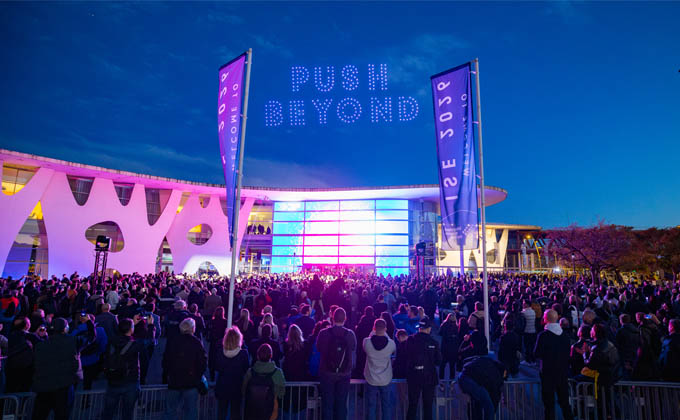
Integrated Systems Europe (ISE) has won the prestigious Sammy Award (Sales and Marketing Excellence Award) for the second consecutive year, taking top honours in the Creative Awards – Power Players category for its “Push Beyond” campaign. Presented by the Business Intelligence Group, the award recognizes the creative initiative that successfully energized the global AV community, promoted innovation, and reinforced ISE’s position as the world’s leading exhibition for the professional audiovisual and systems integration industry.
According to the organizers, the campaign contributed to the most successful edition in the show’s history, delivering record numbers of attendees, exhibitors, and audience engagement. The judging panel highlighted the campaign’s ability to combine a bold creative vision with clear business objectives, measurable results, and strong attendance growth despite challenging market conditions.
“When an entire category is in decline, most teams play defence. ISE did the opposite—they turned ‘Push Beyond’ into a rallying cry that united their internal teams and challenged an entire industry to think bigger. That kind of bold, two-word clarity is exactly what creative excellence looks like,” said Russ Fordyce, Chief Recognition Officer at the Business Intelligence Group.
“Being recognized with a Sammy Award for the second consecutive year is a tremendous achievement for ISE and reflects the creativity, ambition, and commitment of our entire team. With ‘Push Beyond,’ we wanted to capture the energy of a global community that continues to challenge expectations, drive progress, and shape the future of the AV and systems integration industry,” said Mike Blackman, Managing Director of Integrated Systems Events.
The next edition of ISE 2027 will take place from 2–5 February 2027 at Fira de Barcelona Gran Via. More information and newsletter registration are available at: ISE Newsletter.



 “When an entire category is in decline, most teams play defence. ISE did the opposite—they turned ‘Push Beyond’ into a rallying cry that united their internal teams and challenged an entire industry to think bigger. That kind of bold, two-word clarity is exactly what creative excellence looks like,” said Russ Fordyce, Chief Recognition Officer at the Business Intelligence Group.