Home Posts tagged access control

Global Access Control Market to Hit $15.8 Billion by 2030, Driven by IoT and Cloud Adoption

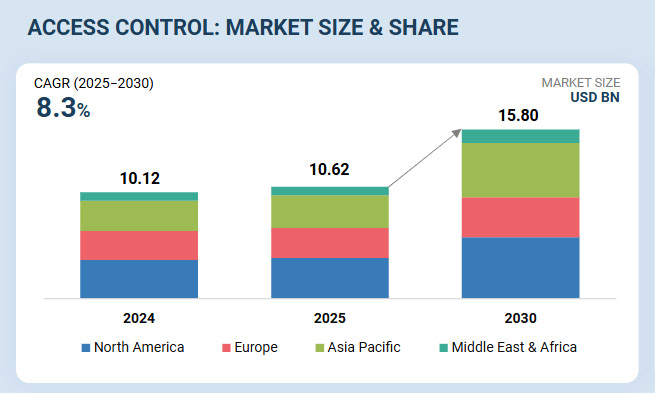
The global access control market is projected to grow from USD 10.62 billion in 2025 to USD 15.80 billion by 2030, achieving a compound annual growth rate (CAGR) of 8.3%, according to new data from MarketsandMarkets. The expansion is fueled by the widespread adoption of IoT-enabled security systems and cloud-based platforms that improve automation, scalability, and cost efficiency.

The shift toward Access Control as a Service (ACaaS) is a major driver of this growth. Hosted ACaaS solutions eliminate the need for heavy on-premises infrastructure, allowing organizations to centrally manage access rights across multiple sites. This model offers greater flexibility, real-time updates, and reduced maintenance costs. Analysts highlight solutions like Identiv’s Freedom Cloud as examples of always-available, resilient systems that ensure uninterrupted operations.

Key sectors fueling ACaaS adoption include oil and gas, pharmaceuticals, power, and water treatment, where secure and scalable access control is essential to protect critical infrastructure.

The residential market also represents a strong growth opportunity, with increasing demand for electronic locks and video surveillance systems driven by home automation trends and rising concerns over burglary and personal safety. Advanced access control systems are becoming integral to smart home ecosystems, offering homeowners greater control and protection.

North America remains the largest regional market, led by robust demand for cloud services, mobile access control, and biometric authentication. Organizations across commercial, government, and enterprise sectors are embracing these technologies to enhance security and efficiency. Major initiatives by U.S. agencies such as the Department of Defense and Department of Homeland Security continue to drive adoption of fingerprint and multi-technology readers.

Leading global players shaping the access control landscape include ASSA ABLOY, Dormakaba, Johnson Controls, Siemens, UTC, Allegion, Honeywell, Hirsch, Nedap, Suprema, Keenfinity, and Thales. Collectively, their innovations are propelling the market toward a more secure, connected, and passwordless future.

Record-Breaking Second Quarter for Allegion

Global security company Allegion plc achieved a significant business milestone in the second quarter of 2025, reporting record revenues of $1.02 billion, representing a 5.8% increase compared to the same period last year. The growth was driven by strong performance in the non-residential sector, primarily in the North American market.

As key success factors, CEO John Stone highlighted the strength of the business and solid relationships with channel partners. “The second quarter was strong, once again demonstrating our team’s agility, the resilience of our business model, and the successful execution of our capital allocation strategy,” Stone said. This marked the first quarter in which Allegion surpassed $1 billion in revenue, representing an important milestone for the company.

The company also increased profitability across multiple business segments, supported significantly by four acquisitions, including the July completion of the Gatewise acquisition.

Allegion is a global leader in security solutions and access control products, with a portfolio that includes mechanical and electronic locks, security hardware, automated doors, access management systems, and related technologies, with a particular focus on commercial and institutional facilities. The company operates in more than 130 countries worldwide.

Suprema Becomes the First Access Control Company with CE RED Certification

Suprema, a global leader in AI-based access control, announced that its facial recognition devices BioStation 3 and BioEntry W3 have successfully obtained CE RED certification in accordance with the updated EU Radio Equipment Directive (RED), which came into effect on August 1, 2025. As the certification was granted in mid-July, Suprema became the first company in the access control industry to meet the new cybersecurity requirements.

The revised RED directive introduces mandatory compliance for manufacturers with advanced security standards for IoT and wireless devices such as smart locks, Wi-Fi, and Bluetooth systems. By achieving this certification, Suprema has reaffirmed its commitment to regulatory compliance and a proactive approach to cybersecurity.

The certified BioStation 3 and BioEntry W3 devices utilize deep learning algorithms implemented directly on the device and support multiple authentication methods, including mobile credentials, RFID cards, Bluetooth, and NFC.

Meeting the CE RED requirements ensures advanced protection against network threats, data breaches, and fraud.

“We are proud to be the first in the industry to meet these enhanced cybersecurity requirements. This certification validates our dedication to delivering secure, reliable, and compliant solutions to customers worldwide,” said Hanchul Kim, CEO of Suprema.

Suprema emphasizes that all of its devices supporting fingerprint, mobile access, and RFID authentication are now fully compliant with CE RED certification, setting new benchmarks for cybersecurity compliance in the access control sector.

Next-Level Access Control From Suprema

Suprema, a global leader in AI-powered access control, has launched two new products: the Corestation 20 (CS-20) and the Door Interface (DI-24) module. These additions enhance Suprema’s Access Control Unit (ACU) portfolio, offering improved security, scalability, and flexibility. The Corestation 20 is a compact RFID-only controller that supports up to 500,000 users, with native PoE+ and encrypted communication. Designed for efficient and secure access management, it is ideal for mid-sized systems that do not require on-device biometric matching.

The DI-24 module allows control of two doors and four readers, streamlining wiring and reducing the need for complex installation. It is engineered to maintain stable operation even without a live network connection, ensuring continuous access control functionality. Suprema’s ACU line supports both centralized and distributed system architectures, making it suitable for small facilities and large enterprises alike. The new products also allow for cost-effective upgrades of legacy infrastructure through cable reuse and simplified installation. This significantly reduces deployment time and long-term maintenance costs.

“The launch of Corestation 20 and Door Interface further strengthens the scalability and flexibility of Suprema’s access control system,” said Hanchul Kim, CEO of Suprema Inc. “These additions allow us to meet a wide range of customer needs while reinforcing security and reducing installation costs.”