Home 2022 (Page 21)

360 Vision Technology certifies barox bt PoE Ethernet switch performance

360 Vision Technology, the UK manufacturer of rugged HD, radar and thermal PTZ imaging cameras, has partnered with barox, the global manufacturer of professional standard switches, PoE media converters and IP extenders, to support installers and specifiers by confirming its range of PoE Ethernet switch products are suitable to power 360 Vision’s range of PTZ cameras and peripherals.

To support CCTV surveillance integrators with the specification and set-up of reliable PoE and video transmission when installing their range of PTZ cameras, 360 Vision recently concluded an in-depth ‘proof of concept’ test. The testing involved a barox RY-LGSPTR23-26 24-port 920W bt PoE managed Ethernet switch and was performed to assess device performance, and compatibility with 360 Vision’s range of PoE Predator and Invictus PTZ cameras.

Reliable PoE

In the compliance test, a sample barox switch was assessed for its reliable delivery of PoE power to a variety of Predator, Invictus and radar PTZ cameras, and fully loaded with operating wipers, white light and infrared illuminators. “The barox PoE switch test yielded excellent results, with non-stop PoE being supplied to the 360 Vision cameras and illuminators sustained by the barox switch,” confirmed Craig Carton, Customer Service Technical Support Manager at 360 Vision Technology. “Testing the switch via a VMS, on connection of a camera, the barox switch auto-detected the PTZ device and auto set-up its power management, without any intervention from us. Along with true Plug & Play connectivity, the switch delivered excellent quality video and data over simulated network conditions.”

The certified 360 Vision/barox PoE integration enables new PTZ camera installations to be configured and installed with complete confidence. Specifically designed to cater for the demands of heavy video and PoE applications, the barox switch range can support any number of 360 Vision PoE cameras, suppling 30, 60 or 90 Watts PoE in compliance with IEEE802.3af/at/bt.

The use of barox switches to supply PoE also allows remote ‘on and off’ powering to 360 Vision cameras via a VMS, whereas this can only be achieved manually when using an injector – by having to send an engineer out to site. For example, if a system loses its mains power supply, temporary back-up power can be provided via a UPS battery pack. However, if the loss of mains power is prolonged, the local battery power can become depleted and the system blacks out. In this scenario, it would be ideal to prevent the total loss of power and system down-time by remotely switching off certain cameras and/or illuminators – to conserve battery power and maintain the operation of critical cameras. Unlike with simple network PoE injectors, by using barox switches and their efficient PoE management, cameras and illuminators can be automatically controlled, to extend battery autonomy and maintain critical video surveillance footage.

In addition, barox switches employ a clever ‘staged power-up’ to avoid overloading the switch when multiple cameras are connected, and to assist with fault diagnosis, they provide a systems topology schematic of all connected devices on the network.

“barox is proud to be associated with a world-class UK surveillance camera manufacturer the calibre of 360 Vision Technology,” says Rudolf Rohr, barox Co-founder & Managing partner.

“Providing maximum installation versatility, fast & simple set-up, and advanced cyber security, the range of barox PoE Ethernet switches can provide the perfect fit for integration to the Predator and Invictus cameras, to deliver the highest levels of surveillance imaging, video transmission and reliable PoE delivery.”

“We are delighted with the excellent performance results of the 360 Vision/barox PoE integration test, and the  ability of the barox range to supply extremely reliable and robust PoE for our range of Predator and Invictus PTZ cameras, and illuminators,” says Sara Fisher, 360 Vision Technology’s Sales Director. “Harnessing the power of IP network infrastructure, 360 Vision Predator and Invictus cameras powered by barox PoE Ethernet switches can be used to deliver a secure surveillance solution for Public Space, CNI, highways, traffic monitoring, retail and border control surveillance applications.”

For more information on the full range of rugged PTZ surveillance, HD, thermal and radar imaging cameras,  customers can contact 360 Vision Technology on +44 (0)1928 570000, email: info@360visiontechnology.com, or visit their website at https://www.360visiontechnology.com
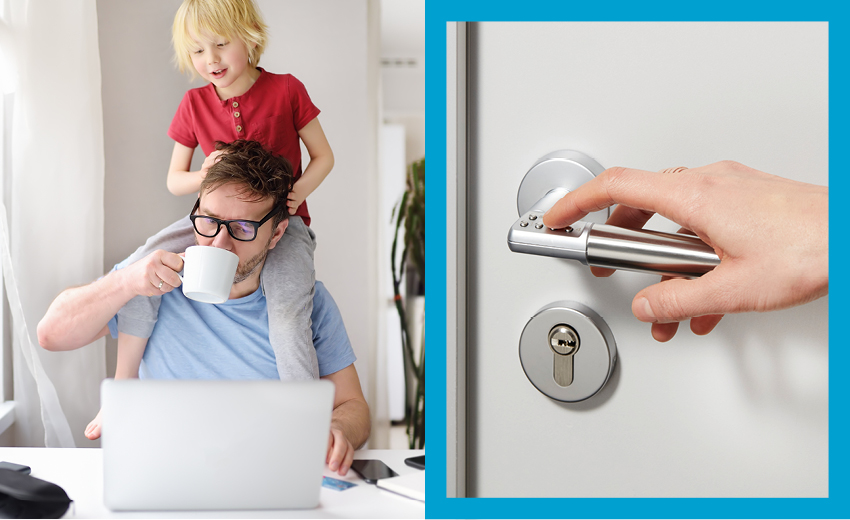
 

One simple door upgrade ensures a home office is private and secure

London, March 2022 – Has the growth in working from home (WFH) outpaced our ability to keep a home office environment secure? Hybrid working — combining WFH with on-site attendance — grew steadily in the decade up to 2019*. It is now here to stay: One-quarter of the workforce in Finland, for example, principally worked from home in 2020, according to one study**. However, many repurposed domestic spaces are not equipped with the security or privacy WFH requires.

 “In many organizations, the convenience and productivity advantages of home and hybrid working are significant,” says Lars Angelin, Business Development Manager, Aperio & Code Handle at ASSA ABLOY Opening Solutions EMEIA. “WFH will remain — at least for some employees, some of the time. In these cases, the security of the home office needs attention.”

Why lock your home office?

“Home security for hybrid workers does not begin and end at the front door. A domestic workspace requires security of its own. After all, not every houseguest should be reading next quarter’s confidential company data!” adds Angelin.

Privacy is another key concern, whether to make important video calls or have a sensitive conversation. Commercial security is always desirable. In many sensitive industries, it is required by law.

“Cybersecurity is usually down to the employer,” says Angelin. “However, the physical security of documents, data and conversations is the responsibility of those who choose to continue working from home.”

The most elegant, seamless way to put an effective barrier between your residence and a home workstation is with a Code HandleÒ digital door lock.

Simple to fit to almost any interior door

Code Handle is a locking handle with built-in digital PIN keypad suitable for most lock cases and door types. A secure 4- to 6-digit PIN ensures only authorized people enter the home office.

There is no need to use or keep track of a key. At the end of a day, homeworkers don’t even need to remember to lock their office: Code Handle locks itself when the door is closed — and for safety, allows simple, code-free exit from the inside.

Installation is simple: A homeworker can simply swap their existing door handle for a Code Handle. Fitting takes just two screws: It is easy even for non-specialists, and also straightforward for any domestic locksmith. In an ASSA ABLOY competition to find the fastest Code Handle installation, the winning entry took just 26 seconds.

To power the lock’s digital security, standard batteries slot into the handle itself. There is no need for software. Batteries typically last 30,000 lock/unlock cycles.

Code Handle is already trusted at medical surgeries, retail stockrooms, flexible workspaces and almost anywhere else a private door meets a public space. It is perfectly adapted for upgrading a home study, basement, attic or spare room.

“Contemporary and elegant, a Code Handle adds digital PIN security without the hassle of keys or any ugly push-button mechanical device,” says Angelin. “It is the simple, secure, convenient solution for any home office door.”

To learn more about the Code HandleÒ door lock, download a free brochure at https://campaigns.assaabloyopeningsolutions.eu/hubfs/aperio/WEB_AA_CodeHandle_HomeOffice_Flyer_03_2022_ENG_EMEIA.pdf

Security screening market approaches $10 billion

The estimated market for security screening currently sits at around US$ 7.8 billion, and according to the latest research, released by Future Market Insights Inc, it is highly likely that this sector could approach revenues worth US$ 10 billion in the next two years.

The ESOMAR-certified research firm suggests that more than half of the total demand for security screening is being accounted for by the developed regional markets. East Asia however is cited as the most lucrative market for investors in security screening systems and solutions.

Rapid growth in the economy, necessitating increasing expenditure on the national and infrastructural security, will continue to push deployment of reliable and advanced technology enabled security screening systems. While analysis identifies an impressive rate of adoption within emerging economies, China, India, and Russia are more likely to be at the forefront of this growth, in the security screening market.

Airports generate maximum demand

Over 2/5th of the global security screening demand is accounted for by airports, which say the analysts, will remain the dominant application area for security screening systems manufacturers and suppliers. As government buildings are highly vulnerable owing to the voluminous sensitive information that they procure, public recreation areas such as malls are also cited as the next sensitive area for implementation of effective security screening. Border check points are also expected to emerge lucrative through the coming years, in the security screening market.

Explosive trace detectors, currently accounting for nearly 1/4th share of the total sales of security screening systems, will reportedly witness strong growth in demand through the coming years. According to the report, x-ray screening systems and biometric systems are also highly popular among the end-use application areas in security screening market. The collective market value share of the aforementioned security screening systems is just-under 50% and the report expects attractiveness of the latter to surge – with growing adoption of fingerprint and face recognition technologies.

Smart security screening trends

Looking at the loopholes in current security screening models in terms of efficiency and sustainability, airports have been accelerating the industry’s shift to smart security screening solutions, over the recent past. A combined initiative of Airports Council International (ACI) and the International Air Transport Association (IATA), smart security is emerging as a streamlined solution for airlines, passengers, and their belongings. Recently, Australia’s first-ever smart security screening checkpoint was unveiled at the Melbourne Airport.

Some of the most prominent companies operating in security screening market landscape, are Westminster Group, American Science and Engineering, Inc., Analogic Corporation, Argus True ID, Aware Incorporation, Digital Barriers, Mangal Security Systems Ltd., OSI Systems, Inc., Smiths Group plc, Laxton Group, Next Biometric, Aratek, NEC Corporation, and Cognitec Systems GmbH.

Telekom, Hitachi and Securitas form Alliance against blackouts

In a unified recognition that the energy sector has become the top target for hackers, together, Telekom, Hitachi Energy and Securitas have formed an Alliance against blackouts, in an effort to protect energy suppliers against attacks.

Telekom Security CEO Thomas Fetten: “Critical infrastructures are being attacked more and more frequently. The latest example in Portugal unfortunately shows how cyber attacks can affect networked technology. Electricity is particularly important. A successful, precise attack on this area of critical infrastructure would cripple life as we know it. The economy, too. That’s why we’re pooling our expertise in fighting physical attacks, just as we do against attacks from virtual space.”

Pierre-Alain Graf, Head of Global Security Business Hitachi Energy: “We have a saying: the future is uncertain but electric. We are addressing climate change with renewable energy from the sun, water and wind. And are generating electricity in an increasingly decentralised way. This inevitably makes us more vulnerable to attack. The partnership therefore extends the umbrella of protection to production technology.”

Anders Gustavsson, Head of Remote Video Solutions Securitas Services Europe: “Building a Fort Knox around solar farms and substations is not enough. Attackers shy away from robustly secured facilities. They move into cyber space. Together, no one can fend off attacks on company networks, operating technology and sites alone. That’s why we’re pooling our expertise.”

Hackers cut off power to more than 700,000 households

Attacks on the energy sector target society as a whole. Attackers include state-backed hacker groups. The German domestic intelligence services cite the intelligence services of Russia, China and Iran as the source of cyberattacks against German plants. In 2015 and 2016, hackers had sabotaged power supplies in Ukraine, highlighting the impact of such attacks for the first time. More than 700,000 households were without power for hours.

The energy industry represents the most critical of infrastructure. Targeted attacks on pipelines, power plants or substations are on the rise. Examples include Colonial Pipeline in the USA and the Danish wind turbine manufacturer Vestas. In Brazil, hackers targeted the nuclear branch of Eletrobras.

Energy sector in top three attack targets worldwide

The sector is one of the top-three targets for cyber criminals worldwide. That’s because the industry is now highly digital. Beyond corporate IT, smart operating computers with sensors control electricity. Digitally networked, they are also targets for attackers. Physical security is needed for plants in the energy sector. This is especially true for remote distribution stations, pumping stations and high-voltage pylons. If a hacker gets his hands on a control cabinet, he attacks from the inside. Even the best network firewall cannot protect against this. Here, for example, networked video cameras keep watch over the site.

Overarching protective shield

Securing critical infrastructures requires an overarching understanding of OT, IT and physical security. A team of experts from Telekom Security, Hitachi Energy and Securitas has developed an overarching approach in recent years. This combines physical protection with enterprise network and digital operational technology security. It enables critical infrastructures to meet protection and regulatory challenges.

How Mobotix P7 Cameras and Their Certified Apps Can Improve Your Business?

Slavoljub Stevanović, MOBOTIX Business Development Manager at Konica Minolta Business Solutions, presented the new MOBOTIX 7 platform cameras, modules and applications built into the cameras on this platform.

In addition, the presenter showed the openness of the MOBOTIX 7 platform delivering ultimate individuality and changing video surveillance with an infinite number of possibilities. The platform already includes specialized apps that cover several industry-specific, individual requirements.

Certified Apps are professional, deep learning-based MOBOTIX camera apps from renowned partners explicitly verified and certified by MOBOTIX. Thanks to the high modularity, users can use the apps they exactly need in their video system to meet their requirements.

The presentation was wrapped by use cases demonstrating how the solution saves time and money.

SALTO Introduces EAN Code Standard into Product Packaging

SALTO Systems has introduced EAN13 standardized barcodes into its product packaging answering to partners and channel needs. The EAN code is a 13-digit bar code used internationally to identify each product. The International Article Number (also known as European Article Number or EAN) is a standard describing a barcode symbology and numbering system used in global trade to identify a specific SALTO product model, in a specific packaging configuration, with a unique identification number.

The use of EAN codes across SALTO products will allow partners and installers in the identification and distribution of SALTO products and reduce the margin of error within their own channels. One of the major benefits of standardization through product codes is having better warehousing processes and product tracking. The EAN code will allow SALTO and its partners to obtain valuable information about SALTO products, and optimize stock management, product information, operations, or even improve competitiveness.

The introduction of EAN13 codes will facilitate the selling and distribution of SALTO products across the channel. EAN codes help in distinguishing one SALTO product model from others easily and fast. These numbers are unique and describe the attributes of the products via identification marks. They can represent details like:

  • The type of lock, cylinder, or reader model
  • Technology compatibility
  • Price, weight, or colour
  • Manufacturer
  • Country code
  • Other product-related data

The EAN13 code standardized barcodes will be adopted gradually into the complete product range from SALTO.

Suprema focuses on security standards and compliance

Suprema, a global leader in access control, biometrics and solutions for time and attendance management, has certified its products and solutions by acquiring international safety certificates to ensure the highest level of security and protection.

Suprema’s four-door access control panel Corestation is its first controller to acquire UL 294 compliance, a certification that evaluates the safety and reliability of the product. Suprema’s compact outdoor RFID reader, Xpass D2 is SIA OSDP verified, meaning that the device conforms to the SIA Open Supervised Device Protocol (OSDP) standard and the related performance profiles. It ensures higher security than a common access control communication protocol by constant monitoring of wires and protecting with high-end AES-128 encryption.

Furthermore, Suprema continuously works hard to update and enhance data protection features to meet security standards. Suprema’s access control and time & attendance platform Biostar2 has acquired ISO 27001 and ISO 27701 certifications, which certify compliance with Europe’s General Data Protection Regulation(GDPR). Overall, these certifications ensure that Suprema access control systems have the highest level of protection against potential security breaches and vulnerabilities.

“Suprema not only provides the world’s leading biometrics security solutions but also takes the lead in the protection and safe use of biometric data, including facial and fingerprint information”, said Suprema Inc. CEO Hanchul Kim. “Suprema will continuously expand our investment in data protection by acquiring certifications to comply with the different regulations on a regional basis. Suprema will provide the most secure biometrics security solutions to the world so that people can enjoy the convenience and safety that biometric technology provides.”

Three ways businesses benefit when they free their access control system from cables

London, March 2022 – An access control system is familiar technology to organizations of every size. Access control may operate as standalone electronic locking. It can also integrate with complementary business systems such as HVAC, time-and-attendance, in-house payments and more. What many businesses may not know is that, by restricting their access system with wires, they are not using its full potential.

In many companies’ access systems, only the most important doors and locks are wired to mains electricity. Software then filters and monitors traffic. It is a tried-and-trusted way to let the right people in — and keep everyone else out.

Yet the expense and disruption of wiring doors can stop electronic access control in its tracks at the front entrance. This leaves building door control in the hands of mechanical locking, which limits the flexibility and control of security, and its potential contribution to business success.

The answer is to unleash access control from its cables: Extending security with wireless devices — managing access around a building interior — benefits a business in at least three ways.

Make sure only authorized personnel open sensitive doors

Not everyone should be able to walk into the CEO’s office or open the server room. In real-world situations, where staff are busy, relying on manual lock-and-key technology often leaves doors unguarded. If a lock is somehow breached, a security manager will have no idea when, nor will they be able to identify the last person to open the door.

Cable-free electronic locking devices are available for all kinds of internal door, of every size and any material. At Luminy University in France, for example, wireless devices ensure only qualified and authorized staff open rooms where hazardous materials are stored*. They are controlled and monitored from the same system as the university’s wired doors.

Businesses can filter and track access to more than just rooms, too. Wireless cabinet locks add security to cupboards, cabinets and drawers — for employee personal items, controlled medicines or almost anything else. A wired system may find it difficult to reach these openings.

Battery-powered locks can add real-time control and monitoring to server racks, so IT staff know right away if unauthorized access has even been attempted. With the cost of a typical data breach estimated at $4.24m (€3.7m), an investment in wireless Aperio server rack locking could repay itself many times over**.

Convenience for employees, peace of mind for facilities teams

Wireless devices can bring access control much deeper into a building. Employees feel safer at work; facilities and security managers can relax, because important openings beyond the front door are secured and monitored, without any time wasted tracking bunches (or hundreds) of physical keys.

The workload to maintain a network of wireless devices is minimal. For example, Aperio wireless locks only need a change of battery every two years on average, nothing more.

Battery operation is energy — and therefore, cost — efficient, too. Compared to traditional wired locking, wireless devices contribute to an energy-efficiency strategy: Installation is less invasive and less energy intensive; it uses fewer materials like cabling.

For visitors and employees, a single credential still opens all their authorized locks. No one carries large, inconvenient key bunches or wastes time hunting for the right key: Time saved can have a real impact on service delivery, as nurses at the Centre Hospitalier Métropole Savoie have discovered***.

Understand building use (and users)

With the exception of designated “high security doors”, wired access control often stops at the front entrance. Once employees and visitors are inside the building, the system loses track of them. This leaves valuable business data un-gathered.

Extending access control with wireless digital devices can help collect this data and put it to work. Technology protocols and standards such as OSDP and LDAP ensure the data is interoperable with complementary systems, now and in the future.

For example, a better understanding of building use enables more efficient energy management. If no one is occupying a suite of offices, why heat or air-condition them? Data from a more comprehensive access system could help automated systems make intelligent, cost-saving decisions in real time.

Granular access control can also help inform decisions about leasing office space — and of what type — or whether to let leases expire. This type of data will only grow in importance as work patterns become fluid. IBM estimates the global mobile workforce will soon number 1.87 billion people****. Understanding how these workers use space will be critical — and could directly influence business success.

To learn more about unleashing your access control system, download a free Digital Solution Guide at: http://campaigns.assaabloyopeningsolutions.eu/aperio-stop-cabling

Euralarm releases guidance on the use of lithium-ion batteries

The Extinguishing Section of Euralarm has published a guidance document on Integrated fire protection solutions for lithium-ion batteries.

This new Euralarm guideline provides information on the issues related to the use of lithium-ion batteries, how fires start in batteries and on how they may be detected, controlled, suppressed and extinguished. It also provides guidance on post fire management. Excluded from the scope are explosion and ventilation issues.

Lithium-ion batteries have become the battery technology of choice in a variety of areas, including amongst others, power generation, communications, industrial, vehicles and many other applications. Active control of the energy being stored and extracted from lithium-ion batteries has been the foundation of their increasing popularity. The relatively low frequency of major incidents is testament to the effort and successful design applied to the critical aspect of using such high-density energy products. However, active control of the battery energy is not sufficient to prevent safety-critical situations and multiple levels of defence are needed to minimize the serious consequences of a failure in a lithium-ion battery.

The increasing number of lithium-ion batteries and an increasing amount of stored energy in different energy storage applications present a new type of fire hazard where fire protection is challenging. Key issues in any fire protection system are the selection of the most appropriate agent for the specific hazard, system layout, the correct discharge of the extinguishing agent, as well as correct installation, the use of approved systems and constant maintenance by appropriately trained staff.

The guidance document ‘Integrated fire protection solutions for lithium-ion batteries’ is intended as guidance for all professionals dealing with fire safety, fire protection, extinguishing and fire suppression in connection with the use, storage or transport of lithium-ion batteries and their fire risks. Aspects of consumers products are not covered in the guidance.

Euralarm states that the document is intended as general guidance and is not a substitute for detailed advice in specific circumstances. It represents the current understanding of the industry and will be updated as more information becomes available.

Motorola acquires Ava Security

Motorola Solutions has acquired London-based Ava Security Ltd, a global provider of cloud-native video security and analytics.

This acquisition means that the Group strengthens its global dominance in the video surveillance industry and especially in the area of video analysis. The video security companies Avigilon, Pelco, Indigovision and Openpath (which deliver mobile access control solutions) are already part of the group.

The terms of the transaction were not revealed in the press release from Motorola Solutions, but according to the American online publication IPVM, it is said among many professionals in the security industry that it is about 400 million dollars.

Impressive growth

Earlier this month Ava’s latest financials revealed another year of triple digit growth for 2021. Overall the figures show that video revenue grew globally by over 300%, ARR grew by 500% and the number of cameras connected to the Ava Aware Cloud continues to double every three months. The company continued to make significant investments across R&D, sales, marketing and leadership throughout the year.

Innovative development

On the innovation front, during the year, Ava introduced two new cloud cameras (the Ava Compact Dome and the Ava Bullet), launched Ava Cloud Storage, delivered a unified dashboard for hybrid deployments and developed native integrations with IP Video’s Halo sensors and Disruptive Technologies’ environmental sensors. Ava also launched software-driven LPR (License Plate Recognition), enabling the technology on both Ava and third party cameras and not requiring separate dedicated LPR hardware.

“2021 was a great year for us, with our growth rate boosted by new enterprise customers – five Fortune 1000 customers in Q4 alone. But we’re not stopping there, as we’re projecting similar growth numbers for 2022,” comments Tormod Ree, CEO & Co-Founder of Ava Security.

Intelligent video surveillance

Ava Security’s scalable, secure and flexible cloud solution provides enterprises with real-time visibility and powerful analytics to optimise their operations and detect anomalies and threats.

“Our acquisition of Ava highlights our continued commitment to advancing cloud-based video security technologies,” states Greg Brown, chairman and CEO, Motorola Solutions.

“With Ava, we’re well-positioned to support our customers’ evolving security needs by expanding our portfolio of intelligent video solutions that help to enhance safety and streamline operations.”

In addition to allowing organisations to easily access, search and manage their entire system from a centralised dashboard, its self-learning algorithms also enhance enterprise security by detecting abnormal behaviour and alerting operators to events in real-time.

Merger created a hybrid

Ava Security was formed through a merger between Jazz Networks, a cyber security insider threat detection and response company, and Vaion, an end-to-end video security provider. Together, they would meet the market’s needs against both physical threats and cyber security threats by making companies and other organisations to monitor, understand and act on threats in real time to protect people, assets and data. Both companies were privately owned by Ubon Partners and employees.