Home Articles posted by a&s Adria (Page 150)

Automated Self-Service Hotels in Adelboden

The Swiss REVIER Hospitality Group, headquartered in Lenzerheide, develops and operates innovative accommodation concepts that are geared to changing travel habits and tougher economic conditions. Against this background, the company has automated its entire process management and uses state-of-the-art cloud-based technologies for this purpose.

The hotel locking system should naturally be part of this ecosystem, on the one hand because the REVIER Hospitality Group did not want to operate a stand-alone solution in every hotel and on the other hand in order to realise an integrated online solution, especially for the allocation of access rights and door monitoring.

Solution

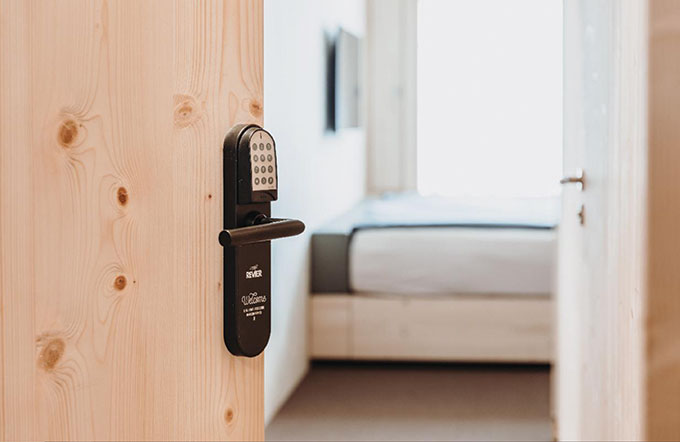
The hotel group has realised this with SALTO KS Keys as a Service. Revier Hotels achieve the overarching goal of simplifying processes for guests by automating everything from booking to check-out. For example, guests can check in from home or on the road and receive their access rights in the form of a PIN code sent to their smartphone on the day of arrival.

The Revier Mountain Lodge in Adelboden was the first property to be equipped with the new access control solution. In the 86-room property, all hotel rooms, service rooms and main entrances are equipped with the solution. At the hotel rooms, guests are granted access via PIN, which achieves the desired media-free door opening. The employees use the app (mobile access) or a smart tag.

Benefits of the Cloud

The cloud infrastructure generally has a number of advantages for the company: It does not need a server infrastructure or document folders and is independent of data volumes. Moreover, those responsible can react quickly, e.g. if guests need an early check-in or a parking space at short notice, or if they want to book breakfast as well. Furthermore, the company benefits from the open architecture of the systems, through which integrations are easy to implement. At REVIER Hospitality Group, SALTO KS is integrated with the cloud-based PMS (property management system) Mews, which is used by the hotel chain for check-in and all processing, and the TABHOTEL check-in terminal. Thanks to the seamless digital interaction of the systems, guests receive their appropriate access rights automatically according to their bookings and check-in.

“What convinces us most about SALTO KS is the centralised access management. We can grant and revoke access rights in real time from the head office for all locations. No one has to be present on site for this. In addition, our employees have access to all hotels and every door for which they are authorised via the app,” said Daniel Renggli, CEO of REVIER Hospitality Group AG.

Customized safety and security solution

21-storey skyscraper is kept safe and secure, combining fire alarm-, voice evacuation-, access control- and video systems.

A skyscraper with a combined and scalable safety and security solution

Located atop a metro station, where two lines of the city’s metro system meet, a huge new 21-storey skyscraper towers over the Warsaw skyline. Primarily designed for premium offices, the 19,100m2 space called Central Point had to be fitted with top of the line fire safety, public address and voice evacuation, access control and video security solutions. The project required that the building management team could centrally manage and monitor the system.

Because the Central Point building is only part occupied, it was important for the owners to factor in scalability and flexibility with the design layout of the individual units within it. Most of the offices at Central Point were created in a ‘white box’ concept, where the tenants would later decide the layout. Since the usage types of the various rooms depends on the needs of the tenants, the safety and security systems had to be deployed in a way that is easily customizable at a later date, to meet the specific requirements of new occupants while being fully in line with all safety regulations.

„Central Point was looking for a reliable fire safety system with maximum flexibility for their tenants in designing their office space. Thanks to the technical capabilities of Bosch point type detectors, building managers can rest easy with a flexible, proven fire alarm system with minimal false positives.“

says Krzysztof Kostecki, Country Cluster Manager at Bosch Security Systems.

A fully integrated system that enables intelligent monitoring everywhere

Fire alarm system and voice alarm

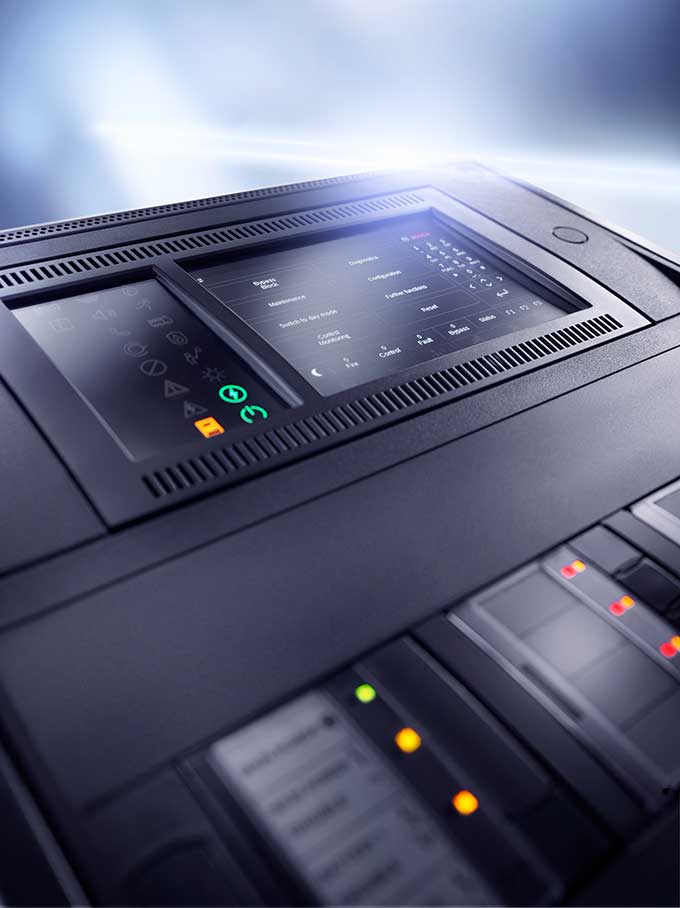
It was important for the Central Point skyscraper to have a single combined system that could manage all aspects of fire safety, public address, evacuation, access control and video security in one. Bosch was able to integrate every part to a custom safety and security solution that gives tenants maximum freedom in using the office space according to their needs with no limitation in creating individual floor plans. For fire safety, the AVENAR Fire Panels manage the detectors and interfaces with other safety systems.

Fully integrated system including AVENAR Fire Panel, PAVIRO Public Address and Voice Evacuation System as well as Access Modular Controller

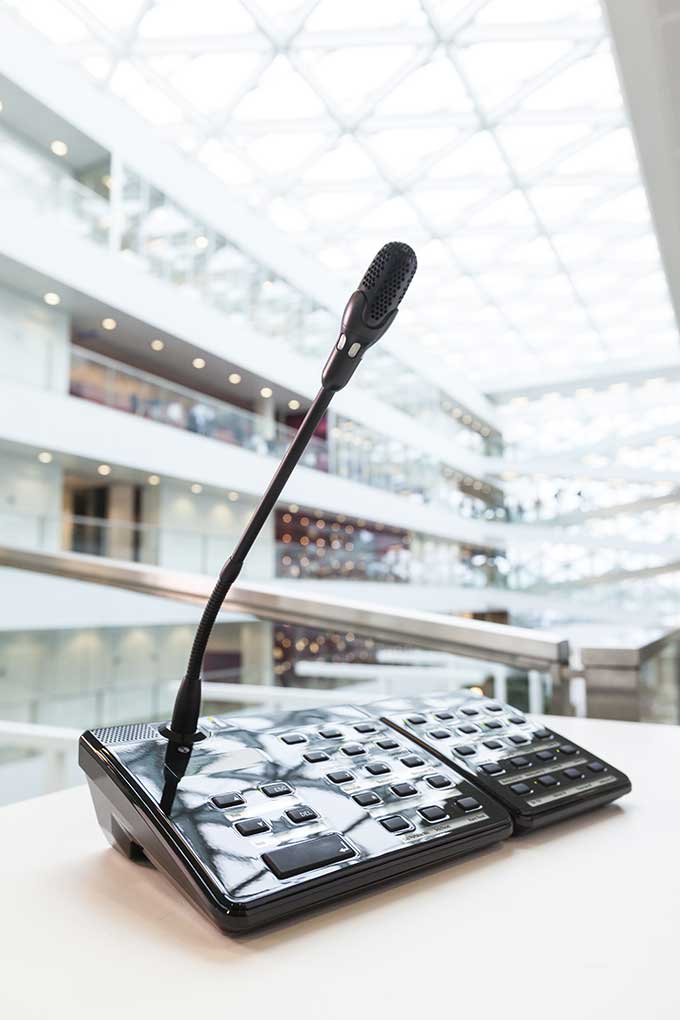
Fire detection and voice alarm are interfaced with the PAVIRO Public Address and Voice Evacuation system via Smart Safety Link. This combination provides complete and permanent control over the evacuation process in case of emergency. Central Point also uses the Access Modular Controller, a flexible technology platform for building and elevator entrance access control.

All in one system

Building Integration System (BIS)

Integration of every part to a custom safety and security solution that gives tenants maximum freedom in using the office space according to their needs with no limitation in creating individual floor plans.

Video security cameras are installed around the building’s perimeter, as well as in each storey of the skyscraper and its central lobby. At the heart of all these technologies is the Building Integration System (BIS) which integrates all solutions into one system. It is capable of automating alerts to building manage-ment staff, for example, if fire detectors require cleaning. At the same time, if a fire alarm is triggered, BIS allows building security staff to view a floor map of its precise location and monitor the alert via the video security cameras, greatly facilitating decisions on which action to take in case of emergency.

New Uniview 4-inch PTZ camera with brackets included

It often happens that customers forget to buy brackets or choose the wrong ones when ordering surveillance cameras. In order to solve this problem, as well as the problem of high brackets tariffs in some regions, Uniview released 4-inch PTZ cameras with included brackets.

Uniview’s new video surveillance devices, in addition to solving the mentioned problems, also have all the advantages of 4-inch PTZ cameras. They are the size of footballs and have a delicate design suitable for installation. With a resolution of 4MP/2MP at 60 fps and 25x zoom, they can clearly track both near and distant targets. Using IR illuminators with a range of 100 meters, they deliver a clear image in various low-light environments, and with IP67 and IK10 protection, they are effectively protected against water immersion and dust ingress.

Benefit

Compared with previous 6-inch models, Uniview 4-inch PTZ camera has a compact drop-shaped design of the hardware, and by the AI chipset and deep learning algorithm, it can support Smart intrusion prevention and face capture features. UNV 4-inch PTZ camera has a strong premium ability and much control punctuation, which not only meets the needs of project-oriented customers but also suits the SMB and distribution market.

Strong intelligent function

It also has the functions of linkage tracking, people counting, fast focusing, and Smart Intrusion Prevention.

  1. Linkage tracking: It can linkage track moving targets, always captures the target and can cooperate with other intelligent functions alarm.
  2. People counting: It can cover the whole picture. The pixel requirements for people counting are realized by optical zoom.
  3. Fast focusing: Compared with the ordinary camera, it can lock and see the target area faster, and focus quickly within 1s. This can improve efficiency and save time.
  4. Smart Intrusion Prevention: Improving alarm accuracy by filtering out those false alarms triggered by animals, bright lights, leaves, and some environmental factors automatically.

Applications

UNV’s LightHunter technology provides great light sensitivity, can capture colorful details in a low-light environment, down to 0.003 Lux. Considering the size and 4MP/2MP@60fps resolution of this PTZ camera, it is oriented mainly to small and medium application scenarios such as residential areas, commercial streets, business parks, etc.

For more information please visit www.uniview.com. If you have any business queries, please contact chenkexin@uniview.com

Milestone Systems Celebrates 25th Anniversary

Milestone Systems, a leading provider of open platform video management software, announced that it is celebrated its 25th anniversary on 23 February 2023.

The company was founded in 1998 by engineers John Blem and Henrik Friborg Jacobsen. The pair started the business from a basement and had approximately USD $11,500 in seed funding.

Today, Milestone has annual revenues over USD $140 million and employs more than 1,200 people around the world.

The first version of XProtect – Milestone’s open-platform video management software – was sold in 2002 to an end user in Canada. Since then, Milestone’s technology has been deployed in more than 500,000 installations and the company became a global leader in that area of the security industry. The company now has a presence in 26 locations around the globe.

“During the early 2000s, together with three or four other companies, we revolutionized the security industry by leading the transformation from analog to IP (digital) technology,” said Thomas Jensen, Chief Executive of Milestone Systems.

“Looking ahead, we are preparing to innovate again. We see a future in which data-driven video technology is a game-changer that will help to make society safer and a better place for us all to work and live.”

Orpheus Theater Chooses Bosch Praesensa Evacuation System

One of the five largest theatres in the Netherlands, Theater & Concert Orpheus, has selected Bosch’s Praesensa for its new evacuation system.

The theatre has three halls with a seating capacity between 242 and 1,286 and a restaurant.

The requirement was to upgrade the current solution to meet the necessary regulatory requirements for public buildings and ensure it received the required EN certification. As an advanced and extremely cost-efficient fully IP-based system, featuring a smart-power concept and integrated redundancy, Praesensa is perfect for both centralized and decentralized network topologies.

The main challenge was the integration of the house PA and background music system with the voice evacuation system. The aim was for a solution that would give the theater complete control over all of its Dante-based audio facilities from one interface. Achieving this aim relied on Praesensa’s built-in OMNEO networking architecture. OMNEO is an IP-based architectural approach to connecting devices to exchange information such as audio content and device control. OMNEO is able to seamlessly integrate with Dante networks ensuring the voice evacuation system and the communications operate together.

The evacuation system needed to be able to completely take over from the house PA and background music system in the event of an emergency, but also give sufficient flexibility on the background music channels when the system is in normal operation.

A 32-channel Dante matrix sits at the heart of the solution, allowing the user to manage the entire house system without effecting the Praesensa public address and voice evacuation system.

The result is a combined solution that delivers what the client required. “Due to the very good cooperation between all involved parties, the migration went very well, without hiccups,” says Henry Bax from Connect AV, the systems integrator responsible for the project. “The goal of upgrading the evacuation alarm system to the latest regulations have been achieved.”

Fixed Network Foundation Layer for 21st Century Smart Buildings

Digital infrastructure technologies are now available to the building industry as it seeks to reduce energy consumption while hosting billions of connected devices. The use of Ethernet cable infrastructure for combined power and data communications solves smart building connectivity, power delivery, network topology, and thermal management issues. This will streamline processes and improve building performance while creating fully connected and environmentally sustainable 21st-century spaces.

By: Robert Zore, Business Development Manager, EGAL

In a security context, public and private multiple and single-use buildings require ever more security and access control. For example, schools, hospitals, government, and other public buildings must balance the needs for accessibility and security by ensuring a building’s physical security at access points and through the expansion of video monitoring. Another change is that the future direction of buildings in urban environments is upward. That means major changes to modern buildings as multi-use and shared environments become ever more common. It is forecast that future city dwellers will live, work, learn, and find leisure within single complexes. This will fundamentally change the number of data sources and data patterns managed by the infrastructure. Single-use environments will also see more need for robust, secure, low-energy digital infrastructure.

These trends all point towards ever-increasing numbers and variety of connected nodes, and the necessity to maintain energy use with optimized parameters for buildings. BSRIA’s (Building Services Research and Information Association) Convergence and Digitalisation of Commercial Buildings in the US, predicts substantial growth for PoE-powered devices across the business environment, as illustrated below:

Device Use Cases

Infrastructure operations, interactivity, and interoperability have been evolving toward PoE over time. The use of PoE started with VoIP in the 1990s, moved on to CCTV around 2000, and onto HVAC controls and lighting. This expansion of capabilities meant the control of these applications being transferred onto the data infrastructure plane. Now PoE is extending to powering and communicating with an ever-growing variety of physical devices.

Low voltage cameras, embedded sensors, kiosks, wireless access points, physical access points, digital signage, and displays are being deployed in ever greater numbers. Market forecasts show an explosion in the number of devices about to enter buildings. Wireless access point numbers alone are forecast to expand by 30% per year until 2027. Kiosks and digital screens will become ubiquitous in multi-use environments.

According to a report on the Global Kiosk Market, published by KBV research, the global kiosk market will reach $5.4 billion by 2024, at a growth rate of 26.4% CAGR. The demand for self-service machines and automated devices, wireless communication, technology advancements, and remote management are some of the notable factors driving the global kiosk market.

Proven, Viable, and Cost-effective Solution

High-performance cable infrastructure is the base layer for these smart technologies. All these different devices need to run over a single network that provides power and data. With lower installation costs, fewer hazards, and more flexibility, PoE is a proven, viable, cost-effective solution. Since 1995, history tells us that connected devices are moving to PoE for power. For example, the latest standards show PoE delivering up to 99w over twisted pair cables – this is easy enough to power the latest lighting, wireless access points, kiosks, and more.

 In the built environment, too many networks remain siloed and separate. This approach is no longer suitable for the new era of intelligent buildings. The new generation of architects and engineers are those responsible for the delivery of the next generation of smart digital buildings. Understanding the power and benefits of future-proofed PoE cable infrastructure is at the core of physical, economic, and digital innovation.

Real Time Monitoring to Significantly Drive Security Sensor Market

Real-time monitoring and the ease of data retrieval for advanced physical and digital security are driving the need for security sensors. This is according to Frost & Sullivan’s recent analysis, Sensor Technologies Impacting the Physical and Digital Security Market.

The research found that by 2025, there will be a significant increase in the use of contactless sensing technologies for physical and digital security applications, including cameras, Lidar, and terahertz (THz) image sensing. Critical assets like personal identity and biometrics are protected by security sensors integrated with other emerging sensor technologies, like Lidar and THz.

“Sensor technologies, drones, robotics, and internet of things (IoT)-enabled devices will fuel the adoption of security systems, offering safety and security advantages,” said Varun Babu, Techvision Industry Analyst at Frost & Sullivan. “Additionally, security sensors integrated with other emerging sensor technologies, such as Lidar and THz sensors, provide highly safe and sophisticated security to critical assets like personal identity and biometrics.”

Babu added: “Sensor technology providers must work closely with security software solution providers to build a robust, user-friendly security management system. Further, they should build strong partnerships and jointly develop video surveillance management systems to overcome internal technology development barriers in the next two or three years.”

According the study vertical markets’ wide adoption of sensors in security applications will unlock vast opportunities for industry players, for example:

  • Artificial Intelligence (AI): With AI, security professionals can pre-emptively spot defective equipment like security cameras and analyse alarms from defective devices. It helps lower the chances of cyber attacks.
  • Machine learning (ML): Physical and digital security manufacturers and service providers can create security and video monitoring systems that dynamically notify users of abnormal activity using ML.
  • Robotics and drones: Mobile drone surveillance can monitor criminals on the road and help avoid or reduce deadly pursuits. Drones are also safer and offer a significant investment return over traditional surveillance.

Unlocking the Potential of Next-Generation Technology: Vision Object Analytics

VIVOTEK provides a full range of AI-based IP surveillance solutions, from cameras to video management systems. Consisting of AI-based IR, Smart Motion Detection, Smart Video Content Analytics, Vision Object Analytics, and Deep Search, VIVOTEK’s line of AI deep learning products enable customers to automate their everyday surveillance with pre-defined detection rules and real-time computing, reduce efforts for post-event footage review, and enhance the accuracy of evidence search by introducing multiple attributes for both people and vehicles.

The new NVR with advanced features such as powerful Deep Search, Scene Search, and a user-friendly interface, allowing security professionals to quickly identify and act on problems before they become major issues. It also features embedded 16x 802.3 at/af PoE ports to provide users with easy and convenient IP camera installation and supports remote and mobile access via VIVOCloud and iViewer apps for both iOS and Android devices. The VIVOCloud app provides instant push notification and direct video playback functions when triggered by an alarm notification and provides users with a flexible and intelligent NVR for seamless use in small to medium-sized video surveillance applications. The new NVR can be used in VIVOTEK server architecture in VSS with full integration where we can manage and monitor multisite NVRs installation from one place. All NVR features are integrated to provide events in VSS, especially features like deep search and scene search, where is possible from one place to search all attributes NVR save from cameras.

Next Generation NVR Firmware: Core+ AI

Core+ AI firmware takes Core+ up to another level. Core+ AI NVRs are empowered with Deep Search, utilizing AI to provide the fastest, smartest, and most efficient evidence search user experience. VIVOTEK cameras enabled with Vision Object Analytics provide the metadata Deep Search’s AI uses. Deep Search is comprised of two main functions: Attribute Search and Scene Search.

NVR with AI Attributes Features

– People gender, age group & clothing colour including backpack & hat

– Vehicle type & color

Where you use it

Why this solution is perfect, with feature deep search and scene search can be used in public space and on the best way to protect the private personal information of any person in public space. With this feature, cameras will be collecting only information about what they wear. For police or other security services, searching for a suspect without the use of facial recognition technology can alleviate concerns, as it will not collect any private personal information. Instead, the system will simply record the suspect’s clothing color.

This solution can be used in traffic solutions where we can collect information about vehicles and will be saved only basic information about vehicles like type and color. That means it will be much easy for police or some security service to find some suspect vehicle in the large numbers of vehicles that pass every day on city streets. And very easy can be follow suspect vehicle. In the end, when is detected suspect vehicle from recorded material and camera high resolution will be very easy to read the license plate and help to get more information about the suspect vehicle. But very important information like license plate numbers will not be saved in the system, which is one more way how to protect private personal information.

Storage in video surveillance

Storage is critical in a video surveillance system. What are the latest trends in storage and how should the user decide which solution to get? This series will address those points.

Source: William Pao

Storage is an important element in video surveillance. It makes sure that the video is properly stored and can be accessed anytime. Indeed, with video datasets constantly growing due to higher resolution and longer retention periods, storage is needed more than ever. According to MarketsandMarkets’ forecast, the global video surveillance storage market size will grow from US$7.5 billion in 2020 to $10.2 billion by 2025, at a CAGR of 6.1 percent.

So what are some of the current solutions and future trends in storage? We take a closer look below.

Storage device

From a device perspective, network video recorders (NVRs) are still the most popular solution. “NVRs that use hard disk drives (HDDs) remain the most popular hardware globally for video storage because of their cost effectiveness, simplicity of installation, and ease of use. Today HDD NVRs are almost like little computers with a raft of internal error correction technologies that make them incredibly robust and reliable. However, quality varies, and users should look for reputable manufacturers that approve HDDs for video recording,” said Peter Kim, Global Technical Consultant at IDIS.

With the increasing popularity of cloud-based video surveillance, more and more NVRs now come with cloud capabilities. “NVR complete with cloud solutions is enabling people to view live or recorded footage remotely over the network, simply by logging into their computer, phone, or tablet. Should an alarm be triggered, an email notification can be sent to a device, and the user can remotely verify, save a snapshot or immediately email the footage to authorities,” said Stefan Lundberg, Senior Expert Engineer at Axis Communications.

Storage medium

From a storage medium perspective, as aforementioned, the hard disk drive is still the mainstream. “Hard disk drives are still the mainstay of almost all video surveillance storage – even in the cloud. There have been some shortages of high-capacity hard disks due to component shortages and a technology shift in cryptocurrency which used massive amounts of storage, although the collapse in cryptocurrency values has significantly decreased the demand for high-capacity drives for those purposes. Solid-state storage has not progressed as expected some years ago, as it has remained too expensive for mass-storage applications such as video. It has also suffered from worldwide component shortages. Therefore, hard disks are still the king of video surveillance storage applications,” said Alastair McLeod, CEO of Veracity.

Software-defined storage

Software-defined storage (SDS) relies on a computer program for managing data storage resources and functionality and has no dependencies on the underlying physical storage hardware. It’s becoming a more popular storage infrastructure in the IT world due to several factors, including the growth of unstructured data, the availability of high-performance servers, and the popularity of the cloud. Increasingly, it’s caught on in the video surveillance industry as well.

“SDS is slowly starting to show some good footing in the video surveillance space. With an agnostic approach to hardware and flexibility of workloads, this option provides great benefits to those well-versed in managing this type of storage infrastructure. Although this approach introduces another layer of complexity, the benefits of SDS can exceed traditional storage environments,” said Eugene Kozlovitser, CTO at BCD. “With the ability to distribute workloads between low-performing and higher-performing systems accordingly, SDS does offer enough elasticity to cater to a broad spectrum of customer service needs. And with every software vendor offering a different approach to this concept, there is a large variety of choices out there for any scale of deployment.”

Hyperconverged infrastructure

Meanwhile, hyper-converged infrastructure (HCI), a software-defined unified system combining compute, networking, and storage elements in a single platform, is also gaining traction in video surveillance. “HCI is the foreseeable next step in the video surveillance market. Although slower inception of the technology, the growth trend has been promising based on some recent market analysis, and more customers are looking to adapt to this model much more quickly and align with the concept of video surveillance as a service (VSaaS),” Kozlovitser said.

Lower energy consumption

Since a storage system consumes a lot of energy, lowering energy consumption has become a priority. “A key trend that will finally emerge as being critically important in surveillance storage systems is energy consumption. Veracity has been arguing this case for many years, but with the recent dramatic increases in electricity costs, many more customers are going to see this as a critical factor in their choice of solution,” McLeod said. “Lower power consumption means lower heat dissipation, and therefore lower-cost A/C systems can be used with lower running costs. Further, lower power consumption means that lower capacity UPS (uninterruptible power supplies) can be employed, again lowering capital and running costs whilst increasing efficiency.”

Increased datasets

It’s important to point out that storage for video surveillance is hugely impacted by the amount of video data, which has become bigger than ever due to higher resolution and longer retention times.

“Across a wide range of vertical market sectors, we are seeing organizations required to store video for longer durations, sometimes significantly longer. For example, in the U.S., regulations state that cannabis operators must store surveillance footage for 90 days across cultivation and logistics sites as well as dispensaries. This is also the standard retention time for a variety of sectors in the Middle East, most notably banking and finance,” Kim said.

He added: “In addition to longer retention periods, the volume of data being generated is also increasing significantly. A few years ago, many users were upgrading to Full-HD systems; now we are seeing 5MP cameras becoming the norm as customers look for the additional benefit of AI-powered video analytics. For wide-area surveillance such as public spaces, parking lots, large perimeters, and stadia, 4K PTZ cameras are also becoming the go-to solution.”

Needless to say, bigger data takes up more space in storage, incurring higher storage costs in the process. Luckily, advances in technology, especially in the area of compression, have been able to address this issue.

“Video compression algorithms are used to encode the original information by reducing and removing redundant information. These algorithms locate regions in the video that have already been transferred so that redundant sending in the next image frame can be avoided. The algorithms also identify places in the video where details can be removed without reducing the visual quality,” Lundberg said.

“Advances in technology have meant that the overall cost of data storage has decreased. The switch from H.264 to H.265 over the last decade brought about a 50 percent reduction in costs, and with the addition of intelligent codecs an additional 30 percent reduction has been achieved, with storage requirements brought down significantly,” Kim said. “In addition, users can choose to use motion adaptive transmission (MAT) technology on specific cameras to gain savings of up to 90 percent on storage and bandwidth compared to older H.264 systems. When switched on – and many users neglect to do this – MAT technology can be a particularly effective tool, restricting transmission during live surveillance to periods without movement in the scene.

How to choose the best solution for you

Storage ensures that the video captured is properly stored and can be accessed whenever needed. Given its important role, purchasing a solution should be done with care. Below we look at how the user should select a storage system that best fits them.

Camera count

One way to select a storage solution is by considering the user’s camera count, which can be divided into low, medium, and high. We take a look at each.

Low camera count (up to 32 cameras)

There are two approaches here if the entity has a low camera count. “One is the conventional NVR system with onboard storage, which may be an integrated appliance, or which may use a separate client application to manage the system. The second is to go for a cloud-based solution, with no on-site equipment other than the cameras. However, the total cost of ownership for the latter can be quite high due to the constant subscription costs, especially compared to one of the more reliable NVR-based VMS systems, which should last for years,” said Alastair McLeod, CEO of Veracity.

“For the smallest applications, compact 4- and 8-channel NVRs will be the most cost-effective. We see these, for example, as a popular choice for individual retail outlets and locations such as coffee shops, restaurants, and pharmacies,” said Peter Kim, Global Technical Consultant at IDIS. “But most SMEs will find that a 16- or 32-channel NVR provides them with the storage capacity they need for full site coverage, internal and external. And these devices give them the flexibility to scale and adapt.”

Medium camera count (32 to 100 cameras)

As the camera count gets higher, a cloud may be less ideal. “Paying for 100 recording subscriptions plus, say, 400Mbits/sec of internet uplink bandwidth (on top of any additional, corporate requirement) can be very expensive,” McLeod said. “The optimum solution here is either one or two NVR units with a client PC, or, depending on camera actual count and retention times required, an integrated high-capacity storage/recording server – again with client PC or web-based management.”

High camera count (100 to 5,000 cameras)

According to McLeod, larger systems require some design effort to ensure the customer gets the solution they require for their application. “We would advise against systems that can store very large numbers of cameras in one server, as this makes the system far less resilient. We would recommend no more than 100 cameras per server. Thus a 1,000-camera system would have a minimum of 10 servers plus at least one failover unit,” he said.

On-prem vs. cloud

As mentioned above, cloud and on-prem solutions each have their own merits and disadvantages. Users should choose based on their scenarios, including camera count and bandwidth availability.

“While cloud storage is gaining ground in the market, the increased bandwidth requirements it brings are an issue. Users may resort to storing lower-resolution video as backup, but this is not ideal if the footage is needed for evidential purposes,” Kim said. “In most cases, on-prem storage can still deliver the best value and most benefits for users. When robust and reliable hardware is used, maintenance issues will be reduced, and choosing a single source provider rather than a mix-and-match solution can also help with this.”

Hybrid, which combines the best of both, may be a better option for some. “A hybrid deployment option is also a great solution for those who have the expertise in managing such an architecture. With the utilization of on-prem servers, a bridge extension to a public or private cloud might just be the better option,” said Eugene Kozlovitser, CTO at BCD.

Storage calculator

To calculate how much storage to get, the user can benefit from a storage calculator. “Over time, business needs are likely to change and so too may the surveillance requirements. A user may add additional locations or add space to an existing location and therefore need to add more cameras. In turn, they’ll need more storage,” Stefan Lundberg, Senior Expert Engineer at Axis Communications. “A storage estimation method is very important, usually this is built into the system design tools. For very large systems it is important to also make a trial to improve the estimate.”

But the user should careful when using a storage calculator. “Most storage calculators are provided by camera manufacturers who will try to emphasize the efficiency of their image compression,” McLeod said. However, the best and most accurate way to estimate the storage required is to use a calculator which uses the average bitrate per camera as an input, rather than the more common frame rate, compression type, scene activity, and resolution settings used by many storage calculators. For example, a full HD camera at 30 FPS and using H.264 compression will produce about 4Mbits/sec for a reliable high-quality video stream.

Additional points

Given storage is as vulnerable to security breaches as other networked devices, cybersecurity measures should be taken. “Things like drive encryption, role-based access control, strong endpoint security, and redundancy are a must for any cyber protection plan. With data in the cloud or data on-prem, securing stored data is, and should be, a top priority for any customer. Regardless of the amount of video surveillance data or where you choose to store it, it’s always best practice to have ‘zero trust’ awareness of any stored private information,” Kozlovitser said.

It’s also important to point out that when the user recycles or disposes of their NVRs, all contents should be erased. “Usually when an NVR or a VMS system is replaced or taken offline, it is kept for the retention period to keep older recordings until they are all automatically deleted. The system is then ready for recycling/disposal; in that process, it is very important to securely erase any video storage medium or any medium containing sensitive configurations like certificates and passwords,” Lundberg said.

“It is best practice to either degauss any storage media or crush the drives completely that have had recorded video data. Overwriting drives do not always guarantee all the data will be fully erased. Recycling old NVR units should always be done by an R2-certified facility and one that can issue a certificate upon completion,” Kozlovitser said.

French hospital takes control of employee and contractor access with eCLIQ

London, March 2023 – The Marin Hospital of Hendaye in the French Basque Country faced common challenges posed by mechanical access control. Relying on mechanical lock-and-key technology made it difficult or impossible to know who had been accessing sensitive areas like treatment rooms and medicine stores.

 Another source of insecurity was the keys and passes issued to employees and contractors. These often remain in circulation beyond their approved use period — if former employees and service providers fail to return them.

To provide proper security for staff and patients, the hospital needed to upgrade their access control system.

Meeting the demands of a large and complex site requires a flexible solution which can secure interior and exterior hospital doors, as well as multiple other types of opening.

Also critical for The Marin Hospital of Hendaye is the ability to trace staff and external contractor movements into and between sensitive areas. An electronic access system with inbuilt audit trail capability was essential.

Hospital access traceable and tailored to user profiles

The hospital chose an eCLIQ system based on programmable electronic keys and wireless cylinders. Since 2016, their security team has gradually rolled out eCLIQ electronic access control to all care and logistics buildings, including drug stores, labs and other sensitive or confidential areas. The wireless eCLIQ solution offers easy installation without the expense or disruption of laying dedicated cabling.

“The choice of this solution is based on reliability and simplicity of implementation for a site that covers 11 hectares,” explains Yves Bourdon, Security Director at The Marin Hospital of Hendaye, “It is the only solution that can equip more than 1,500 doors with quick and wireless installation.”

An eCLIQ solution gives managers control over important aspects of hospital security. They can issue access tailored to an individual’s needs and level of authority — and amend it whenever required.

External service providers use an intelligent eCLIQ key which automatically expires after a pre-defined period. This is much safer than relying on a contractor to return their mechanical key every time.

Employees enjoy much greater comfort and convenience: Carrying a single eCLIQ key programmed with their own permissions makes bulky key bunches a distant memory.

“The Marin Hospital of Hendaye has gained in security, comfort and flexibility. Employees hold only one key compared to 5 or 6 keys before,” adds Yves Bourdon.

The rollout is ongoing, with another 500 eCLIQ cylinders already ordered and ready to install.

The eCLIQ programmable key solution

A fully electronic extension of ASSA ABLOY’s award-winning CLIQ® access control technology, eCLIQ is built around precision-engineered locking cylinders and high-end microelectronics. A standard battery inside each programmable electronic key powers the cylinder or padlock on insertion — and encrypts data transfer between lock, key and system.

The eCLIQ cylinder range can bring almost any opening into an electronic access control system. Robust, durable eCLIQ cylinder locks secure lifts, machines, mailboxes, cabinets and more with the same control as sensitive doors.

“Like many hospitals around Europe, The Marin Hospital of Hendaye now relies on programmable, wire-free access control which is backed by decades of ASSA ABLOY investment and innovation in lock and key technologies,” says Tatiana Bezie, Sales Manager at ASSA ABLOY Opening Solutions France.

“Organizations equipped with eCLIQ intelligent key-based access control can have confidence that their premises and employees are secure.”