The Panduit Fault Managed Power System is a safe, efficient, reliable and practical power delivery system that will go the distance.
The Fault Managed Power System (FMPS) is a novel power delivery system that allows System Integrators to safely provide significant power, over long distances, to remote equipment. The Panduit FMPS is a Class 4 power system that is the first in the market to comply with the new UL 1400-1 Standard for a safer, more reliable, and easy-to-install power delivery system that provides substantial time and cost savings.
How Does Fault Managed Power System Work?
The FMPS uses Pulse Current as its power delivery method. The Transmitter converts standard AC power into high voltage DC power, which is further converted into a Pulse Current waveform delivered over a Class 4 multi-conductor copper cable to the Receiver. The Receiver converts the pulse current waveform into +/- 48 VDC power, which can power multiple end devices. With the ability to monitor faults, the system can safely use higher voltage to deliver power compared to low-voltage systems (Class 2). This allows the FMPS system to have all the safety benefits of low-voltage installations while delivering significantly more power over longer distances than Class 2 systems.
How Much Power and Distance?
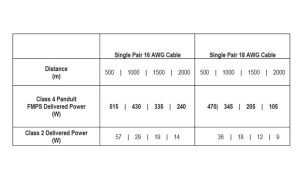
Deliver up to 600W per copper pair and up to 2 kilometers away. The Power and distance any system can deliver depend upon the wire size. Toggle between the charts below to see how much power the Panduit FMPS can deliver across a single pair of copper conductors and at what distance compared to Class 2 systems.
Benefits of Fault Managed Power System
Compared to traditional power
Save up to 40% on material costs
Safe power distribution allows technicians to install the Panduit Fault Managed Power System with less material, for a less costly and faster deployment than traditional power.
Lower your Opex with Centralized Power architecture
The architecture allows centralized power backup for more accessible and less expensive management. Centrally monitor and control your infrastructure to avoid costly site visits.
Compared to Class 2 power…
Save up to 60% on cable costs
The Fault Managed Power System delivers up to 6 times the power and 30 times the distance of a Class 2 system, reducing the number of copper pairs needed while using a thinner wire gauge.
Reduce headend space and cooling requirements
The FMPS safely delivers more power at higher voltage than a Class 2 system and increases the power capacity per RU while reducing the power lost to heat with higher efficiency.
Where is Fault Managed Power System Used?
The Fault Managed Power System provides safe, sustainable, and reliable power distribution anywhere you need it. The Panduit FMPS serves as a backbone for power distribution deployment for any venue or technology. Centralized for ease of back-up, monitoring and control for added resiliency, and scalable to grow with your technological demands.
FMPS with In-Building Wireless
Wireless connectivity continues to make meaningful penetration into enterprise networks unlocking performance and transforming the way people work. Reliable connections, secure access to data, and on-demand communication capacity are mainstays of modern business. These resources are the fourth-utility that people rely on to get through their day. Partner with Panduit for best-in-class solutions throughout your enterprise environments that scale around the globe and optimize connectivity with a single source provider of all network and physical infrastructure solutions.
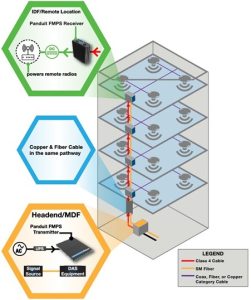
In any Distributed Antenna System (DAS), Distributed-Ran (D-RAN), or small cell architecture, the Panduit FMPS provides safe power anywhere it is needed to power remote radios. Run fiber and copper in the same pathways for a faster installation, and centralize power distribution with the Panduit FMPS for easy power back-up, monitoring, and control in a more reliable wireless network.
FMPS in Smart Building
In smart buildings, connected devices such as lights, security, HVAC, and AV converge on the IP network where these systems communicate with each other, collect actionable data, and fuel efficiencies. High-performing, highly reliable networks rely on Panduit infrastructure solutions to connect devices and deliver voice and data wherever they are needed.
Leverage the Panduit Fault Managed Power System (FMPS) to substantially augment in-building network reliability by facilitating secure and centralized power distribution. The Panduit FMPS is certified for Class 4 power which allows users to run fiber and copper within the same pathways for safe and accelerated installation. With the Panduit FMPS deliver significant power, over long distances safely, to more edge devices using less cable.
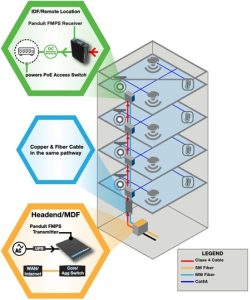
The Panduit Fault Managed Power System delivers optimal safety, efficiency, and reliability for optimal control. System Integrators may deploy cutting-edge technology with centralized power to unique locations, over longer distances, with a scalable, flexible design to future-proof initial deployments.
Welcome to the new world of power distribution with the Panduit Fault Managed Power System.