EdgeDX: Why Edge AI Is Changing the Value of CCTV
Most CCTV systems can see risk. The question is whether they can understand it in time. By combining detection AI with the contextual judgment of Vision Language Models at the edge, Gen3 helps cameras move beyond object detection to risk understanding and accident prevention
By: Panayiotis Kapiniaris, Business Development Director, EdgeDX; E-mail: panayiotis.k@edgedx.ai
Occupational health and safety is becoming a key market for AI video analytics. CCTV was traditionally used to protect assets, buildings and perimeters. But in high-risk environments, the most valuable thing to protect is people.
The International Labour Organization reports that 2.93 million workers die each year from work-related factors, while Eurostat reported 3,298 fatal accidents at work in the EU in 2023, with construction accounting for 24% of them.
Edge AI changes video from passive recording to real-time safety intelligence.
In healthcare, surveys show concern around workplace violence and patient safety. National Nurses United reported in 2026 that 84.8% of surveyed nurses experienced workplace violence in the previous year. AHRQ also states that up to 1,000,000 people fall in U.S. hospitals each year.
Identifying Hazards Before Accidents Occur
EdgeDX can support healthcare teams by detecting aggressive behavior, fallen persons, loitering, intrusion, overcrowding, fire and smoke. Construction and industrial workplaces are often associated with PPE detection, but worker safety does not stop at helmets, vests or uniforms. A serious incident may begin when a worker enters a hazardous zone, a pedestrian walks into a forklift area, smoke appears, or a remote worker falls unseen. Retail, public spaces and senior living facilities also face risks: aggression, overcrowding, unauthorized access, falls, fire or abnormal activity.
The insurance market is also moving toward prevention. In the United States, Nationwide Mutual Insurance Company has highlighted AI computer vision in workers’ compensation as a way to identify workplace hazards before accidents occur. In one deployment, the technology was linked to claims reduction of up to 23%.
EdgeDX Gen3
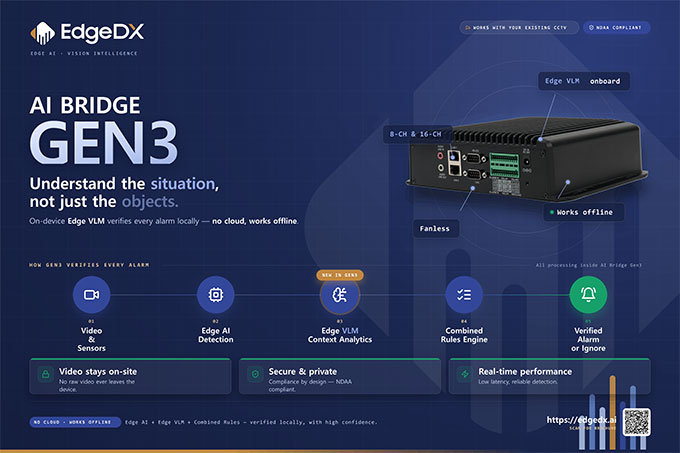
Most AI video analytics have followed one of two approaches. Detection AI is fast at recognizing objects and events, but it only sees what it was trained to label and can create false alarms. Vision Language Models understand scenes and context, but are often heavier, slower and dependent on cloud or GPU-server infrastructure.
EdgeDX brings both approaches together in one analytics engine with the AI Bridge Gen3 recently released units. It achieves this while maintaining the same ruggedized, fanless edge hardware design, creating a powerful software and hardware combination for demanding analytics workloads and challenging environmental conditions.
By combining detection AI with contextual VLM judgment at the edge, Gen3 helps cameras move from detecting objects to understanding risk. It also reduces bandwidth usage, cloud dependency, processing costs and unnecessary movement of sensitive CCTV footage. The future value of video will not be measured only by what it records. It will be measured by what it helps prevent.