The smart stadium market is projected to grow from $14.3 billion in 2023 to a remarkable $34.5 billion by 2028, boasting a Compound Annual Growth Rate (CAGR) of approximately 19.2%, according to the latest data coming from researchers at Marketsandmarkets.
This exponential growth is primarily propelled by remarkable advancements in Internet of Things (IoT) technology, data analytics, cloud computing, and the proliferation of mobile applications. An imperative catalyst is the pressing need for optimizing venue operations, crowd management, and security, all of which converge to drive better resource allocation and cost savings for stadium management.
Services Segment Driving Growth
The services segment within this market is expected to outpace others in terms of growth, encompassing consulting services, deployment and integration solutions, and support and maintenance services. This upward trajectory is substantiated by an increasing demand for enhanced operational efficiency, sustainability measures, and adaptability to the ever-evolving landscape of business dynamics. Consequently, smart stadium services are being embraced with enthusiasm across diverse geographical regions.
A pivotal pillar of the smart stadium ecosystem, network management platforms, are garnering significant attention. These platforms establish seamless communication channels that interconnect stadiums, the workforce, and fans. This seamless connectivity ensures users have access to IT services anytime and anywhere. Notably, these platforms empower network administrators to promptly detect network failures and real-time issues, enabling swift resolution by notifying support personnel. The intensifying frequency of global sporting events has catalyzed the demand for robust and efficient data networks, crucial for the seamless execution of daily stadium operations and management.
Pivotal Role of Network Management Platforms
The support and maintenance sector occupies a strategic niche, providing vital services to ensure uninterrupted functionality and continuous improvements for smart stadium devices. The impetus behind this sector’s growth stems from a confluence of factors, including the pursuit of amplified profitability, enriched fan experiences, streamlined communication channels, and bolstered stadium infrastructure. A key driver in this context is the necessity for technical expertise to guarantee heightened reliability and minimal downtime, further augmenting the growth trajectory of this sector.
A vibrant growth avenue within this landscape is the domain of digital content management. The escalating adoption of web-based digital solutions and services by stadium operators has contributed to the rapid growth of this market segment. The seamless integration of internet resources and sports analytics is propelling stadium operators to leverage mobile apps and web services to enhance the overall fan experience, resulting in heightened engagement and satisfaction.
The global outlook underscores Europe as a frontrunner in the smart stadium market. This region’s growth trajectory is sustained by proactive funding policies at both European Union (EU) and individual state levels. European sports organizations are proactively embracing smart stadium solutions to remain competitive. Notably, countries like the UK, known for their football and cricket fervor, are making substantial investments to preserve their competitive edge within the industry. Various European governments have initiated ambitious research and development ventures, seeking to transform traditional stadiums into cutting-edge smart facilities by integrating IoT solutions and harnessing the power of 5G connectivity.
Among the key players driving this evolution, prominent names include IBM, Ericsson, Intel, NTT, Tech Mahindra, Johnson Controls Siemens, Honeywell, Cisco, NEC, Huawei, Schneider, NXP Semiconductors, Atos, Verizon, AT&T, Vodafone, T-Mobile, Telefonica, VIX Technology, Hawk Eye, Ucopia, Allgovision, Aifi, Pixellot, Locbee, Dignia, and GP Smart Stadium. This consortium of industry leaders is collectively steering the transformation of stadiums into intelligent hubs that not only host sports and events but also provide a futuristic, connected experience for all stakeholders involved.

London, September 2023 – ASSA ABLOY Opening Solutions EMEIA is pleased to announce it has acquired Kinetron, a leading specialist in motion-based energy harvesting systems for self-powered products, as part of its efforts to accelerate growth and continue its journey as a leader in digital access solutions.
“Kinetron is a strategic technological addition to the ASSA ABLOY Opening Solutions EMEIA division and will reinforce our offering in energy harvesting locking solutions that are energy efficient, maintenance free and environmentally friendly. It will provide complementary growth opportunities for our digital access solutions business segment, where we drive innovation to deliver profitable sustainable growth,” says Neil Vann, EVP & Head of ASSA ABLOY Opening Solutions EMEIA.
“Kinetron brings 35 years of experience in developing and manufacturing motion-based energy harvesting systems that enable self-powered intelligent products and facilitate the growth of electronic and IoT solutions in a sustainable way. Their mission of ‘Energy Harvesting Excellence’ comes together nicely with our vision for Digital Access Solutions (DAS) to create an access control ecosystem, that connects all our ASSA ABLOY hardware through one interface in a sustainable way, so we can continue to improve people’s lives even further,” says David Moser, SVP & Head of Digital Access Solutions EMEIA.
Kinetron was established in 1984, with their main office located in Tilburg, Netherlands.

PropTech Breakthrough, an independent market intelligence organization that evaluates and recognizes standout real estate technology companies, products, and services around the globe, announced that SALTO Homelok, a ground-breaking new smart access control solution for the residential market, is the recipient of its annual “Residential Shared Space Platform Of The Year 2023.”.
“Homelok offers an incredible value proposition with its total Smart Building Ecosystem designed to meet the needs of multifamily property managers and deliver an unparalleled resident experience in today’s connected home market. It is the ultimate solution that will revolutionize the way people access and live in their properties while offering a new level of security and convenience. This makes Homelok our choice for ‘Residential Shared Space Platform of the Year,’” said Bryan Vaughn, Managing Director of PropTech Breakthrough Awards.
SALTO Homelok is set to revolutionize residential living with its all-in-one solution that integrates smart access control technology, hardware, cloud software, digital keys, and global service support including Apple Wallet key compatibility. „SALTO is honored to have been recognized by PropTech Breakthrough for Homelok’s efforts to provide advanced, residential-specific, smart access control solutions to multi-family and single-family housing, vacation rentals, and home care / assisted living establishments“, said Frederik Troester, General Manager for SALTO Systems Oceania.
The mission of the annual PropTech Breakthrough Awards program is to conduct the industry’s most comprehensive analysis and evaluation of top technology companies, solutions, and products in the real estate technology industry. This year’s program attracted more than 1,700 nominations from 12 countries.
“SALTO is setting the new standard in residential property access control and security operations and is revolutionizing the operator and resident experience. We are thrilled to be recognized for our work in the 2023 PropTech Breakthrough Awards,” said Troester.

According to Adroit Market Research, the market for access control was estimated to be worth USD 10 Billion in 2023, and by 2029, it is anticipated to grow to USD 15 billion, with a CAGR of 8.5%. Cloud-based access control solutions are gaining popularity quickly due to their adaptability, scalability, and cost.
Access control is a top priority for organissations in a variety of sectors, including government, business, industrial, and residential, in response to the growing number of security risks and events. The need for access control is being driven by the requirement for effective access control methods to stop unauthorised access, data breaches, and security breaches. The analysts found that access control is becoming more popular as a result of strict legal requirements and standards relating to security and data protection. Regulations like the Health Insurance Portability and Accountability Act (HIPAA), General Data Protection Regulation (GDPR), and Payment Card Industry Data Security Standard (PCI DSS) must be followed in sectors including healthcare, banking, and government.
Service providers have the chance to provide access control as a service (ACaaS), allowing businesses to use cloud-based access control solutions rather than spending money on on-premises hardware. Mobile-based access control service offer simplicity and flexibility in light of the ubiquitous usage of cell phones. Businesses may give customers mobile credentials for secure, contactless access by utilising mobile technologies like Bluetooth, near-field communication (NFC), or QR codes. The potential is in creating mobile access control applications that are simple to use and integrating them with current access control applications.
Access control is a mature industry in North America, driven by strict compliance regulations and high-security standards. Advanced technologies including biometrics, mobile access control, and cloud-based solutions have prospects in the region. Access control is being more widely used in industries including government, banking, and healthcare, opening up new opportunities for market growth.

London, August 2023 – Hotel Flint in Dornbirn, Austria, is a new hotel which combines the best of contemporary and traditional hospitality. In renovating 19th-century Villa Weiss, and extending it with a 21st-century structure, developers sought an intelligent access solution which would both look good and help hotel staff to manage the site and provide guest services more effectively.
They also needed flexible system administration to keep them in control — even remotely — and which would future-proof door security and services at this landmark hotel.
The Flint chose ASSA ABLOY’s TESA Wireless Online access management system with 80 i-minimal electromechanical door locks, wall readers and fire-certified i-max locks. This complete, future-proof technology solution is equally suited to a historic building as to a contemporary structure. These electronic door devices help the Flint to offer their guests an up-to-date hotel experience, including self-service check-in and accessing their rooms by smartphone.
ASSA ABLOY’s TESA i-minimal lock: low-profile aesthetics meets robust security
The Flint’s guest rooms, spa and other interior doors are secured with i-minimal wireless mortise locks. The i-minimal is a robust, battery-powered electromechanical door lock which works almost completely out of sight. This minimalist aesthetic footprint works subtly within both traditional and modern interiors. Alongside i-minimal, wall readers for the entrance and panic doors, and the i-max lock for fire-certified doors, were also installed.
An i-minimal’s electronics and mechanical components are embedded within the door leaf, so only the reader module on one side, and a privacy button on the other, are visible. It accommodates multiple DIN handle designs to blend with every interior.
“The major advantages of the TESA access solution are its design and online capabilities,” says Ing. Koch Wolfgang, Managing Director of Schlüssel Koch, the hotel security specialist. “We are already prepared for the future.”
The i-minimal helps streamline hotel management tasks: lock sensors alert staff if a door is left open, for example. From the TESA Wireless Online interface, they can remotely unlock a room.
“Reception can directly communicate with the door, receiving feedback such as whether the guest is in their room or prefers not to be disturbed,” he adds. “Battery status notifications are transmitted directly to the technical team, so we can be proactive.”
System management software integrates with the hotel’s self-service kiosks: guests will check-in from home, enter the hotel with a PIN and receive their keycard at the kiosk.
To learn more about how digital access maximizes management and guest convenience, visit our website: https://campaigns.assaabloyopeningsolutions.eu/tesa-hospitality

Accenture Future of Work Study has shown that 68% of high-revenue growth companies have embraced a hybrid model worldwide. With businesses enjoying remote or hybrid working, benefits including reduced maintenance costs, improved flexibility and extended talent pool, cyber security awareness has become more critical than ever.
With this in mind, Indusface is intrigued to find out the most secure countries for businesses to allow their employees to work from, by creating an index score based on cybersecurity data including DDOS attacks, phishing sites, Malware hosting sites and compromised computers.
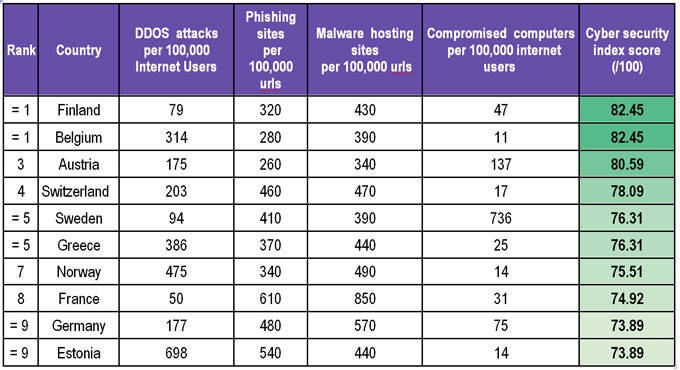
Indusface found out that Finland and Belgium share the title of the most secure European countries for businesses to allow employees to remotely work from, each with a cyber security score of 82.45 out of 100. Finland has received the second lowest number of DDOS attacks (79) during 2015 to 2021, only 29 attacks higher than France who has the lowest among the top 10 European countries. This is an important factor for businesses to consider as successful DDOS attacks could block your business sites and bring down all servers and connections you depend on.
Contributing to Belgium’s top ranking is that it has the lowest number of compromised computers per 100,000 internet users (11) in the country. Computers that have been infected with the Gamarue botnet open doors to hackers and make it easier for them to take control of your business data and devices. Belgium also has the joint second lowest malware hosting sites among all top 10 European countries, with an average of 390 sites per 100,000 urls.
Ranking third as the most cyber-secure European country is Austria with an overall cyber security index score of 80.59/100. Boasting the lowest number of both malware hosting sites (34) and phishing sites (260) per 100,000 urls, the country owns less sites that could trick you or contain malware, making businesses less worried about sensitive information being stolen. In fourth place is Switzerland with a cyber secure index score of 78.09/100. Sweden and Greece rank joint fifth place with a score of 76.31/100.
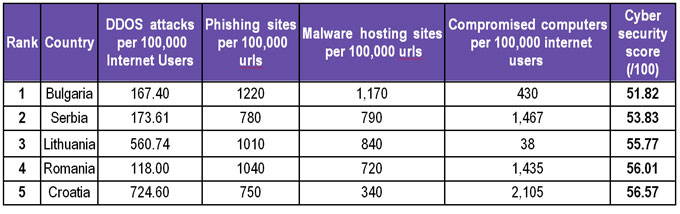
Bulgaria ranks the least secure European countries for businesses to allow employees to remotely work from, with a total cybersecurity score of only 51.82 out of 100. With 1,220 phishing sites and 1,170 malware hosting sites per 100,000 urls, businesses in the country will need to be extra careful when identifying whether a website is genuine. Serbia owns one of the highest number of compromised computers per 100,000 internet users (1,467) which leads to its low cyber security score of 53.83 – ranking as the second least cybersecure European country.
Top 10 most cyber secure European countries to work from
5 least cyber secure European countries to work from

Arecent report by Novaira Insights cites a correction in the global video surveillance industry in 2022, due largely to a sharp decline in the Chinese market in the wake of COVID-related lockdown measures.The correction however is likely to be transient as China recovers, putting economic development and related projects back on track, the report added.
Video surveillance has long been a growth industry. But it took a downward turn last year, according to a recent report by Novaira Insights, which cited a 3.4 percent decline in the global video surveillance market in 2022. This, however, was largely due to a sharp decline in the Chinese market, which dropped 18.6 percent last year, the report showed.
According to the report, the China drop was primarily due to lockdowns causing restrictions on business during 2022 waves of the COVID pandemic. “In the public sector, Chinese government spending was diverted away from areas such as video surveillance, and towards battling COVID-19 and supporting the economy during the lockdowns,” said Josh Woodhouse, Lead Analyst and Founder of Novaira Insights. “China is estimated to have remained the world’s largest regional market for video surveillance equipment, accounting for 44 percent of the world market in 2022. However, this is a reduction from the previous year when it accounted for 52 percent.”
He added that outside China, most markets continued to grow, with the market in the world excluding China growing 13.2 percent in 2022.
As for this year, with China reopening and COVID-related restrictions lifted in most countries in the world, projects and other developmental efforts are back on track. This will be a positive development for the global video surveillance market, which the Novaira Insights report said will grow 11.8 percent this year, making it worth over US$27 billion in 2023.
Impact on Video Surveillance
Like other industries, China’s video surveillance market felt the pinch of the lockdown measures and the resulting business inactivity. Perhaps nowhere can the lockdown impact on China’s video surveillance market be more revealing than Hikvision’s 2022 financial report, which reported 2022 video equipment sales of 65.9 billion RMB, a 1.12 percent growth from 2021’s 65.1 billion RMB. This contrasted sharply from the 16.9 percent growth between 2020 and 2021. 2023 Q1 revenue was also down 1.94 percent year-on-year.
Return to Growth Imminent
Indeed, various positive developments in the video surveillance/security market, both in China and rest of the world, give us reason to be optimistic. Perhaps H1 reports to be released by security companies later this year will provide further insights into how strong the market will fare in 2023 and 2024. Stay tuned for asmag.com’s 2023 Security 50 compilation to be released in November for more information and details.

Milestone Systems, a provider of open platform video management software, is very pleased to announce the appointment of Morten Illum as its new Chief Revenue Officer (CRO).
Morten Illum brings extensive experience and a strong track record in channel sales across regions. His leadership in driving transformation, coupled with his deep knowledge of the tech industry makes him an invaluable addition to the Milestone Systems team. Morten has consistently demonstrated his ability to drive revenue growth, forge strategic partnerships, and build high-performing sales teams.
Thomas Jensen, CEO of Milestone Systems said, “I am thrilled with Morten Illum’s appointment as our CRO which represents a significant strengthening of our company” He added, “Morten’s strong competences with channel sales and international organizations, his extensive background in the tech industry, as well as his proven track record in developing sales, creating the right structure for scalability, and driving business transformation, will be instrumental in Milestones ongoing transformation journey. I look forward to collaborating with Morten to drive Milestone’s growth and success.”
For the past eight years, Morten Illum has spearheaded the growth of HPE Aruba, a Hewlett Packard Enterprise company, doubling the business within a five-year period.
Morten Illum said, “I am delighted to join Milestone Systems as the Chief Revenue Officer.” He added, “Throughout my career, I have witnessed firsthand the transformative power of technology, and firmly believe that Milestone Systems has a huge potential. I am truly excited to become part of the Milestone team, contribute to the growth journey and unlock the immense potential that lies ahead.”

According to the latest findings from 6wresearch, the government in Thailand is planning to install more video surveillance cameras to reduce the crime rate in Thailand. More than 62,000 security cameras were installed in Bangkok alone in 2022 to strengthen the security in the city. Based on these findings and other aspects of their research, analysts at 6wresearch are predicting that Thai video surveillance market revenues are projected to grow at a strong CAGR of 12.7 percent during the period 2023-2029.
As one might expect, in 2020 the Thai video surveillance market witnessed a decline, owing to various restrictions imposed by government causing a halt in the construction sector as the pandemic negatively impacted the construction market due to factors such as delay in projects, labour shortage, supply chain delay and increased material costs. Around 290 Large scale government projects were vastly affected with the total value of 6.6 billion US dollars.
2023 Growth 5 Percent
However, the market has returned to its growth trajectory in 2022 & 2023 as after the contraction it grew at 4 percent in 2022 and is expected to grow at 5 percent in 2023, owing to robust demand from home improvement and renovation in the residential sector and new hotel room openings along with huge urbanisation in form of smart cities across the country.
Focus on Smart Cities
And now, the research shows that the Thai government has come up with a concept of smart cities. In the year 2022 they had 15 smart cities all over the country, with an agenda to have one of their Thai smart cities in the list of the world top 10 smart cities by 2037. Two of the key aspects of these new smart cities are Smart Environment and Smart Governance, in order to increase security and safety for its citizens and foreigners visiting the country.
Transition towards IP surveillance technology is also spurring the demand for video surveillance systems principally in hotels and several convenience stores, shopping malls and outlets. Also, rising tourism industry propelling growth in hospitality and commercial sector in Thailand will increase the requirement for video surveillance market in Thailand especially in major urban cities such as Bangkok, Pattaya, Phuket and others.