Johnson Controls has completed the sale of its ADT Spain business to Norwegian company Sector Alarm for net proceeds of $98 million, according to Memoori. The transaction was completed on April 1, 2026, and Johnson Controls confirmed it in its third-quarter report filed at the end of July. With the acquisition of ADT Spain, Sector Alarm has further strengthened its position in one of Europe’s most competitive alarm markets, where it now ranks third behind Verisure and Movistar Prosegur Alarmas. Founded in Norway in 1995, Sector Alarm operates across Europe and provides alarm solutions to more than 730,000 residential and business customers.
The Spanish sale continues Johnson Controls’ withdrawal from its international alarm monitoring operations, which began in 2023 and has already included businesses in Australia and New Zealand, Mexico, as well as its UK residential portfolio. According to Memoori’s analysis, this series of transactions points to a broader restructuring of the company’s security portfolio and a greater focus on other strategic areas of its business. Memoori also refers to earlier reports that Johnson Controls is considering the potential divestment of its access control and intrusion detection businesses, although no such transaction has yet been confirmed.
For Sector Alarm, whose expansion strategy is backed by investment firm KKR, the acquisition of ADT Spain represents another step in strengthening its presence in the European alarm and monitoring services market.
This year, DSV proudly celebrated 50 years of connecting people, businesses and markets around the world. From a small group of Danish hauliers founded in 1976 to becoming one of the world’s leading transport and logistics companies, DSV has built its success on innovation, customer focus and a continuously expanding global network. Today, with more than 150,000 employees operating in over 90 countries, DSV delivers integrated transport and logistics solutions that keep global supply chains moving.
As part of this global network, DSV Croatia combines international reach with strong local expertise to provide reliable, efficient and tailored logistics solutions. Strategically positioned at the crossroads of Central and Southeast Europe, Croatia plays an important role in connecting regional and international markets. With offices across the country and direct access to key European transport corridors, Adriatic ports and international airports, DSV Croatia provides seamless road, air and sea freight services, customs clearance, warehousing and value-added logistics solutions.
Beyond transportation, DSV Croatia supports customers with integrated supply chain services designed to improve efficiency, flexibility and resilience. From contract logistics and warehousing to customs brokerage and project logistics, the company works closely with customers to develop solutions that address increasingly complex supply chain requirements. Whether supporting daily distribution or large-scale international projects, DSV acts as a long-term logistics partner focused on creating value throughout the entire supply chain.
One of DSV Croatia’s key strengths is its extensive road transport network, providing full truckload (FTL), less-than-truckload (LTL) and groupage services throughout Croatia and across Europe. Through scheduled departures, a highly connected European network and efficient terminal operations, groupage enables customers to transport smaller shipments with the same reliability, visibility and flexibility as full truckloads – offering a cost-effective solution without compromising service quality. Combined with DSV’s global air and sea freight capabilities, this integrated network provides customers with seamless multimodal transport solutions that connect Croatia with destinations across Europe and the rest of the world.
Following the successful integration of DSV and Schenker, DSV Croatia has further strengthened its market position by expanding its operational capabilities, infrastructure and service portfolio. Customers now benefit from one of Europe’s most comprehensive transport and logistics networks, combining enhanced road connectivity with strengthened air, sea and contract logistics capabilities. The integration enables DSV to deliver even greater flexibility, scalability and supply chain resilience while maintaining a strong local presence supported by global expertise.
Digitalisation is at the core of DSV’s operations. Through advanced digital platforms, including myDSV, customers can easily book shipments, monitor cargo in real time, access shipment documentation and gain greater visibility across their supply chains. Combined with data-driven insights and experienced logistics specialists, these digital solutions help businesses optimise logistics processes, improve transparency and make faster, more informed decisions.
As supply chains become increasingly complex, businesses require logistics partners capable of delivering secure, reliable and flexible solutions. From transporting high-value equipment and sensitive technology to managing international projects and time-critical shipments, DSV Croatia combines global standards with local expertise to ensure seamless, secure and efficient logistics operations. Regardless of the industry or shipment complexity, customers can rely on DSV’s global network, operational excellence and commitment to delivering consistent service quality.
Sustainability is also becoming an increasingly important part of supply chain management. DSV is committed to supporting customers on their decarbonisation journey by improving transport efficiency, optimising networks and developing more sustainable logistics solutions. Through continuous investment in digitalisation, innovation and operational excellence, DSV helps businesses build supply chains that are not only efficient and resilient, but also prepared for the future.
As supply chains continue to evolve, DSV remains committed to helping businesses grow through innovation, operational excellence and customer-focused logistics solutions. Backed by five decades of experience and one of the world’s strongest logistics networks, DSV Croatia continues to connect local businesses with Europe and the world—delivering reliable logistics that drive long-term success.
The security industry is undergoing a fundamental transformation. As enterprise organisations become increasingly dependent on connected technologies, the selection of security infrastructure is no longer based solely on functionality, performance and price.
Today, digital sovereignty, the origin of technology, long-term product availability and access to European technical support are becoming increasingly important criteria in technology procurement. Organisations want greater transparency regarding where solutions are developed, how cybersecurity is managed and whether manufacturers can provide reliable product development, maintenance and support throughout the entire system lifecycle.
This shift is being reinforced by a changing geopolitical environment, growing supply-chain concerns and the increasing strategic importance of protecting critical infrastructure. As a result, organisations across Europe are placing greater value on trusted technology partners that develop and manufacture their solutions within the European Union and operate in accordance with European regulations, quality standards and cybersecurity requirements.
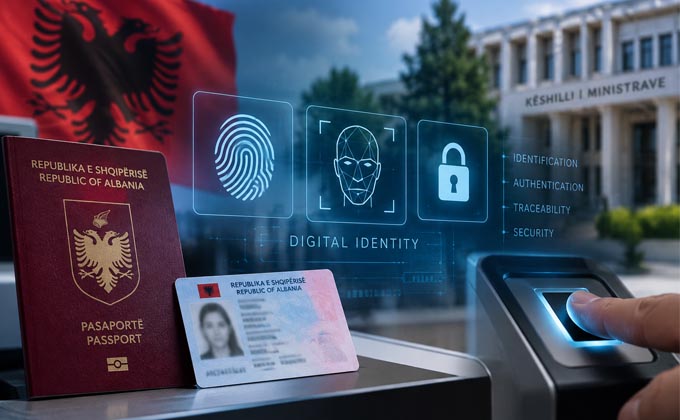
At the same time, regulatory frameworks such as the NIS2 Directive are raising expectations around cybersecurity, operational resilience and supply-chain security. Identity & Access Control systems are therefore no longer viewed simply as tools for controlling entry into buildings. They are becoming an integral part of an organisation’s overall security and identity architecture.
For system integrators, this creates both new opportunities and new responsibilities. Enterprise projects increasingly require more than reliable readers, controllers and credentials. They require an integrated technology platform capable of connecting identities, devices, access rights and workforce processes while remaining secure, scalable and supported over the long term.
From Access Control to an Integrated Enterprise Platform
Modern Access Control extends far beyond controlling entry into buildings. Today’s organisations expect physical access, logical access, mobile credentials, time & attendance and workforce management to operate within one centrally managed ecosystem. Employees, contractors and visitors should be able to use a single trusted identity across physical and digital environments, while administrators manage access rights, security policies and audit trails from one platform.
As a result, organisations are increasingly looking for integrated Identity & Access Control platforms rather than collections of standalone products. They want fewer technology vendors, simplified integrations and a clear line of responsibility for hardware, software, firmware, identity media and technical support.
For system integrators, partnering with a European platform manufacturer is therefore becoming a strategic business decision, not simply a product selection. One example of this new generation of European Identity & Access Control platforms is KADRIS 4, developed and manufactured by the Slovenian company ČETRTA POT. The platform demonstrates how enterprise organisations can unify physical security, workforce management and identity management within a single ecosystem while working with one trusted European manufacturer.
Discover KADRIS 4 at Adria Security Summit 2026
At this year’s Adria Security Summit, visitors will have the opportunity to discover KADRIS 4 – the international platform and market brand of ČETRTA POT, a Slovenian manufacturer and developer with more than 35 years of experience in developing and manufacturing enterprise security solutions. KADRIS 4 combines Enterprise Identity & Access Control, Time & Attendance, Workforce Management, Mobile Credentials and Physical & Logical Access within one integrated ecosystem.
Unlike vendors focusing on only one layer (hardware, software or HR), KADRIS 4 is a vertically integrated platform. From in-house designed and manufactured controllers, terminals and readers, through firmware and enterprise software, to HR and payroll processes, everything is developed as one integrated ecosystem. One platform, one vendor, one accountability. The platform is trusted by more than 950 organisations, including Bayer, Novartis, Elan, Kansai Helios, Trelleborg, Addiko Bank, Gorenjska Banka, Elektro Ljubljana, Elektro Gorenjska, hospitals, ministries and numerous public authorities.
Designed for enterprise environments, KADRIS 4 is built around European quality and security standards, including EN 60839-11-1 (Security Grades 2 – 4), ISO 27001 and ISO 22301. Its NIS2-ready architecture is complemented by advanced NXP-based cryptography and quantum-ready identity media built on NXP MIFARE DUOX® technology (CC EAL6+, AES-256 and ECC dual encryption), providing organisations with a future-ready foundation for enterprise identity management.
The KADRIS 4 team at Booth 105 during the Adria Security Summit 2026
Let’s Meet in Zagreb
Adria Security Summit is more than a technology exhibition – it is a place where manufacturers, system integrators, distributors and technology partners build the collaborations that shape the future of the security industry.
We invite system integrators, security solution providers, distributors and technology partners to visit us at Booth 105 or schedule a meeting in advance through the Adria Security Summit event platform after completing your visitor registration. You will get a chance to experience the KADRIS 4 platform firsthand and discuss how a European-developed and manufactured Identity & Access Control platform can strengthen your portfolio.
Whether you are looking for an integrated enterprise solution, a reliable long-term technology partner or new business opportunities, we look forward to meeting you in Zagreb.
Hochiki has kept people and property safe from fire for over 100 years. We started in Japan in 1918, and that same precision engineering background still shapes every product we design and manufacture today. Each device carries that precision through into manufacture, then is tested and certified to European fire safety standards before it reaches the market.
If you are new to Hochiki, the best place to start is our Training Academy. It is a free online platform covering system design, installation best practice and product training, and it already has over 2,000 users worldwide, including installers, specifiers and engineers. Visitors to our stand who have not worked with our products before can use the Academy to get up to speed quickly and understand how our systems fit into their projects.
We have worked across the European market for more than 30 years, building strong relationships with distributors, installers and specifiers in every country we operate in. Europe is not one market. Standards, approvals and building needs differ from country to country, and we work closely with local partners to make sure every project gets the right solution for the Adriatic and Balkan region.
Our experience in Southeast Europe includes several notable projects across a range of building types. In Bulgaria, our systems safeguard Smart Tower, a large mixed use development in Sofia where 1,152 people live and work across two connected blocks. Our fire detection products are also installed at the BULTEX99 Logistics Centre, helping keep staff and stock safe for a business serving over 24,000 customers across the country, and at the historic Sofia National Library, home to important national collections since 1881.
In Serbia, our products are installed at the BiG Shopping Mall in the Srem District, a busy destination for shoppers and visitors. In Turkey, Hochiki fire detection equipment is in place at Ankara Numune Training and Research Hospital, one of the country’s oldest and most respected hospitals. Together, these projects show our products and systems working reliably across many types of buildings, from hospitals and libraries to shopping centres and logistics sites.
At the centre of our commercial range is the ACD Multi-Sensor, our award winning detector. The ACD won an Intersec Award, and it is certified to EN 54 Parts 5, 7, 26, 29, 30 and 31, with all 24 detection modes certified. This gives specifiers the flexibility to match detection settings to the building, helping reduce false alarms while still detecting real fires quickly. It also includes carbon monoxide detection, with a 10 year CO cell life and a 3 year product warranty.
Visit our stand at 140 at Adria Security Summit to learn more about the award winning ACD Multi-Sensor, hear about our project experience across the region and find out how the Training Academy can support your team.
SCANLOCK is a technology company with more than 20 years of experience in the distribution, integration, and development of advanced security solutions. Operating across Central Europe, we help customers design and implement comprehensive security systems that protect critical infrastructure, industrial facilities, logistics centers, commercial buildings, transportation hubs, and public spaces. Our philosophy goes beyond simply supplying products–we deliver complete, tailor-made solutions, from initial consultation and system design to implementation, technical support, and long-term service.
At SCANLOCK, we combine best-in-class technologies from leading global manufacturers with our own expertise in artificial intelligence and video analytics. This allows us to provide customers with reliable, scalable, and future-proof security solutions that improve safety, operational efficiency, and situational awareness.
One of our flagship technologies is SAFR, an industry-leading facial recognition platform designed for highly accurate and lightning-fast biometric identification. Powered by an AI engine with an accuracy of up to 99.87%, SAFR enables secure access control, visitor management, and real-time identity verification across a wide range of environments. The platform supports both controlled enrollment (“visa faces”) and recognition of individuals in real-world scenarios (“wild faces”), making it suitable for offices, manufacturing plants, critical infrastructure, retail, and large public venues. With centralized management, synchronization of multiple readers, support for databases of up to 50,000 identities per reader, and integration with mobile credentials, access cards, and QR codes, SAFR delivers an exceptionally flexible and reliable biometric security solution.
Complementing our biometric portfolio is SCANNERA, SCANLOCK’s proprietary AI-powered video analytics platform. Developed through years of research in computer vision and machine learning, SCANNERA transforms standard CCTV systems into intelligent decision-making tools. The platform is hardware-independent and can be integrated with virtually any existing camera infrastructure, protecting previous investments while significantly extending system capabilities.
SCANNERA performs real-time analysis using advanced neural networks to detect security threats, monitor operational processes, and automate visual inspections. Its applications include intrusion detection, object and behavior recognition, traffic analysis, industrial quality control, people counting, and forensic video search. By continuously analyzing live video streams, SCANNERA enables organizations to identify risks before incidents occur, optimize operational efficiency, and reduce the need for manual monitoring. The solution is fully customizable and can be adapted to the specific requirements of each project, whether in manufacturing, logistics, transportation, smart cities, or critical infrastructure.
Together, SAFR and SCANNERA represent SCANLOCK’s vision of modern security–where artificial intelligence, advanced analytics, and seamless system integration work together to create safer, smarter, and more efficient environments. Whether protecting people, assets, or business operations, SCANLOCK delivers innovative technologies that help organizations stay one step ahead of evolving security challenges.
Axis Communications has introduced three purpose-tuned camera kits for automatic license plate recognition (LPR), all with AXIS License Plate Verifier preinstalled. The cameras capture license plates and, under optimal conditions, can also identify vehicle type, color, make, and model, without requiring external servers.
The AXIS P3285-LVE Kit is designed for slow-speed traffic and features a 2 MP dome camera, with allow and block lists managed directly on the device. The AXIS P1485-LE Kit uses a robust 2 MP bullet camera for reliable license plate capture in free-flow traffic, while the AXIS P1486-LE Kit combines a 3 MP camera with global shutter technology to capture fast-moving vehicles with low distortion across two traffic lanes.
All three kits are ready to use out of the box and designed to provide accurate and reliable license plate recognition even in challenging lighting conditions. Built on open APIs, they can be easily scaled and integrated with Axis and third-party VMS platforms. The cameras also feature electronic image stabilization, while the vandal-resistant slow-speed model can be safely installed at lower, easily accessible mounting heights.
Texecom, a leading UK manufacturer of professional security systems, today announced the launch of Texecom Guardian with AURA UK, a security technology company providing businesses and individuals with instant access to private security response services anytime, anywhere using a connected device.
The launch creates a new commercial opportunity for Texecom installers. By making a professional response service available to customers with compatible systems, installers can add greater long-term value to every installation, strengthen ongoing customer relationships, and benefit from an additional recurring revenue stream, without having to build or manage their own response operation.
For self-monitoring security users, an alarm activation has traditionally meant receiving an alert and being limited about how to react to the situation. Traditional solutions have typically offered no guaranteed route to physical intervention, leaving users reliant on keyholders, friends, family members, or police attendance, which is increasingly uncertain given pressure on time and resources – or simply to hope that it is a false alarm and ignore the notification.
Texecom Guardian changes this by giving users direct access to guaranteed physical security responses. When an alarm is triggered, self-monitoring users can now request attendance from a vetted, SIA-licensed security officer through AURA’s nationwide network of ACS-accredited partners.
Behind the integration is AURA’s intelligent response platform, which automatically matches each request with the nearest available vetted, SIA-licensed responder, using real-time location data to coordinate attendance and provide users with live visibility from dispatch through to arrival.
Indeed, once the responder has been dispatched, users can track the responder’s journey in real time and communicate directly with AURA’s 24/7 UK control room, providing visibility and reassurance throughout the incident. AURA, which already operates across more than 178,000 protected sites, is able to deliver average response times of under 29 minutes across the country.
Texecom Guardian is available now through a simple monthly subscription, providing access to physical security response when it is needed most, without the uncertainty of arranging or paying for a callout during an active incident.
Alex Booth, Managing Director of AURA UK, said “self-monitoring has transformed how people manage security, but until now there has been a clear gap between receiving an alert and getting help on the ground. This partnership closes that gap by giving users access to a trusted, guaranteed physical response whenever they need it — directly from the security app they already use.”
David Mountfield, CEO of Texecom, added that “Texecom was built to give users greater control over their security, and this integration takes that further by adding access to a professional physical response when it matters most. AURA’s technology and responder network provide a natural extension of the self-monitoring experience.”
The OSDP Verified program, administered by the Security Industry Association (SIA), has so far validated 222 products from 32 companies and brands for compliance with the OSDP standard for access control communications. Open Supervised Device Protocol (OSDP) enables bidirectional communication between readers and controllers and was developed as a more secure and capable alternative to the legacy Wiegand interface. Its implementation improves interoperability between devices from different manufacturers, enhances device management, and supports capabilities such as Secure Channel encryption, smart card communications, and biometric readers.
SIA took ownership of the OSDP protocol in 2012, while the product verification program was launched in April 2020. “Since its launch in April 2020, the SIA OSDP Verified program has tested and validated 222 products from 32 companies and brands – substantial progress in six years, highlighting the market need and the program’s success,” said Cameron Walker-Miller, director of standards and technology at SIA. He added that the program now includes participants from nine countries across North America, Europe, Asia, and the Middle East, with growing interest from international manufacturers. As of July 2026, the verified product list also includes 46 access control units and nine peripheral devices.
More information about the standard and verification program is available from SIA OSDP.
Professional security media platform asmag.com has launched its new annual survey in cooperation with Hikvision, aiming to gather insights from security industry professionals on current technologies and trends in video surveillance. The research is part of a series of surveys through which asmag.com and Hikvision track the views of users, integrators, and other industry stakeholders and examine the changes shaping the security market. Previous joint surveys have addressed topics including the application of large AI models in video surveillance, sustainability, and technologies for capturing images in low-light conditions.
The results of these surveys are used to analyze the adoption of new technologies, evolving customer requirements, and the direction of market development. The organizers are therefore inviting security professionals to share their experiences and opinions and contribute to a more representative picture of current industry trends.
In the modern world, a single layer of security is sometimes not enough. Premises with sensitive areas or higher-security rooms often benefit from an extra deterrent against unauthorized access. In many sectors, regulations require it. Implementing reliable digital two-factor authentication (2FA) – without adding delays or complexity at the door – is the most convenient, compliant solution. It keeps premises and their users safer from an evolving range of threats.
The SMARTair® i-reader Keypad was designed to meet this need for additional security, offering PIN, credential, or PIN+credential (2FA) access within a SMARTair digital access system. This new device extends the functionality of the SMARTair i-reader, already deployed successfully in diverse settings, and is compatible with SMARTair Wireless Online, Update on Card, and Openow system administration options.
Like the original model, the new i-reader Keypad can control and audit access almost anywhere. It accommodates a range of credentials, including cards, fobs, badges, and mobile keys. With the same device, facilities managers can also offer secure, cost-effective PIN entry.
A capacitive backlit keypad, customizable LED, and IP56 certification enhance usability outdoors and in low-light environments. Trusted, end-to-end encryption, robust engineering, and energy-efficient operation provide peace of mind for building managers and users. When fitted at a parking barrier, an Openow® mobile credential is detected automatically (up to 5m) for driver safety and convenience. And because the device can operate even when offline, a power cut does not compromise site security.
PIN, RFID, mobile, 2FA – or all the above?
The i-reader Keypad simplifies the flexible implementation of 2FA at key openings or areas. Easy switching between PIN, card, and 2FA enables security teams to toggle any opening between fast/easy and higher-security access protection, including remotely. Devices can be programmed to switch between card/PIN and 2FA at different times of day – boosting building security overnight when occupancy is lower, for example, and saving round-the-clock staff costs. PINs may be issued remotely, further streamlining the management of contractors.
In multi-residential buildings, it adds PIN access to amenities like a gym or pool; protects staircases or filters elevator access; and enables block managers to quickly issue temporary time- and location-restricted access, including dedicated PINs for subcontractors or temporary users who are not assigned a permanent credential. In commercial, healthcare, or education premises, an i-reader Keypad can permit temporary entry by PIN for staff who have forgotten their credential, for example. It can also be deployed to manage and control access to specific floors within a building or to simplify 2FA implementation for sensitive doors in courthouses, hospital wards, data centers, and similarly sensitive settings.
To learn more about the new SMARTair i-reader Keypad, download a brochure or technical datasheet at SMARTair i-reader