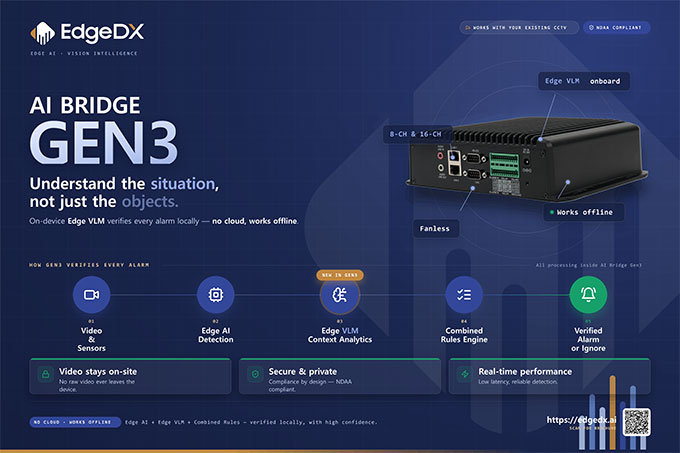
Most CCTV systems can see risk. The question is whether they can understand it in time. By combining detection AI with the contextual judgment of Vision Language Models at the edge, Gen3 helps cameras move beyond object detection to risk understanding and accident prevention
By: Panayiotis Kapiniaris, Business Development Director, EdgeDX; E-mail: panayiotis.k@edgedx.ai
Occupational health and safety is becoming a key market for AI video analytics. CCTV was traditionally used to protect assets, buildings and perimeters. But in high-risk environments, the most valuable thing to protect is people.
The International Labour Organization reports that 2.93 million workers die each year from work-related factors, while Eurostat reported 3,298 fatal accidents at work in the EU in 2023, with construction accounting for 24% of them.
Edge AI changes video from passive recording to real-time safety intelligence.
In healthcare, surveys show concern around workplace violence and patient safety. National Nurses United reported in 2026 that 84.8% of surveyed nurses experienced workplace violence in the previous year. AHRQ also states that up to 1,000,000 people fall in U.S. hospitals each year.
Identifying Hazards Before Accidents Occur
EdgeDX can support healthcare teams by detecting aggressive behavior, fallen persons, loitering, intrusion, overcrowding, fire and smoke. Construction and industrial workplaces are often associated with PPE detection, but worker safety does not stop at helmets, vests or uniforms. A serious incident may begin when a worker enters a hazardous zone, a pedestrian walks into a forklift area, smoke appears, or a remote worker falls unseen. Retail, public spaces and senior living facilities also face risks: aggression, overcrowding, unauthorized access, falls, fire or abnormal activity.
The insurance market is also moving toward prevention. In the United States, Nationwide Mutual Insurance Company has highlighted AI computer vision in workers’ compensation as a way to identify workplace hazards before accidents occur. In one deployment, the technology was linked to claims reduction of up to 23%.
EdgeDX Gen3 Most AI video analytics have followed one of two approaches. Detection AI is fast at recognizing objects and events, but it only sees what it was trained to label and can create false alarms. Vision Language Models understand scenes and context, but are often heavier, slower and dependent on cloud or GPU-server infrastructure.
EdgeDX brings both approaches together in one analytics engine with the AI Bridge Gen3 recently released units. It achieves this while maintaining the same ruggedized, fanless edge hardware design, creating a powerful software and hardware combination for demanding analytics workloads and challenging environmental conditions.
By combining detection AI with contextual VLM judgment at the edge, Gen3 helps cameras move from detecting objects to understanding risk. It also reduces bandwidth usage, cloud dependency, processing costs and unnecessary movement of sensitive CCTV footage. The future value of video will not be measured only by what it records. It will be measured by what it helps prevent.
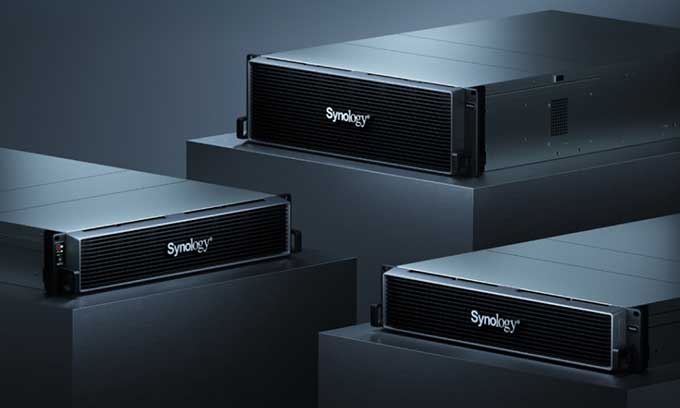
As organisations manage growing volumes of data across offices, endpoints, applications and locations, storage must do more than hold files. It must deliver reliable performance, support business-critical services, and scale as organisational requirements evolve—without costly disruption. Synology’s new RackStation series combines rackmount storage hardware with the flexibility of DiskStation Manager (DSM), providing options for deployments from branch offices to central data centres.
The series spans a range of deployment needs. The 1U RS1626xs+ brings enterprise capabilities to space-constrained environments. The RS3626xs and RS4826xs+ provide scalable platforms for demanding business workloads, while the 16-bay RS6426xs+ is designed for organisations requiring high throughput and substantial expansion capacity.
Performance and Scalability
The RS1626xs+ is powered by the six-core Intel Xeon D-1726 processor and delivers up to 84,000 4K random-write IOPS and sequential read/write performance of up to 2,100/1,500 MB/s. Dual 10GbE ports, a PCIe 4.0 expansion slot and two integrated M.2 NVMe slots for SSD cache help organisations maintain performance as users and workloads grow.
At the higher end, the RS6426xs+ delivers up to 165,000 4K random-write IOPS and sequential throughput of up to 6,700 MB/s for reads and 4,300 MB/s for writes. With 16 drive bays and support for up to four RX1225RP expansion units, it can scale beyond 1.5 PB of raw capacity. The RS3626xs and RS4826xs+ provide additional performance options for businesses deploying HDD, SSD or hybrid storage.
Connectivity and Continuity
Selected systems include integrated 10GbE RJ45 networking and support optional 10/25GbE network interface cards or Fibre Channel connectivity, allowing organisations to match networking capabilities to workload requirements. Enterprise features such as redundant power supplies, hot-swappable drives, redundant fans, online volume expansion and out-of-band management help maximise availability and simplify maintenance. In compatible two-server deployments, Synology High Availability provides automatic failover for critical services.
A Unified Data Platform
DSM transforms RackStation into a unified data management platform. Synology Drive provides a private cloud platform for file access and synchronisation, while Synology’s collaboration applications support on-premises file sharing, document collaboration, email, messaging and calendar services.
For data protection, Active Backup Suite, Hyper Backup and Snapshot Replication provide comprehensive backup, replication and recovery for endpoints, servers, virtual machines and cloud services. Surveillance Station provides video-management capabilities, while Virtual Machine Manager and Container Manager support application hosting, testing and disaster-recovery use cases. On compatible deployments, Synology Tiering can help improve storage efficiency by moving less frequently accessed data between performance and capacity tiers.
Ready to Scale
From branch offices to central data centres, the new RackStation series provides a scalable enterprise platform for consolidating data, protecting critical workloads and supporting long-term business growth.
Performance figures are based on Synology testing and vary depending on system configuration, installed drives, network environment and workload.
To learn more about the Synology RackStation (RS) Series and explore Synology’s enterprise storage solutions, scan the QR code below.
By: Andrea Palomeque, Marketing Expert, Central and Eastern Europe, Salto Systems; E-mail: andrea.palomeque@saltosystems.com
Located on Croatia’s Adriatic coast between Rijeka and Opatija, the Hilton Rijeka Costabella Beach Resort & Spa is a five-star destination combining premium accommodation, private villas, extensive wellness facilities and beachfront hospitality. Designed to offer a high-end guest experience across a variety of spaces, the resort required an access control solution capable of balancing security, convenience and operational efficiency.
As a destination featuring hotel rooms, luxury villas, shared guest facilities and a large wellness centre, Hilton Rijeka Costabella needed an access ecosystem that could support different user profiles and access requirements while maintaining a seamless experience for guests and staff alike.
To meet these goals, the resort selected a comprehensive Salto smart access control solution, built around the Salto ProAccess SPACE platform, creating a unified infrastructure capable of managing access across the entire property.
A Unified Access Strategy Across the Resort
Luxury hospitality environments present unique operational challenges. Different accommodation types, public and restricted areas, staff circulation requirements and premium guest amenities all need to be managed without compromising the overall guest experience.
At Hilton Rijeka Costabella, Salto deployed a tailored solution that combines multiple technologies designed to meet the specific needs of each area of the resort.
The resort offers a total of 194 accommodation units, comprising 132 hotel rooms and 62 villas. Enhancing both security and guest convenience, the property is equipped with 175 Salto electronic locks tailored to the specific needs of each accommodation type. Hotel rooms feature Salto AElement Fusion electronic locks, selected for their sophisticated design and advanced technology, delivering a seamless access experience while complementing the resort’s contemporary architecture and premium hospitality standards.
Meanwhile, the resort’s collection of villas and suites is secured with Salto XS4 Original+ electronic locks, providing the reliability, flexibility and premium user experience expected in high-end hospitality environments.
Supporting a Premium Wellness Experience
One of the resort’s standout features is its extensive spa and wellness centre, which includes treatment rooms, hydrothermal facilities, fitness areas and relaxation spaces, making it a key part of the guest experience.
To support secure and convenient access throughout this environment, Salto supplied approximately 50 XS4 Eco Locks across the spa facilities and other common areas. Integrated within the wider access control ecosystem, the solution helps streamline movement through authorized areas while providing staff with effective control over access rights and day-to-day operations.
Smart Management Through Salto ProAccess SPACE
At the core of the installation is SALTO ProAccess SPACE, the platform that supports the resort’s access control infrastructure. Bringing together the various SALTO solutions deployed throughout the property, from guest rooms and villas to common areas and spa facilities, SALTO ProAccess SPACE provides a unified access management environment across the resort. The platform combines SALTO’s data-on-card technology with a networked electronic access control system, enabling the different access points across the property to operate as part of a single, integrated solution.
For a luxury resort operating multiple accommodation types and guest facilities, this integrated approach helps ensure consistent access experience throughout the property while supporting the resort’s long-term operational and security requirements.
Elevating the Guest Journey
In today’s hospitality industry, access control is about far more than security. It plays a key role in shaping the guest experience.
At Hilton Rijeka Costabella Beach Resort & Spa, Salto’s technology helps create a frictionless environment where guests enjoy secure and convenient access throughout the property, while staff benefit from greater control and operational efficiency.
By delivering a seamless and connected access experience across the resort, SALTO supports the property’s commitment to exceptional hospitality. The result is a secure, flexible and future-ready access ecosystem that helps Hilton Rijeka Costabella provide the comfort, exclusivity and service excellence expected from a world-class luxury destination.
The global fire-resistant glass market is expected to grow from $11.65 billion in 2026 to $18.09 billion by 2031, at a compound annual growth rate (CAGR) of 9.2%, according to an analysis by MarketsandMarkets. Market growth is primarily being driven by stricter fire safety regulations and standards, increased construction activity, and growing requirements for occupant safety and building resilience, with demand rising for solutions that combine fire protection with transparency, aesthetics, and greater architectural design flexibility. The use of fire-resistant glass is expanding particularly in doors, partitions, façades, windows, and glazed walls, where it helps prevent the spread of flames, heat, and thermal radiation, while advances in laminated and ceramic glass are further improving its thermal and optical performance.
Building and construction is by far the largest application segment, accounting for 83.7% of the market by value in 2025, while laminated fire-resistant glass dominated the product segment with a 57.7% share.
Europe is expected to remain the largest regional market, supported by strong construction activity, stringent fire safety standards, and the increasing adoption of certified fire-rated glazing systems and advanced building envelope solutions. The fastest growth, however, is expected in the Asia-Pacific region, with a CAGR of 10.8%, driven by rapid urbanization.
Leading market players include Saint-Gobain, SCHOTT, AGC, Nippon Sheet Glass, and Central Glass, which MarketsandMarkets identifies as key companies due to their broad market presence and strong operational and financial capabilities.
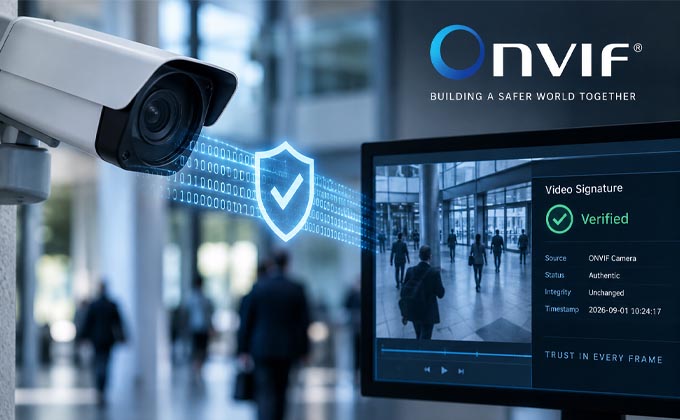
ONVIF has announced the Release Candidate of its new Media Signing Add-on, a standardized solution designed to verify the origin and authenticity of surveillance footage amid the growing prevalence of manipulated and AI-generated video. The ONVIF Media Signing Add-on enables users to determine which device produced a recording and verify whether it has been altered since its creation, an increasingly important capability for law enforcement and internal investigations, insurance claims and legal proceedings.
The solution allows IP cameras and video encoders to cryptographically sign encoded video at the point of creation, linking the footage to the specific device that generated it. A video player or verification tool supporting the Media Signing Specification can then validate the signature and confirm the source of the footage even after it has been shared across different platforms and services.
“Proving authenticity is central to trust in video. The Media Signing Add-on Release Candidate gives the security industry a standardized method to help counter manipulated video and defend authentic content,” said Leo Levit, Chairman of the ONVIF Board of Directors. According to Levit, making it an open standard ensures transparency and enables investigators, insurers and courts to verify video from different sources using consistent tools and workflows.
The current version supports video, while audio support is planned for future releases, and products claiming conformance with the Media Signing Add-on will also need to conform to an ONVIF profile. ONVIF has also released the implementation as an open-source project on ONVIF GitHub, making the technology easier for camera manufacturers and developers to implement while providing transparency into how video signing and verification work. The final specification is expected by the end of 2026, with more information about the organization and its standards available from ONVIF.
Modern buildings are placing ever-increasing demands on door communication systems. Property owners, operators, and residents require intelligent solutions that accommodate different user groups, support flexible access methods, and meet high standards for security, connectivity, and integration.
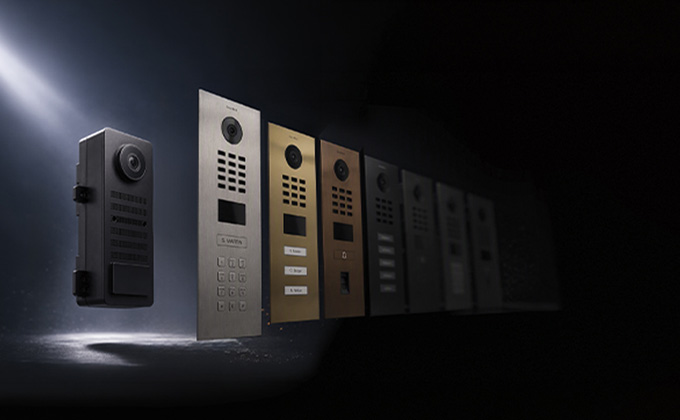
With the new D22x series, DoorBird introduces a new generation of IP video door intercoms. Developed based on specific customer requirements, the series combines cutting-edge technology, exceptional flexibility, premium design, and Made in Germany quality. As part of the ASSA ABLOY Group, the global leader in access solutions, DoorBird combines innovative IP-based door communication with extensive expertise in modern building security.
Security and Control at a New Level The D22x series comprises more than 30 models and is the direct successor to the globally successful D21x Series. New additions to the portfolio include versions with digital nameplates, which can be managed centrally and remotely, offering significant advantages for property managers, housing associations, and operators of larger buildings.
All models feature a 5 MP HDR camera with a Sony image sensor and a 180° ultra-wide-angle lens, providing excellent visibility of the entrance area even under challenging lighting conditions. Video transmission is available in HD quality via the local network or through DoorBird Cloud Pro. Outstanding audio performance ensures clear and intelligible communication between visitors and residents, even in demanding environments.
Depending on the model, a variety of authentication methods are available, including the app, dual-frequency RFID, Bluetooth, PIN code, QR code, and fingerprint recognition. The security concept is further enhanced by a radar-based 4D motion sensor and an integrated tamper sensor.
Simplified Installation and Maximum Integration With the D22x series, DoorBird also simplifies installation. Thanks to the integrated power output for electric door openers, many installations no longer require a separate power supply for the door release mechanism. This reduces cabling complexity, saves installation time, and lowers overall system costs.
Open interfaces such as SIP, OSDP, RS485, and Wiegand, along with a comprehensively documented LAN and Cloud API, enable integration with more than 100 smart homes, access control, video surveillance, and building management systems.
The door station supports installations with up to 3,000 residential or office units. In addition to traditional call buttons, digital nameplates and displays with resident directories are available. Accessibility features can be added to every model, including an integrated hearing loop, pictograms, and acoustic door-opening confirmation signals.
As an ISO/IEC 27001-certified company, DoorBird incorporates privacy and information security throughout the development process in accordance with the Security by Design principle.
Sustainable Modernization of Existing Installations The D22x series offers a particularly cost-effective way to modernize existing DoorBird D21x installations. When upgrading, only the main electronic unit needs to be replaced. Existing housings, front panels, and other components can continue to be used, while all existing settings can be retained. This significantly reduces installation effort and contributes to environmental sustainability.
Design as Part of the Architecture In addition to technology, design plays a central role. More than 50 finishes and color options allow seamless integration into a wide variety of architectural concepts, from private residences to prestigious commercial properties.
Using the DoorBird 3D Configurator, customers can customize the D22x series to their individual requirements. Front panel size and shape, engravings, mailboxes, and the integration of reader units from leading manufacturers can all be configured with maximum flexibility.
“Modern buildings require solutions that can adapt flexibly while remaining easy to integrate,” says Sascha Keller, Founder and CEO of DoorBird. “With the D22x series, we provide a future-proof platform that combines powerful door communication, flexible access solutions, and sophisticated design Made in Germany.”
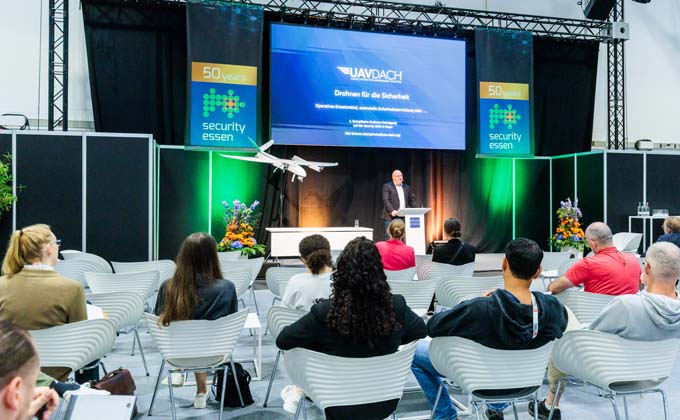
Security requirements for critical infrastructure are changing rapidly. Recent events, such as the discovery of a drone at Leipzig Airport, have once again demonstrated how quickly modern technologies can become a security challenge. This makes dialogue between industry, authorities and emergency services all the more important. Security Essen, which will take place at Messe Essen from 22 to 25 September 2026, is placing precisely this exchange at the heart of two key programme highlights: the European Drone Conference and the Emergency Services Forum.
Unmanned aerial systems open up a wide range of potential applications – from inspecting critical infrastructure to supporting security and emergency services. At the same time, they present new challenges for operators of sensitive facilities. The European Drone Conference on 23 and 24 September will therefore bring together experts from the security industry, public authorities, academia and politics to discuss current developments, the regulatory framework and effective protection strategies. The conference is organised by the Drone Expert Committee of the German Security Industry Association (BDSW), together with Security Essen and the Confederation of European Security Services (CoESS).
Experts discuss drone deployment, detection and countermeasures
Around 20 specialist presentations will examine drone technology from various perspectives – ranging from regulatory issues and the protection of critical infrastructure to detection and counter-drone systems. In his statement, Cornelius Toussaint, Vice-President of the BDSW and Chair of the Drone Expert Committee, will focus on security and drone technology in Germany. Marcus Schermann (DB Sicherheit GmbH) will discuss the protection of critical infrastructure, using multicopteroperations as an example. Drone management, with a particular focus on detection and countermeasures, is the main theme addressed by the two speakers, Ralf Holstein and André Danner (German Business Protection GmbH).
The programme is complemented by presentations on research and development, as well as international keynote speeches from the worlds of politics and the security industry. The central question is how to capitalise on the opportunities offered by the technology whilst effectively managing new risks.
Emergency Services Forum (Blaulichtforum) takes place for the first time
In collaboration with Feuerwehr-Magazin (Fire & Rescue Magazine) and Rettungs-Magazin (Emergency Medical Services Magazine), the Emergency Services Forum 2026 will make its debut at Security Essen. On 22 September, the new forum will bring together public safety authorities and organisations (BOS), the security industry and public authorities, focusing on a key question: How are new threat scenarios and technologies changing security and emergency response?
On stage, experts from the fire service, police, civil protection, the security industry and defence will discuss current challenges: What role will drones and autonomous systems play in future operations? How well is Germany prepared for CBRNE incidents and hybrid threats? And how do control centres, communication technologies and networked systems ensure that a shared situational picture emerges in an emergency? The focus will also be on cooperation between civilian and military actors.
Specialist conferences included in the trade fair admission ticket
Both the European Drone Conference and the Emergency Services Forum will take place directly in Hall 5. Admission is already included in the Security Essen trade fair ticket. Tickets for Security Essen 2026 are available online. A day ticket costs €49. The trade fair is open from 9 am to 6 pm from Tuesday to Thursday and from 9 am to 4 pm on Friday.
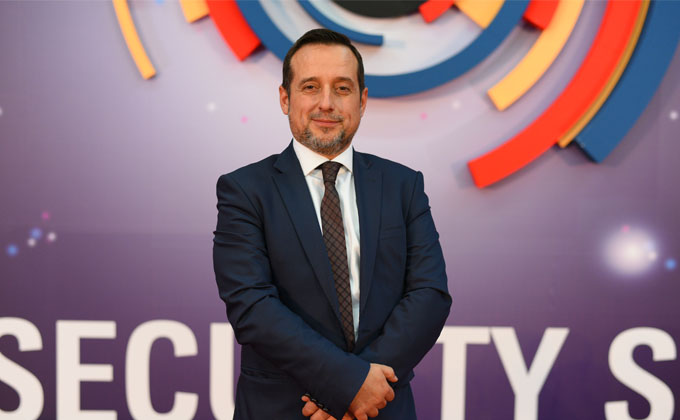
Mahir Hodžić is a security expert with more than 20 years of experience across the public and private sectors. As the owner of Global Security, the publisher of the security trade magazine and online platform a&s Adria, as well as the international media platform a&s Middle East, he plays an active role in informing, educating, and connecting professionals throughout the security industry.
Hodžić chairs the Organizing Committee of the Adria Security Summit, Southeast Europe’s largest security industry event, as well as the Organizing Committee of the newly established Bulgarian Security Summit. Through the media, business, and conference platforms he leads, he has spent the past two decades following the sector’s development, connecting its key stakeholders, and helping bring important questions about the future of security to the forefront.
In this interview, he discusses the changes brought about by artificial intelligence, the practical application of AI solutions, the risks of automated decision-making, the importance of education, and the development of new skills. He also considers how prepared companies and institutions across the region are to use emerging technologies responsibly, as well as the role of the summits in Zagreb and Sofia in further connecting and advancing the regional security industry.
How would you describe the current state of the security industry, and which developments are having the greatest impact on how companies and institutions manage security today?
Hodžić: The security industry is extremely dynamic and evolving virtually every day. Technologies continue to advance, security threats are changing, user expectations are growing, and new regulatory requirements are being introduced. As a result, everyone working in the sector must be prepared to learn continuously, keep pace with emerging trends, and improve their processes. Case studies and the exchange of experience gained through real-world projects are particularly valuable, as they show us what truly works in practice and what needs to change.
The convergence of physical and cybersecurity is particularly evident. It is no longer sufficient to protect facilities, networks, and data separately; risks must be managed through an integrated approach. Cybersecurity has become a key priority for institutions and companies because it is directly linked to business continuity, reputation, user trust, and the effective operation of critical processes.
AI is becoming increasingly integrated into security systems. Where do you see its greatest practical value today?
Hodžić: I see AI’s greatest practical value in its ability to rapidly transform vast amounts of data into actionable insights and alerts. In video surveillance, AI can identify unusual behavior, reduce false alarms, and support the early detection of incidents. In cybersecurity, it accelerates the detection of phishing, intrusion attempts, and anomalies in user behavior.
The automation of routine analysis is particularly important because it gives security professionals more time to assess risks and make informed decisions. AI should therefore not replace people, but enable them to respond faster and with greater precision.
Its greatest value lies not only in more advanced technology, but also in enabling a shift from reacting after an incident has occurred to proactively identifying and preventing threats.
Alongside the opportunities it creates, AI also raises certain concerns. What are the greatest risks associated with its use in the security sector, and how can responsible governance, transparency, and human oversight of automated decisions be ensured?
Hodžić: The greatest risks include inaccurate or biased assessments, insufficient transparency regarding how a system reached its conclusion, threats to privacy, and the potential manipulation of both the data and the AI model itself. In the security sector, a single misidentification or uncritical reliance on an automated recommendation can have serious consequences.
AI should therefore be used as a support tool, not as a substitute for responsible human decision-making. Organizations must clearly define where AI is used, what data it operates on, and who is accountable for the outcome. Regular testing, decision logs, independent audits, data protection measures, and mechanisms that allow an authorized individual to stop or override an automated decision are all essential. Particularly when decisions affect people’s rights, safety, or privacy, humans must retain the final say.
How prepared are companies and institutions in the region to use AI as a tool for improving business and security processes, rather than simply viewing it as another technology to purchase?
Hodžić: Readiness varies considerably. Some companies in the region are already using AI successfully for data analysis, video surveillance, automation, and cybersecurity. However, a significant number of organizations still approach it primarily as a technology to be purchased. Legacy systems, fragmented data, and slower procurement and approval processes pose particular challenges for institutions. As a result, the introduction of AI solutions must be gradual and carefully planned.
AI cannot fix a poorly defined process; it can only repeat its flaws more quickly. The first step is therefore to identify a specific business or security problem, ensure access to high-quality data, assign clear responsibilities, and set measurable objectives. AI should then be tested within a limited process, with the results carefully monitored before its use is expanded.
The organizations best prepared to harness AI will be those that invest simultaneously in technology, employee training, and responsible change management.
What role do education and the development of new skills play in this process? Can AI accelerate professional training while also helping the industry address the shortage of qualified personnel?
Hodžić: Education is essential because technology is now evolving faster than formal education programs can keep pace with. One-time training is no longer sufficient for professionals; continuous development through hands-on training, incident simulations, case studies, and the exchange of experience is essential.
AI can significantly accelerate this process. It can tailor training to an individual’s level of knowledge, create realistic scenarios, support incident analysis, and make technical documentation more accessible. At the same time, by automating routine tasks, it allows experienced professionals to focus on more complex assessments and mentoring younger colleagues.
However, AI will not solve the workforce shortage on its own. It can help alleviate the problem and increase productivity, but it cannot replace human experience, critical thinking, and accountability.
The Adria Security Summit is coming to Zagreb this year, while Sofia will host the inaugural Bulgarian Security Summit. What will these two events bring to the regional security industry, and what role can they play in strengthening its connections and supporting its continued development?
Hodžić: For years, the Adria Security Summit has served as the central gathering place for Southeast Europe’s security industry. By bringing the event to Zagreb, we are continuing its regional mission and bringing together manufacturers, system integrators, distributors, institutions, end users, and professionals from different countries. As one of the region’s most important business and transportation hubs, Zagreb provides an excellent opportunity to connect European Union markets with the countries of Southeast Europe.
The Bulgarian Security Summit represents the next step in the development of this regional ecosystem. Bulgaria has a well-developed market, highly capable specialist companies, and a strategically important geographical position. However, it has lacked a specialized international platform connecting all segments of the security industry. Together with our partner, the National Association of Industrial Security Companies (NAFTSO), we aim to give Bulgarian companies greater international visibility while making it easier for global and regional manufacturers to enter the Bulgarian market.
The value of these two events extends beyond showcasing new products. Their more important role lies in facilitating knowledge exchange, sharing experiences from real-world projects, and fostering dialogue. Through the conference program and B2B meetings, participants can discover new solutions, find business partners, and engage directly with decision-makers—all in one place.
Today’s security threats do not stop at national borders, and the industry’s response cannot remain confined to individual markets. Our goal is for both Summits to be places where participants do more than discuss trends—where they exchange practical experience, forge partnerships, and develop projects that can enhance security across the entire region.
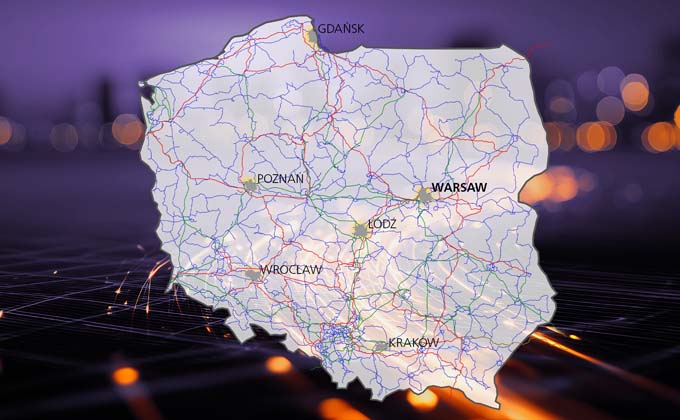
In December 2025, coordinated cyber attacks hit over 30 renewable energy facilities and a major CHP plant in Poland. The attackers disabled RTU controllers, wiped IT systems, and disrupted remote control between wind farms and grid operators.
Their toolbox? Default credentials. Exposed VPN interfaces without MFA. Standard management protocols like HTTP, FTP, and SSH – used against devices that still had factory-set passwords.
In OT networks, where communication patterns are stable and tightly coupled to operational roles, this kind of activity is inherently noisy. Unauthorized HTTPS sessions to RTU web interfaces, SSH connections to controllers from unexpected sources, port scans, SOCKS tunnelling – all of these produce clear network-visible signals.
We mapped the CERT.pl-documented attack chain to concrete OT IDS detection points and examined where and how an intrusion detection system like OMICRON StationGuard could have alerted operators, in many cases well before the destructive phase began.