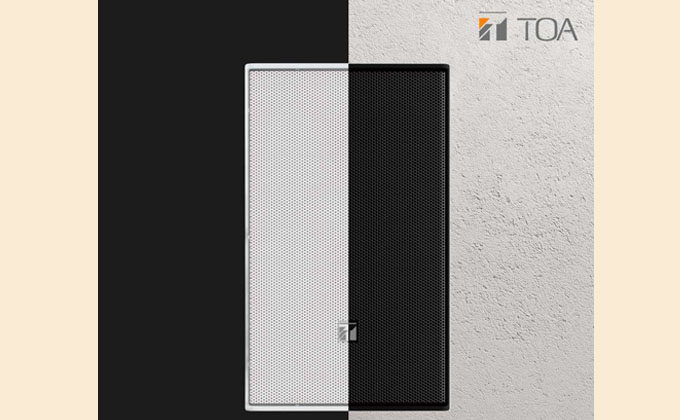
TOA Electronics Europe has introduced the F-BOX Series of speakers, designed to combine high-quality acoustic performance, easy installation and a design that blends naturally into a wide range of spaces. The speakers can be mounted on walls or ceilings, while the accompanying brackets follow the same design concept to maintain a consistent appearance throughout the installation. The series is available in different sizes and in black or white, making it easier to integrate into various architectural and interior environments.
F-BOX speakers are designed to deliver clear and balanced sound for both speech and music. TOA emphasizes that particular attention was paid during development to ensuring that the audio equipment does not dominate the space but instead integrates harmoniously into its surroundings. This approach combines acoustic performance and aesthetics with flexible installation options suitable for different types of facilities.
More information about the F-BOX Series is available from the manufacturer.
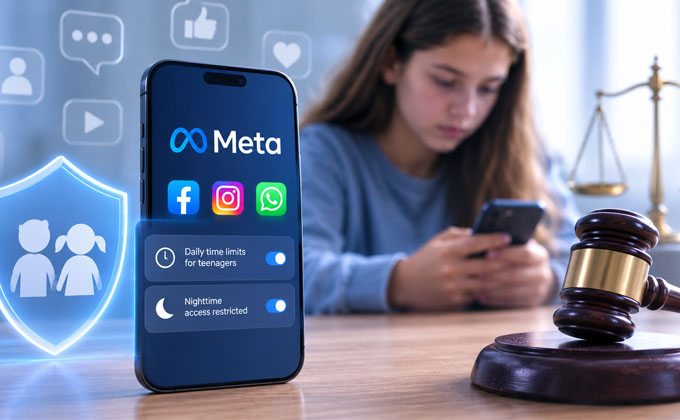
Years of legal pressure on Meta over the impact of its social media platforms on children have resulted in a settlement that could cost the company up to $18 billion. According to the BBC, the agreement was reached with all US states and territories that had launched legal proceedings against the company, alleging that its platforms were designed to encourage prolonged use among young people. The lawsuits also linked social media use to depression, anxiety, body image issues and other negative effects on young people’s mental health, claims that Meta has denied.
The settlement, however, goes beyond financial obligations, as Meta will be required to introduce default daily usage limits for teenagers and restrict access to its platforms during nighttime hours. Some of the proceedings also focused on the handling of minors’ data, with 29 states alleging that the company had unlawfully collected and used children’s personal information. Legal pressure on the industry extends far beyond this case, with thousands of individuals and more than a thousand US school districts filing lawsuits against major social media companies over their platforms’ alleged impact on young users.
Other platforms, including TikTok, YouTube and Snapchat, are facing similar legal action, while US lawmakers are also considering stricter rules to protect minors online.
The Meta settlement could therefore set an important precedent for how technology platforms approach their youngest users, but one question remains: will the financial consequences and new obligations finally lead to meaningful changes in the way social media platforms are designed for children and teenagers?
Rohde & Schwarz is a global technology group dedicated to enabling a safer and connected world. With more than 90 years of innovation and expertise in communications, cybersecurity and critical infrastructure solutions, the company supports governments, enterprises and public institutions in achieving technological and digital sovereignty. Operating in around 70 countries worldwide, Rohde & Schwarz develops trusted technologies that combine security, reliability and long-term value.
At this year’s Summit, Rohde & Schwarz will showcase solutions that address some of the most important challenges facing modern organizations: secure communication, protection of sensitive information and resilient network infrastructure.
A key focus will be QPS/QPW (Body Scanners) solutions, designed to support the protection of critical environments and public spaces. As security requirements continue to evolve, organizations require technologies that enable efficient screening processes while maintaining a smooth user experience and operational effectiveness. Rohde & Schwarz solutions help customers strengthen security without compromising efficiency.
Another highlight will be LANCOM Systems, the networking and cybersecurity specialist within the Rohde & Schwarz Group. LANCOM delivers secure European networking solutions including enterprise Wi-Fi, switching, SD-WAN and cloud-managed network infrastructure. Organizations increasingly seek reliable alternatives that combine high performance, security and compliance requirements. LANCOM helps customers build scalable and future-proof networks while supporting digital sovereignty and cybersecurity resilience.
Visitors will also have the opportunity to learn more about Apple Indigo, Rohde & Schwarz’s secure mobile working solution designed for organizations with the highest security requirements. Apple Indigo enables protected communication and collaboration on Apple mobile devices through trusted device management, secure VPN connectivity, strong encryption and centralized administration. The solution supports secure handling of sensitive information while providing users with the flexibility and productivity of a modern mobile work environment. Together with Rohde & Schwarz cybersecurity technologies, Apple Indigo helps organizations achieve secure mobile communication without compromising usability.
As cyber threats continue to grow and digital transformation accelerates, organizations need trusted partners who understand both networking and security. Rohde & Schwarz combines decades of expertise in communications, cybersecurity and critical infrastructure protection to deliver integrated solutions that help customers operate securely and confidently in an increasingly connected world.
We invite visitors to meet our experts at the Summit and explore how Rohde & Schwarz, together with LANCOM Systems, Apple Indigo and QPS/Walk (Body Scanners), can support secure digital transformation, resilient communications and future-ready infrastructure.
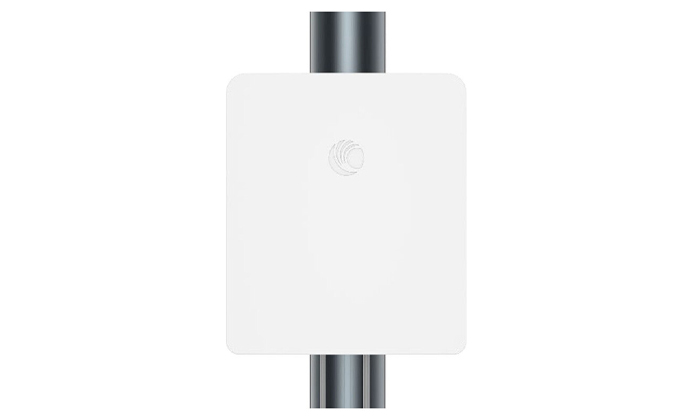
The new ePMP 4518 from Cambium Networks is a compact 5 GHz Subscriber Module (SM) designed to provide stable, high-speed wireless connectivity in demanding outdoor environments. The device features an integrated 18 dBi antenna and supports throughput of up to 1 Gbps thanks to 802.11ax, OFDMA, and 2×2 MU-MIMO technologies. It is designed for low-latency PMP and PTP links, while multi-level QoS enables more efficient management of network traffic. Centralized management is provided through the cnMaestro platform, simplifying network infrastructure monitoring and administration.
Its rugged IP67-rated enclosure is designed for demanding outdoor conditions, while PoE power further simplifies installation. The combination of compact dimensions, an integrated antenna, and gigabit performance makes the ePMP 4518 suitable for locations where reliable connectivity and straightforward deployment are essential. The solution is particularly suited to WISPs and other operators requiring stable broadband connectivity in outdoor environments. The ePMP 4518 is available through the AikomGo B2B platform.
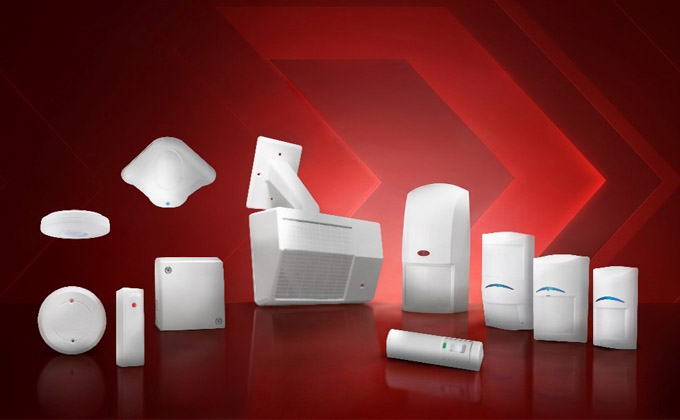
Radionix proudly represents Bosch intrusion alarm solutions worldwide, delivering advanced intrusion systems and reliable motion detectors. Radionix, a part of KEENFINITY Group, builds on trusted technology to deliver mission control for your security. Security that’s more than a system. It’s a mission that never rests.
At this year’s Summit, visitors can discover why Bosch intrusion solutions continue to set industry benchmarks for detection accuracy and reliability. Our renowned motion detectors have earned a global reputation for patented innovation and award-winning performance, delivering best-in-class catch performance while virtually eliminating false alarms. In addition, our motion detectors are designed with unique features that simplify installation and reduce errors that can lead to false alarms or missed detection, reducing installation and maintenance costs.
It doesn’t stop there, we continue to invest not only in new solutions, but also in our existing portfolio, to keep up with current requirements and challenges. Our latest Blue Line Series and Commercial Series motion detectors have been designed for today’s increasingly connected environments. These detectors offer enhanced radio frequency interference (RFI) immunity up to 6 GHz, making them resistant to interference from devices such as Wi‑Fi routers and other wireless technologies. This ensures stable, reliable operation even in increasingly connected environments. At the summit we will show our entire intrusion detectors portfolio, including panoramic ceiling detectors, glass break, shock and seismic and Request-to-Exit detectors.
Next to that, you will be able to get a preview of the new Solution Series intrusion system to be launched in 2027. Designed to deliver a complete, reliable intrusion system that combines protection, control, and connectivity in a single platform. Built around simplicity and everyday usability, the system provides an intuitive user experience while advanced connectivity technologies work seamlessly in the background.
Visit Radionix at the summit, meet with our experts to learn more about our trusted motion detection technologies, and be among the first to discover the new Solution Series intrusion system.
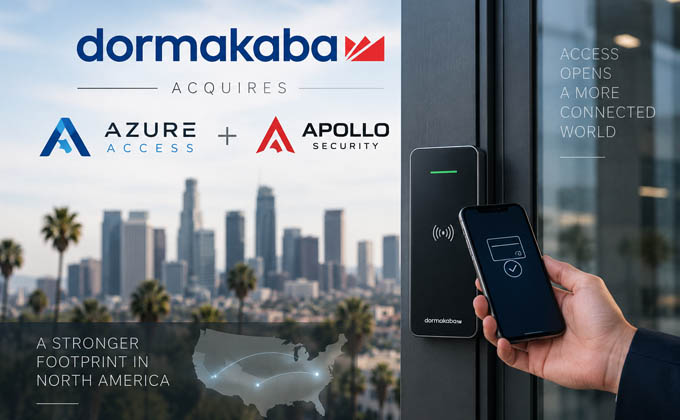
A new acquisition in the US access control market brings Azure Access Technology and Apollo Security under dormakaba, as the group continues its expansion in North America. According to an analysis by Memoori, this is dormakaba’s 12th acquisition in the past 18 months and the first to significantly change its approach to selling access control solutions in the US. The move forms part of a broader strategy to increase the company’s North American revenue to CHF 1 billion by fiscal year 2027/28.
Founded in 2019 in Newport Beach, California, Azure Access develops electronic access control hardware for the US commercial market. Its open-architecture controller platform enables original equipment manufacturers (OEMs) and software providers to flexibly integrate and customize their solutions. Apollo Security, which operates under ADME Inc. and is also based in Newport Beach, was founded in 2008 and manufactures access control and integrated security systems. Together, the two companies employ around 30 people and serve access control companies worldwide.
Although relatively small in scale, Memoori believes the acquisitions carry greater strategic significance by giving dormakaba more direct access to the US access control ecosystem and creating additional opportunities for growth. The deal therefore fits into the company’s accelerated M&A strategy in North America, where it still needs to close a revenue gap of approximately CHF 278 million to reach its CHF 1 billion target.
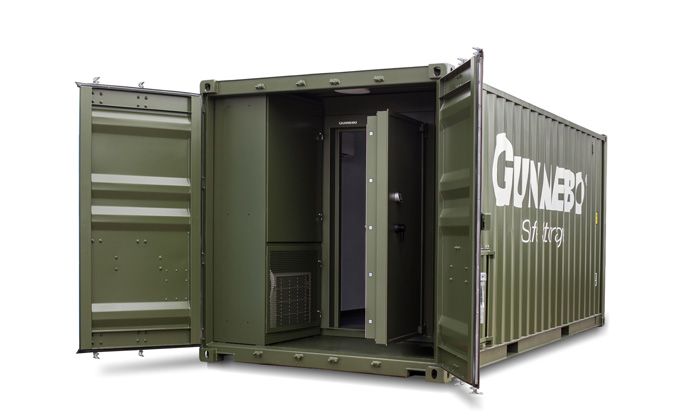
Gunnebo Safe Storage is returning to Security Essen to showcase how secure storage, connected locking technologies and cyber resilience are converging to shape the future of physical security. On stand 3A65 in Hall 3 within the Euro Defence Expo, visitors can explore TransitGuard, Gunnebo Safe Storage’s mobile vault solution, developed to provide secure protection for cash, valuables and other high-value assets while in transit or in mission.
As organisations continue to review how assets are secured throughout the supply chain, the movement of valuables between locations remains a critical area of focus. Gunnebo Safe Storage will also showcase its Gunnebo Encry high security electronic locks, highlighting how electronic locking technologies are supporting greater control, auditability and flexibility across a wide range of security applications.
“One of the most significant shifts we’re seeing is the link between physical security and cybersecurity,” said Viktoria Lövberg, Director Strategic Key Distributors and Defence, Gunnebo Safe Storage Europe. “Customers are no longer evaluating these areas separately but looking for solutions to protect assets and support the resilience of the wider connected systems. Security Essen provides an excellent opportunity to discuss these challenges and share knowledge with customers, partners and industry professionals.”
A key focus at Security Essen will be the European Cyber Resilience Act (CRA) and its implications for connected security products. Olof Sandberg of Tecnosicurezza will explain how dedicated locking systems have been developed to support the CRA framework through secure system architecture, controlled access management and lifecycle security considerations.
Stephan Seifert of Gunnebo Safe Storage will focus on technical developments in safe storage design. His session, “Minimising Risk: Combining Core Drill Protection and Integrated Alarm in One – Safes and Strong Rooms with Planar Protection,” will outline the implementation of planar protection systems designed to integrate resistance to core drilling attacks with embedded alarm functionality.
“We want visitors to leave Security Essen and our stand with a clearer understanding of how physical security, connectivity and compliance requirements are becoming increasingly interconnected,” added Viktoria. “Our objective is to share expertise and help organisations assess the security, operational and compliance considerations that will shape future security strategies and investment decisions.”
The global generative AI cybersecurity market is projected to grow from $10.8 billion in 2026 to $56.8 billion by 2033, representing a compound annual growth rate (CAGR) of 26.8%, according to Grand View Research. Market growth is being driven primarily by the expanding adoption of large language models (LLMs), AI copilots, and autonomous AI agents, increasing the need to protect AI models, data, and prompts while strengthening security risk management. Threats such as prompt injection, model poisoning, data leakage, and other attacks targeting AI systems are raising particular concerns, while evolving regulatory requirements are further encouraging investment in specialized security platforms.
Solutions accounted for 71.5% of the market in 2025, while data security and privacy represented the largest security-type segment with a 23.3% share. Cloud deployment also dominated with a 66.5% market share, reflecting the rapid adoption of cloud-based GenAI platforms, LLMs, and AI-as-a-Service offerings. The BFSI sector, encompassing banking, financial services, and insurance, held the largest share among end users as generative AI is increasingly deployed for customer service, fraud detection, risk assessment, and financial analysis.
North America led the market with a 40.9% revenue share in 2025, while Asia Pacific is expected to record the fastest growth through 2033. Europe is also experiencing strong growth, supported by wider generative AI adoption, stringent data protection regulations, and an increasing focus on secure and responsible AI deployment.
Key companies identified by Grand View Research in this market include Acronis, Check Point Software Technologies, Cisco Systems, CrowdStrike, Fortinet, Google, IBM, Microsoft, NVIDIA, Palo Alto Networks, Proofpoint, SentinelOne, Sophos and Trend Micro.
Modern security systems, LANs, IP surveillance, and industrial infrastructure are getting increasingly vulnerable to the effects of surges caused by lightning strikes, power grid interference, and potential differences. This is due to the miniaturization of electronic components; even a short surge can lead to device damage, system downtime, and costly repairs.
EWIMAR has specialized in the design and manufacture of surge arresters for CCTV, LAN, and industrial automation systems for 15 years. Our solutions are designed for installers and end users who expect not only high protection effectiveness but, above all, system stability.
Our products are designed to meet the PN-EN 61643-21 standard, allowing them to be used in LPZ 0/LPZ 1 zones and higher – those are defined by the EN-62305 standard.
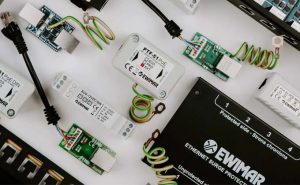
Our product range includes surge arresters for CCTV (VSS) systems. It has been divided into three product series: ECO, PRO, and EXT, which allow for the optimal selection of protection levels for specific installations. The ECO series is designed for indoor applications with a lower risk level. The PRO series is a solution for professional outdoor installations requiring a higher level of surge immunity. It features two levels of surge suppression, along with protection against surges on PoE pairs, in any power supply standard. The protection level is 2.5kA (8/20 μs) per conductor. The EXT series, in addition to the components used in the PRO series, features an additional level of protection in the form of ultra-fast MOSFET fuses with automatic reset. The MOSFET fuse reduces surge voltage levels and extends the life of the surge arrester. The protection level is 2.5kA (8/20 μs) per conductor.
The core of our offer is single-channel protection in various housing variants. Depending on the intended use, they are available for mounting in camera boxes, on DIN rails, and in hermetic enclosures. To achieve full protection, the other side of the signal line must also be protected. For this purpose, we have designed 4-channel modules, which, together with a 1U housing for a 19″ rack, create an integrated multi-channel panel. This approach allows for flexible and optimal selection of the protection level to suit the installation’s needs.
Thanks to our solutions, installers can build a security system precisely according to the project’s needs – from single security elements to complex multi-port systems. Modules can be easily replaced, expanded, and serviced without having to disrupt the entire installation.
Solutions dedicated to various communication buses are also very popular in our product lineup. In addition to surge protectors for the RS-485 bus, customers are also gladly choosing PTZ protocol converters. These products enable the integration of legacy CCTV systems with modern devices.
See you at the Adria Security Summit at booth 139!
The Croatian Personal Data Protection Agency (AZOP) has launched an ex officio investigation into the Croatian Pension Insurance Institute (HZMO) following reports of a possible cyberattack and the public disclosure of Croatian citizens’ personal data, according to ICTbusiness. The investigation was initiated after a group calling itself INF Group claimed to have obtained a database containing 105,000 records allegedly originating from HZMO systems. According to the attackers’ claims, the exposed information includes names, personal identification numbers (OIBs), phone numbers and email addresses.
However, the authenticity of the published database and its connection to HZMO’s information systems have not yet been officially confirmed, and the origin of the data can only be established through technical and forensic analysis. Following the initial reports, HZMO stated that it had no information confirming a security breach, while AZOP has so far not received a personal data breach notification from the Institute or any other authority. The investigation will seek to determine whether unauthorized access actually occurred, when HZMO may have become aware of the incident and whether its reporting obligations under the General Data Protection Regulation (GDPR) were triggered.
Under Article 33 of the GDPR, a data controller must notify the supervisory authority of a personal data breach within 72 hours of becoming aware of it, unless the breach is unlikely to pose a risk to individuals’ rights and freedoms.
If the reported data compromise is confirmed, the combination of exposed information could increase the risk of targeted phishing, vishing, identity theft and other forms of social engineering. If the breach is assessed as posing a high risk to affected individuals, the GDPR also requires them to be informed directly, subject to certain exceptions. Final conclusions regarding the potential data breach and any possible responsibility of HZMO will only be possible once the investigation and analysis of the collected information have been completed.