Home Articles posted by a&s Adria (Page 34)

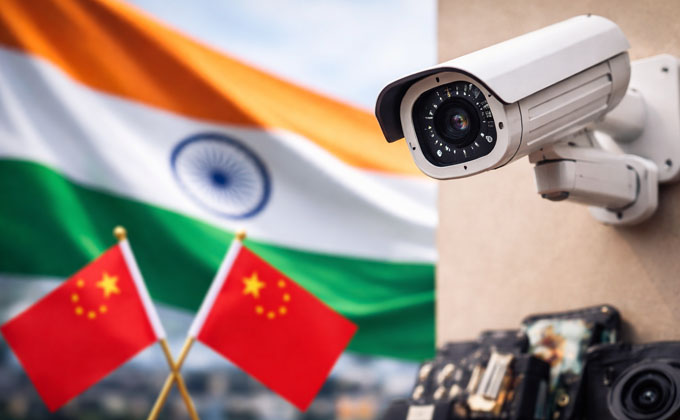
New Rules in India Effectively Push Chinese CCTV Manufacturers Out of the Market

At the beginning of April, India introduced a strict state certification regime for CCTV equipment, effectively closing the market to most Chinese video surveillance manufacturers. Instead of a direct ban, authorities implemented mandatory STQC certification as a condition for sales, without approving devices that fail to meet stringent security criteria. The new rules, which came into force on April 1, 2026, after a two-year transition period, require all CCTV systems to comply with the so-called Essential Requirements (ER) standards in the field of cybersecurity.

In practice, this means that manufacturers must prove the security of their devices through vulnerability testing, encrypted communications, and transparent sourcing of key components such as chipsets. However, the key shift lies in the fact that Indian authorities are not issuing certifications for equipment that relies on Chinese components or technologies that do not meet defined security requirements, effectively eliminating companies such as Hikvision and Dahua from the IP camera market. This regulatory move has already caused significant disruption, as Chinese brands previously held a notable market share, while domestic manufacturers are now taking a dominant position. At the same time, global vendors outside China continue to maintain a presence in the premium segment, while supply chains are rapidly shifting toward “new sources.”

Experts warn that the short term may bring price increases and supply disruptions, but that the market is likely to become more stable and secure in the long run. The decision comes amid growing concerns over cybersecurity and the risk of unauthorized access to data collected through surveillance systems. The Indian model demonstrates how regulatory mechanisms, rather than outright bans, can be used to reshape markets and technological standards. In this context, the move is not just a local measure, but a signal to the global market that video surveillance is increasingly becoming a matter of digital sovereignty and data control.

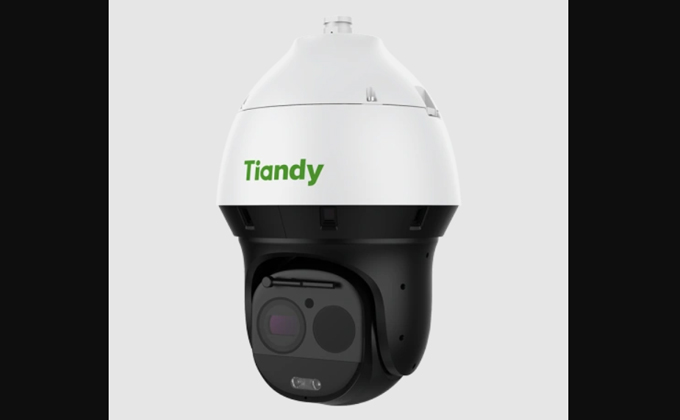
A New Standard in Video Surveillance: Tiandy Introduces a Camera with a 2-Kilometer Range

Tiandy has unveiled its new TC-H3169M 63X Polar Day PTZ camera, pushing the boundaries of video surveillance and opening a new dimension in long-range monitoring. While the range of conventional cameras is typically measured in tens or hundreds of meters, Tiandy claims its latest solution can detect objects at distances of up to two kilometers.

The camera features dual 1/1.8” sensors, combining a 16MP panoramic view with an additional 4MP channel for detailed imaging. Thanks to its 63× optical zoom and a focal length of up to 359 mm, the device can simultaneously monitor wide areas and zoom in on precise details, including identifying individuals at long distances.

According to the manufacturer, the camera can detect human movement at distances of up to two kilometers, while facial recognition is possible at several hundred meters, representing a significant leap compared to standard video surveillance systems. These capabilities are particularly relevant for securing critical infrastructure, borders, industrial sites, and large open areas.

A key factor behind its performance is Polar Day technology, which, combined with advanced illumination, ensures clear imaging even in low-light and nighttime conditions. This enables continuous monitoring regardless of lighting conditions, addressing one of the main challenges of long-range surveillance.

With this solution, Tiandy is clearly targeting the advanced security systems market, where integrated solutions that combine detection, analytics, and proactive response are increasingly in demand. The TC-H3169M is therefore not just another addition to the company’s portfolio, but a potential new benchmark for long-range video surveillance.

XPR Group Announces Participation at The Security Event 2026 with Xpro Solutions Showcase

XPR Group has announced its participation at The Security Event 2026, taking place from April 28 to 30 at the NEC Birmingham. During the event, the company will showcase its latest access control solutions, with a strong focus on flexibility and adaptability to modern security requirements. At the center of the presentation will be the Xpro product range, a universal and scalable platform covering a wide spectrum of devices, from RFID readers to advanced triple-technology solutions combining keypads, RFID, and QR code readers. These solutions are designed for diverse applications, enabling seamless integration into existing systems while supporting future upgrades.

According to the company, Xpro solutions offer a high level of security and compatibility, making them suitable for both small-scale installations and complex projects. Particular emphasis is placed on scalability, allowing systems to expand over time without requiring a complete infrastructure replacement.

In addition to the Xpro range, visitors will also be able to explore other new products, including a mobile ID solution that further enhances access control capabilities. Live demonstrations will be held at the stand to showcase real-world applications of the technology. XPR Group invites all interested professionals to visit them at stand 5/K95, where they can meet the team and discover the latest innovations in security and access control.

ECCOS Implements Advanced Parking System at Žnjan Plateau in Split

The redevelopment of the Žnjan Plateau in Split has delivered a higher-quality public space while also showcasing a modern and efficiently organized parking system. Spanning approximately 150,000 square meters, the area has been transformed into a multifunctional zone with sports, recreational, and hospitality facilities, requiring adequate parking infrastructure. The project provides a total of 1,000 parking spaces, with half located in an underground garage and the rest on open parking areas. The parking solution was implemented by ECCOS, which integrated multiple technologies for traffic management and space optimization.

LPR cameras for license plate recognition have been installed at ten entry and exit points, enabling faster vehicle flow through the system. In addition, more than 60 LED displays provide real-time information on available spaces and guide drivers accordingly.

System efficiency is further enhanced by sensors installed above each parking space, using color indicators to display occupancy status and space type. User safety is supported by a video surveillance system with over 85 IP cameras, while parking payment is handled through automated machines supporting both cash and card transactions. Integration of solutions from Skidata enables centralized management of access control, payment, and occupancy monitoring.

The entire system is further connected to the ESCEP platform, contributing to the digitalization of city services and the development of smart city concepts. This approach enables more efficient infrastructure management while providing a faster and more user-friendly parking experience. The Žnjan Plateau thus stands as an example of an integrated and functional parking solution in modern urban environments.

Visitor Registration Opens for Bulgarian Security Summit 2026

Visitor registration is now open for the Bulgarian Security Summit 2026, scheduled to take place on October 28–29, 2026, at the Inter Expo Center in Sofia. The summit is part of broader regional networking initiatives and projects supported by a&s Adria magazine, aimed at strengthening collaboration and knowledge exchange within the security industry across Southeast Europe.

The event will bring together manufacturers, system integrators, distributors, consultants, institutional representatives, and end users from the region and beyond, providing a platform for sharing expertise and showcasing the latest technological solutions. The focus will be on current challenges and trends in the security sector, with particular emphasis on integrated solutions and regional cooperation.

Participation is free of charge for qualified security industry professionals, while the number of available places is limited. Interested attendees are encouraged to register early and plan their visit, given the expected interest and the event’s importance for the regional market.

Link for registration: https://bulgariansecuritysummit.com/

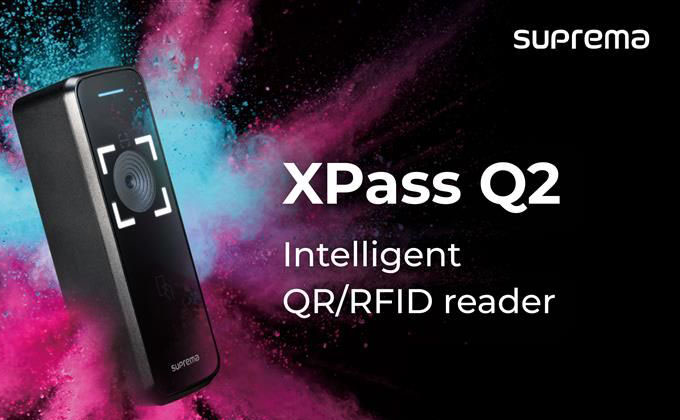
Suprema Launches XPass Q2: A Unified Reader for QR, Mobile, and RFID Access in High-Traffic Environments

Suprema has introduced its new XPass Q2 access control reader, designed for facilities with high user flow and increasingly diverse identification methods. The device arrives at a time when access is no longer tied to a single credential, but instead combines RFID cards, mobile identities, and QR and barcode technologies, which are increasingly used for visitors and temporary users. Traditional readers, primarily built around RFID, struggle to meet these demands, especially when QR functionality has been added later, often resulting in slower performance and additional hardware.

XPass Q2 brings all major non-biometric credentials into a single device, enabling the reading of QR codes, barcodes, RFID cards, and mobile credentials via BLE and NFC. This eliminates the need for separate readers and external scanners, simplifying installation and reducing maintenance costs while ensuring a consistent user experience regardless of credential type.

A strong focus has been placed on speed and reliability in high-traffic environments. The device reads QR and barcode credentials in fractions of a second, even in low-light conditions, thanks to its integrated camera module with an operating range of 5 to 15 centimeters.

Its IP65-rated enclosure ensures reliable performance in both indoor and outdoor settings, while LED indicators and audio feedback help maintain a smooth flow of users by reducing hesitation at entry points. The solution integrates natively with the BioStar X platform, enabling centralized management of access for visitors, members, and employees. Through its open API, it can also connect with third-party visitor management and ticketing systems, supporting complete workflows from credential issuance to real-time access logs.

With its slim form factor and modern design, XPass Q2 blends seamlessly into a wide range of environments, from office buildings to sports and event venues. From Suprema’s perspective, the device represents a response to increasingly complex access control requirements, offering a unified solution that combines multiple technologies while simplifying everyday access management.

Vivotek: Think Alert: Stop Threats Before They Escalate

Most environments are already covered by cameras. The real challenge in modern AI video surveillance is response time. Many incidents are not missed because they are invisible, but because they are noticed too late. Policy violations, unsafe behavior, or suspicious actions often unfold within seconds, and once they are discovered through review or manual checks, the opportunity to intervene has already passed.

Traditional AI alerts help reduce this gap, but only when scenarios fit predefined detection types. In real operations, risks are often more contextual. Policies vary by space, rules change over time, and many behaviors that matter cannot be easily expressed through fixed alert categories. This is where Think Alert becomes valuable.

What Think Alert is and how it fits into existing workflows

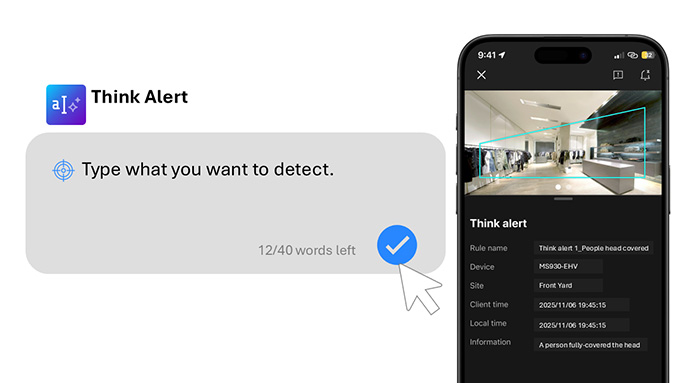
Think Alert is a generative AI–powered alert capability within VORTEX that allows users to describe what action or situation they want to detect using natural language. Built on visual language model (VLM) technology, it enables more flexible real-time video alerts while still defining where detection applies through familiar line or zone drawing—bringing this capability into the broader VORTEX AI video analytics platform.

To see why this matters in day-to-day operations, it helps to look at what Think Alert changes for teams in three practical ways.

  • Act immediately to mitigate losses: Theft, accidents, and unauthorized access cost money and endanger people. Think Alert detects these situations in real time, so teams can respond immediately—before damage occurs and before incidents escalate.
  • Set up in seconds, not hours: No manuals or training needed. After defining the detection area, simply use natural language to describe what you want to monitor and activate the alert in moments. No technical skills, no complex rule building, and no IT help required.
  • Your alerts, your rules: Every person and team has different needs. Think Alert lets each user customize monitoring based on what matters most to them, instead of being limited to fixed, predefined alert rules.

Think Search: Find What Happened, Faster

Before Think Alert, VORTEX introduced another VLM capability: Think Search. It uses visual language model technology to make investigation feel as simple as searching the web. Instead of scrubbing timelines or guessing which filters might work, users can type what they want to find in plain language, and the system surfaces relevant moments from recorded footage.

This matters because investigation is often where teams first discover patterns—recurring behaviors, repeat problem areas, or situations that consistently create risk. Think Search helps teams find those signals faster and with less effort.

Elevating VORTEX from “what happened” to “stop it next time”

Once teams identify what keeps happening, the next question is always the same: how do we stop it earlier? That’s where Think Alert takes what teams learned during investigation and turns it into real-time monitoring. Instead of repeatedly searching for the same incidents after they occur, teams can go directly to the location that matters, define the detection area, describe the behavior, and receive alerts the moment it happens again.

This is what elevates VORTEX into a more complete video intelligence workflow. It supports both sides of the job: understanding the past with faster investigation, and protecting the future with proactive, real-time alerts. By turning intent into immediate action, Think Alert helps organizations reduce risk, respond earlier, and stay ahead of incidents as they happen.

Hytera: The 450MHz Pivot: High-Impact Connectivity for the Adria Region’s Toughest Terrains

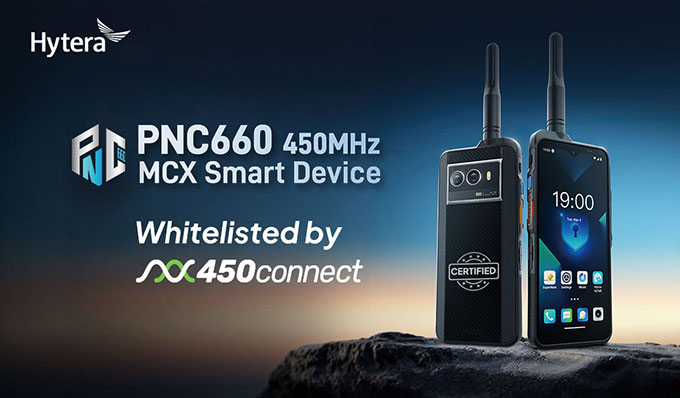
At the recent MWC26 in Barcelona, an announcement from Hytera regarding the “whitelist” certification of the PNC660 450MHz by 450Connect signaled a major shift in the future of public safety and utility communications across the Adriatic and Balkan regions.

As the region migrates from legacy narrowband technologies to LTE/5G, demand for devices that combine ruggedness with high-speed intelligence has reached a critical turning point.

The Strategic Shift in the Adria Region

The 450MHz frequency is increasingly recognized as the strategic backbone for national resilience. Across the Adria region, a clear trend is emerging:

  • Smart Grid Evolution: critical infrastructures are increasingly leveraging 450MHz for smart grid management, ensuring resilient energy distribution that remains independent of commercial networks.
  • Regulatory Alignment: Regulatory bodies across the region are phasing in updates to reallocate spectrum, prioritizing civil public safety and mission-critical broadband for state and utility applications.
  • Infrastructure Hardening: Governments are shifting from legacy CDMA to LTE to support the massive data requirements of modern smart metering and IoT deployments.

Addressing Regional Challenges, from Mountains to the Coast

The Adria region’s geography – spanning high mountain ranges to dense coastal archipelagos—demands a signal with maximum geographic reach. The PNC660 450MHz capitalizes on the 450MHz band’s superior propagation capabilities to maintain connectivity in challenging terrains where standard commercial LTE signals often falter.

Furthermore, for field teams working in deep basements or reinforced concrete substations, the 450MHz band’s penetrative power ensures stable communication links—making it an indispensable tool for modernizing aging infrastructure.

A Strategic Milestone

During MWC26, Sophia Yin, General Manager of Hytera Europe, highlighted the significance of this development:

“It is really exciting to receive these two pieces of good news at MWC26. Obtaining 450Connect whitelist certification and signing the distribution agreement with B.Schmitt simultaneously perfectly illustrates the proverb ‘good things come in pairs’, giving us a great start to 2026. We will expedite the promotion of the PNC660 450MHz in Europe and continue investing in R&D for 450MHz-related products, reinforcing our commitment to supporting critical infrastructure operators with reliable, secure, and robust communication solutions.”

More than Just a Device

For public safety and utilities sectors, the PNC660 450MHz’s value extends far beyond basic communication, it is a masterclass in Economic Efficiency and Operational Resilience. By leveraging the 450MHz band’s ability to cover vast territories with significantly fewer base stations, it offers a drastically lower Total Cost of Ownership for national safety networks compared to traditional high-frequency deployments.

This efficiency is most visible during the Adriatic’s peak tourist seasons. While public commercial networks become overwhelmed by extreme congestion, the PNC660 450MHz operates on dedicated private channels, ensuring first priority for emergency responders and utilities crews. It effectively bypasses the public network providing a clear dedicated line of command.

Ultimately, with its CC EAL5+ security chip and full MCPTT/MCVideo capabilities, the Hytera PNC660 450MHz is more than just a radio. It is the rugged, secure gateway to the next generation of Adriatic infrastructure, a critical tool for those who cannot afford to wait for a signal when every second counts.

Mercury AI: Digital Shield of the Future

The Mercury AI next-generation digital shield demonstrates how AI technology is redefining the security of our environment.

In a world changing faster than most ever imagined, the issue of security has ceased to be a question without an answer or something beyond our influence; it has become a part of our daily lives in an environment full of challenges. To properly address one of the most vital concerns for every individual—their safety and the safety of their loved ones—it is necessary to utilize the latest modern achievements. This includes not only traditional “hard security,” such as armed police and physical barriers, but also the “soft,” almost invisible hand of security that utilizes cameras, smart software, and Artificial Intelligence. At the center of this new technology, which helps us feel safer than ever before, is the company The Mercury AI, specialized in the latest digital advancements in the field of security with its “digital shield.”

Most people do not think about security until they have to. However, the environment in which we live and work is changing so rapidly that one must react quickly to new challenges, while the reality unfortunately remains that most security systems still operate under the old rule—react only after something has already happened. But if we already possess technology that can recognize a problem early, why should we wait for it to become an incident? That is why we created the digital shield—a weapon detection platform that uses artificial intelligence to identify potential threats before they turn into problems. Security should come through prevention, not reaction.

A Watchful Eye That Never Blinks

What exactly is the digital shield? The core of this system is not just in “recording the environment,” but in understanding what is happening in real-time. While the human factor is naturally subject to fatigue, loss of concentration, or a limited field of vision, The Mercury AI platform offers constant surveillance that knows no breaks and functions 24 hours a day, seven days a week.

The main advantage of this technology over existing ones is the specialized AI algorithm. Unlike ordinary security cameras that merely transmit an image, this system performs a constant analysis of every video frame. It establishes instantaneous visual contact with any form of weaponry—whether it be firearms or bladed weapons like knives.

But that is not all. What sets this system apart in the market is its incredible accuracy. Namely, the biggest problem with automated systems is “false alarms” that can cause panic and unnecessary costs. Our platform, however, makes a precise distinction in a fraction of a second between a dangerous object and harmless everyday items like phones, keys, or tools. This achieves a dual goal: maximum vigilance while eliminating unnecessary stress.

Silent Guard: Discretion as a Priority

As we have started to grow accustomed to relaxed and safe work environments, one of the greatest challenges in introducing high-security measures into public spaces is maintaining a pleasant atmosphere. No one wants to feel like they are in a high-security “prison” with an “all-seeing eye” at every turn in a shopping mall or school. Although citizens know that surveillance cameras are all around, it is natural that they do not want them to be intrusive. This is where silent and discreet monitoring comes into play.

The system functions almost invisibly, operating in the background of existing video infrastructure. It does not require bulky installations that would disturb the public or ruin the aesthetics of the space. While life goes on normally, the AI silently scans the surroundings 24/7. This continuous security support provides a level of protection that the human eye, no matter how well-trained, simply cannot maintain at every moment and on every square meter of a facility.

Automation That Saves Lives

The greatest advantage of such a system is, of course, in crisis situations, where every second is literally a matter of life and death. Statistics show that the highest number of casualties in incidents occurs during those crucial minutes spent waiting for emergency services to be called and for them to arrive on the scene. The digital shield solves this problem through automated rapid response.

The moment the algorithm detects a threat, the system does not wait for someone to press a button. It automatically triggers a series of predefined protocols:

Instant Notifications: Security teams and police receive an alarm with the exact location and visual evidence of the threat in real-time. Smart Locking: The system can automatically lock strategic doors to isolate the attacker, preventing movement through the facility. Lockdown Protocols: Procedures for evacuation or moving people to safety are automatically initiated.

This proactivity drastically shortens reaction time, leaving an attacker with minimal room to act while simultaneously providing life-saving seconds to those inside the building. The reaction time compared to traditional methods is dramatically reduced.

Versatility and Application

Due to the versatility and adaptability of this platform, its application is possible in almost any place where large numbers of people gather or where there is a need for property protection:

Educational Institutions and Public Places: Schools must be the safest places in the world. By implementing The Mercury AI detection in schools, malls, and stadiums, we raise the level of security to a standard generations before us could not have imagined. Transport Hubs: Airports, bus terminals, and railway stations are the “lifeblood” of every city, but also potential targets. The Mercury AI system enhances the security of key points without slowing down passenger flow. Critical Infrastructure: Administrative centers and energy facilities require a special level of protection. The Mercury AI detection ensures that vital state systems remain intact and safe from external threats. Business Sector: Workspaces are where we spend half our day. Protecting employees from potential threats is not just a legal obligation, but an ethical imperative for every modern employer.

The Future is Proactive

The time when we relied solely on luck or post-incident reaction is behind us. The future has arrived. The digital shield offered by The Mercury AI is not just a technological novelty—it is a necessary evolution in preserving human lives and property. Investing in such a system is an investment in the peace of mind of parents, the safety of workers, and the stability of the entire community.

We at The Mercury AI team leave nothing to chance. We do not gamble with security; we raise safety to the maximum level enabled by technology and provide an environment truly dedicated to preserving vital interests and values. That is why we work daily on implementing new solutions and keeping pace with the latest technologies—all so our clients can fully relax and not worry so much about security, knowing the digital shield is around them, protecting them.

Interview: Peter Mita, President, Euralarm

Translating policy into practice and bringing real-world industry insight back into the legislative process is Euralarm’s mission. Today, this role is more important than ever because regulation is becoming increasingly complex and interconnected, particularly with the convergence of digital, cyber and physical security. Our strongest impact in recent years has been in helping shape EU legislation

By: Damir Muharemovic; E-mail: editorial@asadria.com

a&s Adria: Can you please present yourself to our readers, with an emphasys on your professional career and position at Euralarm?

Mita: I am Peter Mita, President of Euralarm, the European association representing the fire safety and security industry. My professional career has been dedicated to advancing safety technologies and fostering collaboration between industry stakeholders, policymakers, and standards bodies.

At Euralarm, I have the privilege of working with experts across Europe to ensure that our sector not only complies with regulation but actively shapes it. Our role is to bring technical expertise into policy discussions and ensure that legislation supports innovation while maintaining the highest levels of safety and security for citizens.

a&s Adria: Euralarm sits between policymakers, standards bodies and the industry. How do you define that role today, and where has the association had the strongest practical impact in recent years?

Mita: Euralarm acts as a bridge—translating policy into practice and bringing real-world industry insight back into the legislative process. Today, this role is more important than ever because regulation is becoming increasingly complex and interconnected, particularly with the convergence of digital, cyber and physical security. Our strongest impact in recent years has been in helping shape EU legislation such as the Cyber Resilience Act and contributing to standardisation efforts. We ensure that technical realities are understood, preventing unintended consequences that could compromise safety or innovation.

a&s Adria: The Cyber Resilience Act is now becoming a reality for manufacturers. What does it actually change for fire safety and security companies, especially those that may not traditionally see themselves as “cyber” businesses?

Mita: The Cyber Resilience Act fundamentally changes how our industry must think about products. Fire safety and security systems are no longer just physical devices—they are connected, digital systems. Even companies that did not consider themselves “cyber” businesses must now address cybersecurity throughout the entire lifecycle of their products, from design to maintenance. This means implementing secure development practices, vulnerability management, and long-term support strategies. Ultimately, it raises the baseline for trust in safety and security technologies.

Serious Consequences of Incorrect Device Classification

a&s Adria: Your organization has published guidance clarifying how products should be classified under the Cyber Resilience Act as default, Important, or Critical. Why does this classification matter so much, and what are the risks if companies misunderstand it?

Mita: Classification determines the level of obligations a manufacturer must meet. If a product is misclassified, companies may either underinvest in security—creating vulnerabilities—or overcomply, increasing costs unnecessarily. For safety-critical systems such as fire detection or access control, incorrect classification can have serious consequences, including increased exposure to cyber threats that could directly impact life safety systems. This is why Euralarm has provided a fact sheet —to ensure clarity and consistency across the industry. The fact sheet also outlines how future harmonised standards under development—such as EN 62443-4-x and other horizontal standards—may support manufacturers in demonstrating conformity and benefiting from presumption of conformity where applicable.

a&s Adria: The association has also raised concerns about the Data Act, particularly provisions that could create new security vulnerabilities. What was the core issue from the industry’s perspective, and what does it reveal about the tension between data access and system security?

Mita: The Data Act aims to improve data accessibility, which is a positive goal. However, from our perspective, some provisions risk weakening system security. Safety and security systems often rely on controlled data environments to maintain integrity. If access is not carefully managed, it could introduce vulnerabilities or enable malicious interference. This highlights a broader tension: enabling data sharing while preserving system resilience. Both are essential, but they must be balanced carefully.

a&s Adria: Another issue the association has addressed is the proposed Digital Networks Act and the shutdown of legacy communication networks. Why could this transition pose risks for fire safety and security systems, and what would a responsible migration strategy look like?

Mita: Many fire and security systems still rely on legacy communication networks that are being phased out. If this transition is not managed properly, critical systems could lose connectivity, compromising their effectiveness. A responsible migration strategy must include risk assessment, backward compatibility where necessary, and clear timelines. Most importantly, safety systems must remain operational at all times during the transition.

a&s Adria: Your recent position on the EU Battery Regulation highlights concerns specific to safety and security systems. Why does battery classification matter so much in this sector, and what could happen if the regulation is applied incorrectly to the installed base across Europe?

Mita: Batteries are essential for ensuring continuity of operation during power outages. If regulations are applied incorrectly, it could lead to unsuitable battery technologies being used or unnecessary replacement of existing systems. This could compromise reliability or impose significant costs without improving safety. The installed base across Europe must be treated carefully to avoid unintended disruptions.

a&s Adria: Critical infrastructure resilience has become a central theme in Euralarm’s recent communications. Why has this topic moved so high on the agenda, and how has the conversation evolved in recent years?

Mita: The risk landscape has changed dramatically. We now face hybrid threats that combine cyber, physical and geopolitical elements. Critical infrastructure—energy, transport, data—has become a target. As a result, resilience is no longer just about preventing incidents but ensuring systems can withstand and recover from them. This shift has elevated the topic to a strategic priority across Europe.

Protecting Critical Infrastructure Is Everyone’s Responsibility

a&s Adria: Guidance published by the association suggests that protecting vital installations is a shared societal responsibility rather than solely an operator’s task. What does that mean in practice for governments, infrastructure operators, system integrators and manufacturers?

Mita: Protecting critical infrastructure cannot be left to operators alone. Governments must provide clear regulatory frameworks and support enforcement. Operators must implement robust systems and processes. Manufacturers must design secure and reliable technologies. System integrators play a key role in ensuring that all components work together effectively. It is a collective effort.

a&s Adria: The association has also highlighted the growing importance of perimeter protection as hybrid threats increasingly combine physical, cyber and informational attack vectors. How should the industry rethink perimeter security in this environment?

Mita: Perimeter security must evolve from being purely physical to being integrated and intelligent. Threats today are multi-layered, combining physical intrusion with cyber manipulation and misinformation. We need systems that can detect, analyse and respond across these domains in real time. Integration and interoperability are key. Euralarm has taken the initiative to start a Perimeter Round Table, bringing together all stakeholders in this field. Together we will be working on more guidance and information in this important field.

a&s Adria: Data centers have emerged as another strategic focus in your recent work. Why should fire safety and physical security in data centers be treated as board level concerns rather than purely technical issues? Where do you see the biggest gaps between regulatory expectations, available technologies and what operators are actually implementing in practice?

Mita: Data centers are now critical infrastructure. Any disruption can have widespread economic and societal impact. Fire safety and security are not just technical issues—they are business continuity issues. The gap we often see is between what technology can provide and what is actually implemented. Greater awareness at board level is needed to close that gap. That is why our association has released several guidance documents and organized webinars focusing on fire safety and security for datacenters.

a&s Adria: The association welcomed the European Commission’s e commerce initiative aimed at tackling non compliant, low cost safety products sold through online platforms. How serious is this issue today, and what enforcement mechanisms does Europe realistically need?

Mita: It is a significant and growing problem. Low-cost, non-compliant products undermine safety, distort competition and erode trust in the market. Europe needs stronger enforcement mechanisms, including better market surveillance and accountability for online platforms.

a&s Adria: The Energy Performance of Buildings Directive is expected to drive a major renovation wave across Europe. You have warned that this process could introduce overlooked fire safety risks, including those linked to new insulation materials, EV charging infrastructure and battery storage. How significant are these risks, and what needs to change?

Mita: The renovation wave driven by energy efficiency goals is essential, but it brings new risks. Materials such as insulation, as well as technologies like EV charging and energy storage, introduce new fire dynamics. Fire safety must be integrated into renovation strategies from the outset—not treated as an afterthought.

a&s Adria: The association has also spoken about attracting young professionals and improving diversity in the sector. How serious is the talent gap today, and what must the industry do to remain capable of meeting increasingly complex regulatory and technological demands?

Mita: The talent gap is a real concern. Our industry is becoming more complex, requiring expertise in digital technologies, cybersecurity and system integration alongside traditional engineering skills. We must attract young professionals, promote diversity and clearly communicate the societal importance of our work. That is why Euralarm started the Euralarm Young Professional initiative – a community designed to engage, educate and empower the next generation of leaders in the fire safety and security industry.

a&s Adria: Finally, what will Euralarm work on in the upcoming period, what will be in the focus of your work?

Mita: Our focus will remain on supporting the implementation of key EU legislation, particularly in cybersecurity and digitalisation. We will continue to advocate for balanced regulation, promote best practices, and strengthen the role of safety and security in broader societal discussions such as sustainability and resilience. Above all, Euralarm will continue to position itself as a trusted voice—bringing expertise, clarity and leadership to a rapidly evolving landscape.