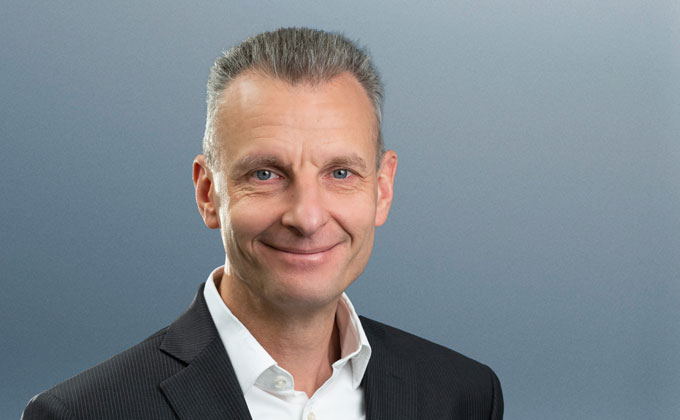
Interview: Jens Holzhammer, Managing Director EMEA, Panduit
The development of AI-focused data centers over the last few years has been a key factor in our success. Our work spans all elements necessary to keep a data center neat, organized, and fully connected. The rapid growth in bandwidth demands for AI has driven many fiber installations and the evolution of fiber connectivity. Currently, our main focus is on fiber and power solutions to meet these evolving needs.
By: Damir Muharemovic; E-mail: editorial@asadria.com
a&s Adria: Mr. Holzhammer, can you please present yourself for a start? How did you end up in a network company?
Holzhammer: I have been with Panduit in this role as the head of the EMEA commercial organization of Panduit for pretty much exactly a year now. So, still wet and green behind the ears, still learning the ropes of how the company operates and the markets we are operating in. I have a high-tech background, with experience as a regional sales or commercial leader, in a career that spans pretty much 30 years now. I started my career in electronic test and measurement, mainly centered around the wireless communication network, mobile, and satellite communication. Then moved on to another testing measurement company that was more centered around the wire line type of networks. Stayed in infrastructure or moved over to the infrastructure side then later on, still more on the wireless networks front, antennas, cables and so on. And then eventually, ended up in industrial automation communications. That was the journey before I joined Panduit and then ventured into communications infrastructure again, but more on the networking side of things.
a&s Adria: So, your current role—what does it actually involve?
Holzhammer: Well, my role is to lead the commercial organization, which covers everything from the front end to the back end, including marketing, sales operations, finance, and some other operational areas. I work closely with all other functions within EMEA. Since we’re an American company, we operate in a matrix setup, but of course there’s also interaction with manufacturing and logistics. Essentially, my job is to orchestrate the entire ecosystem to address the markets, satisfy our customers, attract new ones, and deliver the best possible products and solutions from our portfolio.
a&s Adria: Looking at the evolution of networking and industrial infrastructure, where is Panduit placing its emphasis today? Which sectors and technologies are currently driving the company’s growth?”
Holzhammer: Panduit has 70 years of history in mechanical and physical infrastructure equipment—equipment that helps install, protect, and maintain physical infrastructure on the electrical industrial side, as well as in data communications, whether in enterprise environments or data centers.
In recent years, data centers have been the main driver behind the company’s growth. You could say that in a data center environment, we handle everything except the active equipment: from cabinets to cable management, connectivity within the cabinets, and even cooperating with cooling companies to provide a full one-stop solution. The development of AI-focused data centers over the last few years has been a key factor in our success.
Our work spans all elements necessary to keep a data center neat, organized, and fully connected. The rapid growth in bandwidth demands for AI has driven many fiber installations and the evolution of fiber connectivity—8, 12, 16 fibers, and so on. Currently, our main focus is on fiber and power solutions to meet these evolving needs.
We’ve also seen tremendous expansion in industrial and, particularly, electrical environments, as electricity is becoming increasingly critical for a wide range of applications. You just have to look at the energy transition from fossil fuels to more sustainable, renewable energy systems. Many of these installations require robust solutions, and that has been another key driver, especially in Europe, where we lead in these applications, but also in the US.
There’s also a connection between data centers and the electrical side of the business, because power-hungry applications—servers, GPUs, and AI racks—consume massive amounts of energy. In some cases, a single rack can draw up to one megawatt of power, which requires significant upgrades on the gray space side. Here, Panduit provides innovative solutions to help data center providers and hyperscalers achieve quick, easy, and reliable installations.
So, to sum up, data centers and electrical applications are the two main drivers for us. We are also active in other fields, such as enterprise networks and smart buildings, but now we are increasingly focusing on enterprise AI applications. Panduit is a premium player, and we are not competing in tier-two or tier-three markets.
a&s Adria: What about the markets, which one are currently driving Panduit’s growth the most?
Holzhammer: At the moment, the U.S. is mainly driven by the major tech companies—the “seven sisters” of high tech, like Microsoft, Oracle, Google, Meta, Amazon, and AWS. All of them are our customers.
We’re also entering other segments. Pharmaceuticals is one area, and banking is a big focus for us—always with a touch of data center or enterprise connectivity. Essentially, we operate wherever quality and reliability matter, particularly in high-density data center markets. One banking customer recently told us, “We only work with the top three players in this industry, and Panduit is one of them.” I think that says it all.
We’re also expanding into industrial communications, which is becoming increasingly networked and integrated. With the OT-IT convergence, there’s a spillover from both sides, and that’s an area where we can play a role. In these harsh environments, you need reliable, protected connections and electricity—and that’s exactly where Panduit delivers.
a&s Adria: The European market?
Holzhammer: Our biggest challenge is also our opportunity. The evolving data center and electrification markets offer many possibilities, but focus is key. In Western Europe, our main focus is on the UK and Germany. In Spain, we concentrate on electrical infrastructure for solar and wind farms. The Nordics are becoming increasingly important for data centers, thanks to green energy availability, especially in Norway and Finland. In Eastern Europe, we see opportunities in Poland, the Czech Republic, and other areas covered by EGAL. Individually, these markets may be small, but together they are significant.
a&s Adria: What about the Middle East?
Holzhammer: Thank you for the question. For us in the EMEA region—the Middle East is one of our key growth markets, probably with the highest growth potential. This is not only because many of these countries have a higher average GDP, but also because significant investments are going into infrastructure, especially data centers.
We have an established footprint in the UAE, with a setup in Dubai and a team that we continue to invest in. We are also building a customer briefing center in Dubai, which is underway as we speak. In the UAE, we are well-covered, holding a significant market share. We have strong relationships with end customers, system integrators, and local partners, creating an ecosystem that we have a firm handle on. Of course, there is always room for growth, but the current setup is stable, and the market continues to expand. Our goal is to replicate this model in Saudi Arabia, which represents an even larger market than the UAE. We’re investing in that country, building up an organization there, and focusing on people and partnerships. We also have an office in Qatar.
a&s Adria: The Stargate project, which everyone is talking about right now, involves Oracle, G42, and other companies joining forces to build a massive data center hub. Could you tell us more about it?
Holzhammer: Yes, the Stargate project in Abu Dhabi is an enormous initiative. In its final stage, the data center hub is expected to consume around two and a half to three gigawatts of power. It essentially replicates a similar installation in the U.S., in Texas, and there’s already another large data center that has been implemented as well.
Several major high-tech players are investing heavily in the project, including Microsoft, Oracle, and Amazon. Panduit is also involved in the Stargate project, with established connections and an active role in the implementation.
It’s a highly complex project, involving multiple existing customers and a range of contributions—from system integration and hardware to software and operations.
Besides data centers and electrical infrastructure, we are involved in hospitals and hospitality, working on large projects in the health sector as well as in hotels and resorts. Other drivers include major sporting events, like the upcoming World Cup in Saudi Arabia, as well as the Olympics and Asian Games. There is a strong push to develop infrastructure for stadiums and related facilities, all aligned with the Saudi 2030 vision. It’s truly impressive—these projects are expected to be even bigger than what has been built in Dubai over the years, or in Qatar.
a&s Adria: Could you highlight the latest trends and technological solutions in data center infrastructure, and tell us about Panduit’s latest innovations in power distribution?
Holzhammer: Certainly. The industry focus today is on energy efficiency along with power distribution in high-demand environments, currently reaching up to 600 kW per cabinet, and the need to redefine infrastructure in networking and industrial applications. Key trends we see include edge computing, intelligent Power Distribution Units (iPDUs), and containerized data centers.
For instance, Panduit’s new EL2P iPDU (Elevate to Power) simplifies installation while providing precise energy metering (±0.5%), 4-in-1 outlets, hot-swappable modules, dual 1Gb Ethernet with daisy-chain capability, high-temperature support up to 60°C, and advanced cybersecurity features. It also integrates with Cisco Nexus Dashboard for energy insights without additional hardware. This iPDU will also have an EL2S version and a higher-capacity model up to 100 A, planned for 2026, which highlights our commitment to innovation and scalable power solutions for modern data centers.
a&s Adria: What innovations are you introducing in cabling infrastructure?
Holzhammer: With growing energy demand, grid limitations, and rising electricity costs, fundamental changes in power distribution are needed. Panduit is developing next-generation Cat6 cables with extended reach up to 150 meters—compared to the 100-meter limit of current Ethernet cables—capable of delivering 90 W power and PoE data. This expands the covered space from 31,400 m² to 70,600 m², impacting multiple industries while maintaining premium quality.
We also introduced RapidID technology, which uses factory-embedded labels to simplify cable documentation. It allows for quick verification, tracing, and up to 50% faster installations, while reducing errors and enhancing cybersecurity by providing full visibility of all active connections. We cannot protect what we cannot see.
a&s Adria: Panduit recently introduced the world’s first UL-certified Class 4 power system. What makes your Fault Managed Power System (FMPS) innovative, and how does it meet modern infrastructure needs?
Holzhammer: Panduit’s FMPS is groundbreaking because it combines low-voltage safety with high-power delivery over long distances, and it’s the world’s first Class 4 system certified under UL 1400-1 and IEC/UL 62368-1. In today’s IoT, smart building, and digital transformation era, efficient and secure power is critical. FMPS delivers up to 600 W per pair over 2 km with over 97% efficiency, supports hot-swappable modules, and reduces installation costs by up to 60%. It uses pulsed power technology, monitoring every pulse to stop power within 2 ms if a fault occurs, greatly lowering fire or shock risks. Remote monitoring allows technicians to manage systems without on-site intervention. This architecture is more efficient because future buildings will use DC power. Fault Managed Power enables direct energy distribution, and even data centers will start adopting it. Tests for 2 kW delivery are already underway, generating strong interest.
a&s Adria: Cybersecurity has become a critical concern for networks today. How has the importance of security evolved over time, particularly in industrial and operational networks, and what role does Panduit play in addressing these challenges?
Holzhammer: When it comes to communication, cybersecurity — especially the security aspects within networks — is one of the most important, overarching topics today. In my prior role in industrial automation, historically, security was not given the attention it deserved. Machines were simply connected, and few considered the impact of a security breach. As a result, these operational networks were—and in some cases still are—more vulnerable than enterprise networks. Over recent years, we have seen numerous incidents where attackers focused on OT (operational technology) networks, rather than traditional IT systems, and whose impact went far beyond just data theft: operational disruption, downtime, and more. Hackers often exploit OT networks, but internal threats are equally worrying. For example, someone could unintentionally plug in a virus‑infected USB stick on a factory floor device. These kinds of risks underline that cyber threats in industrial environments are very real.
At Panduit, our primary business is the physical infrastructure — hardware for data and power connectivity. While cybersecurity isn’t our only focus, we take it seriously. Some of our devices are network‑connected, and we implement protective measures to guard them against intrusion. Panduit’s cybersecurity strategy is built on three core pillars: Physical protection — this is our first line of defense: controlling access, securing ports, and physically protecting critical infrastructure; Network infrastructure visibility — we place sensors in our cabinets, enabling administrators to see in real time who is attempting access; Business continuity planning — a well-defined strategy, including processes and technologies, helps us restore systems rapidly after any major incident.
Taken together, these three pillars help Panduit not just to deliver robust physical infrastructure, but also to provide a resilient and secure foundation for modern IT and OT systems.