By: Damir Muharemović; E-mail: redakcija@asadria.com
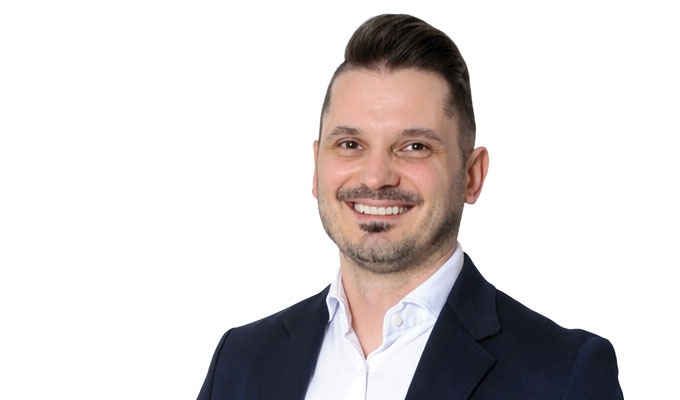
a&s Adria: Mr. Rek, could you tell us about your professional journey and what attracted you to the ICT and ultimately led you to accept this new role?
Rek: I have nearly two decades of experience across the software, electronic security, building automation, and public safety sectors. For almost ten years, I served as Chief Operating Officer at CDVI Polska, where I was responsible for regional sales strategy, partner network development, and the introduction of access control, electromechanical locking, and door automation technologies across Central and Eastern Europe.
I was also involved in the “Third Signal” project, an initiative focused on improving road and rail safety by transmitting early-warning FM signals to drivers about approaching emergency vehicles or trains. As part of this work, I participated in discussions with public institutions, including a working group at the Chancellery of the Prime Minister, focused on adapting the legal framework required for certification and commercial deployment of this technology in Poland.
Earlier in my career, I spent almost ten years at Comarch, one of Poland’s largest software companies, where I worked as Director of Sales Department managing technology projects that combined software, hardware integration, and public-sector requirements.
This background gave me a strong understanding of partner channel development, enterprise security systems, IT and OT integration, and strategic business growth. The Sales Director CEE position at ICT came at the right time and was a good match/ for me. The company has been successfully building its EMEA presence, including in Central and Eastern Europe and is offering a strong unified access control and intrusion detection portfollio I am delighted to contribute to ICT’s growth in the region, strengthen ICT’s partner ecosystem, and increase brand awareness in a market that I know very well.
a&s Adria: You have spent a large part of your career working in the Central and Eastern European markets. How has the security industry in this region changed over the past decade, and which trends do you consider the most important for its further development today?
Rek: Central and Eastern Europe has become one of the most dynamic and innovation-driven security markets in Europe. The region now stands very close to Western Europe in terms of technology adoption, investment activity, and the technical competence of system integrators.
The past decade has seen a strong shift from standalone security systems toward integrated platforms. Customers increasingly expect access control, intrusion detection, building automation, identity management, IT systems and OT environments to work together as part of one coherent security ecosystem. This is especially visible in commercial real estate, critical infrastructure, healthcare, industry, logistics, energy, and smart city projects.
For ICT, this trend fits with the philosophy and design of our enterprise solution Protege GX a unified platform for access control, intrusion detection, automation and integrated security management. This gives integrators and end users a consistent environment for managing doors, areas, alarms, users, events, outputs, integrations and operational workflows.
That unified architecture is one of the strongest advantages of Protege GX. It allows customers to build advanced security environments without the typical limitations of closed or fragmented systems. I believe the key trends for the coming years will be building digitalisation, cybersecurity, OT security, mobile credentials, open APIs, higher levels of system interoperability, and stronger convergence between physical security, IT and OT.
a&s Adria: What will be your main priorities during your time in this position, and what goals have you set when it comes to strengthening ICT’s presence in Central and Eastern Europe?
Rek: My main priority is to increase ICT’s brand awareness and strengthen our partner network across Central and Eastern Europe. In some countries, ICT already has a strong base of partners and successful installations. In others, we still have room to grow.
I want to focus on developing relationships with specialised security distributors, system integrators, consultants, designers, and technology partners. For ICT, the right partner profile is very important. We are not only looking for companies that want to sell products. We are looking for partners who understand complex projects, value open platforms, and want to deliver long-term business value to demanding customers.
Our solution portfolio gives us a strong foundation for this strategy and our ambition is to support existing, and new partners in competing for advanced, customised and demanding projects in the region and bring long-term value to the end-users
a&s Adria: Over the past few years, ICT has significantly expanded its presence in international markets. How do you position the company today in relation to other manufacturers in the field of access control and integrated security solutions?
Rek: ICT is in a very strong position today. We operate in more than 50 countries and have over 30,000 installations worldwide. In recent years, we have achieved significant business growth and made a number of operational and organizational changes to support further international expansion.
What clearly differentiates ICT is our pragmatic approach to unified security. Protege GX was developed from the beginning as one integrated platform combining access control, intrusion detection, automation and security management. This gives customers more than a door control system — it gives them a scalable environment for improving both security and operational efficiency.
At the same time, our global project experience shows that many organizations are not starting from zero. They often operate legacy systems that are no longer supported, difficult to expand, or no longer meet today’s functional and cybersecurity requirements. Replacing an entire system at once can require significant investment in both software and hardware.
ICT offers a more practical migration path. Customers can modernize step by step, starting for example with the controller layer, while protecting part of their existing infrastructure where possible. Tools such as ICT Data Sync Service also support this transformation by allowing Protege GX to exchange and synchronize data with external systems, helping reduce administration, improve data accuracy and simplify the transition to a more future-ready platform.
a&s Adria: ICT is present across a wide range of sectors, from commercial buildings and educational institutions to critical infrastructure and healthcare. In which verticals are you currently achieving the best results, and where do your solutions deliver the greatest operational and security value to customers? Can you name a few significant projects you were working on?
Rek: One of the advantages of our Protege GX enterprise platform is that it can be deployed across many different verticals.
It is used in commercial buildings, government facilities, healthcare, education, military environments, smart city projects, manufacturing, energy, banking, and other demanding sectors. The highest value is usually delivered in projects where access control, intrusion detection, automation and third-party integrations must work together as one operational environment. This applies for new installations but also for sites with legacy, sometimes obsolete, access control systems which need to migrate to newer, function rich, cybersecure platform while still operating part of the old system. ICT offers many possible migration paths.
Looking at the CEE market, we can mention installations connected with major infrastructure operators in Poland, as well as premium office buildings such as Rondo 1 in Warsaw. The specificity of the latter project is the high-level integration of access control with the lift management system, allocating lifts to employees in the most efficient way to manage the people flow especially at the busiest time of the day.
Deployments requiring an open platform, scalability, easy integration with third party systems (HR, lift, booking, visitor management, operational systems or other security systems), are the types of projects where ICT’s technology and support excel.
a&s Adria: What are partners and integrators today most commonly looking for from access control manufacturers that was not previously a primary focus, and how important are open platforms and interoperability today for end users and integrators?
Rek: Partners and integrators are no longer looking only for devices that open doors. In more advanced projects, they expect secure communication, encrypted technologies, reliable hardware, flexible software, open APIs, and the ability to integrate with IT, OT, building automation and business systems.
For enterprise-level projects, installation companies are looking at stability, scalability, cybersecurity, OT awareness and long-term support. End users want systems that will not limit them in the future. Integrators want platforms allowing them to design a complete solution instead of forcing them into a closed ecosystem.
The cost of ownership should be transparent to partners and end-users, which part is capital expenditure (CapEx) and which part is Operating Expenditure (OpEx).
Open architecture is no longer just an advantage, it has become, for most projects, a requirement. The most demanding customers want systems that can communicate, exchange data securely, support automation, and remain adaptable throughout the lifecycle of the building or facility.
a&s Adria: ICT has recently introduced a new generation of TSL readers featuring support for mobile credentials, OSDP 2.2 communication, and advanced security features. Could you present this product line in more detail and explain the advantages it brings to end users and integrators?
Rek: The new TSL reader range represents a complete multi-technology reader platform for modern access control environments, where security, flexibility and ease of installation are equally important. The readers support multiple credential technologies, including DESFire, MIFARE, 125 kHz cards, Bluetooth and NFC mobile credentials, making them suitable for both new installations and migration projects where different identification technologies may need to coexist for some time.
Security is a central part of the TSL design. The readers support encrypted RS-485 communication and OSDP with Secure Channel, while also allowing the use of custom encryption keys for MIFARE and DESFire credentials. An additional level of protection is provided by the EAL6+ Secure Access Module, which helps protect and manage encryption keys in higher-security projects.
For integrators, the TSL range also brings practical installation and service benefits. The readers can be configured through the Protege Config App using Bluetooth, which simplifies commissioning and reduces time on site. They also support over-the-network firmware updates when connected via ICT RS-485 or OSDP, which is especially valuable on larger sites with many readers.
Overall, the TSL range combines modern credential support, secure communication, flexible configuration and advanced encryption protection with practical features that make installation, maintenance and future upgrades easier for integrators and end users.
a&s Adria: As part of ICT ecosystem, you offer integration with wireless locks. How do you see their most common applications?
Rek: Wireless locks are an important extension of the access control ecosystem, especially in projects where cabling is difficult, expensive, or not justified by the use case. They are often a good solution for offices, education, hospitality, healthcare, and retrofit projects where customers want to extend access control to more doors without major construction work.
In the types of large enterprise projects that ICT often focuses on, wired architecture is still very common because of performance, monitoring, and integration requirements. However, wireless locks can add a lot of value when used in the right part of the project.
ICT supports integrations with established wireless lock ecosystems such as Aperio and Salto giving integrators and end-users options. Depending on the project, they can combine wired access control, wireless locks, intrusion detection and third-party integrations within one broader security concept.
a&s Adria: Mobile credentials, digital identities, and smartphone-based access management are becoming part of everyday use at an increasing pace. How do you see the development of this segment, and do you believe mobile devices will eventually replace traditional access cards in the long term?
Rek: Mobile credentials have developed significantly over the past few years, and I expect this trend to continue. They offer a high level of security and convenience for users who are already accustomed to using smartphones for banking, payments and identity-related services.
Through ICT’s mobile credential integration capabilities, mobile access can also become part of broader building, campus or tenant applications. In this context, the mobile credential is not a standalone service for booking or ordering, but part of the user’s digital identity within the facility. It can support a consistent access experience across doors, shared spaces, amenities and other controlled areas.
With the Protege Access+ mobile application, the user experience can go beyond simply using a smartphone as an access credential. Depending on system configuration and user permissions, the app can also allow users to monitor system status, unlock doors, and arm or disarm intrusion areas directly from their mobile device.
I do not believe, however, that mobile credentials will completely replace physical credentials such as cards, fobs, tokens or wristbands. They remain practical and secure solutions in many environments. Most users will continue to need a mixed credential strategy to meet their operational requirements. ICT’s role is to provide partners with secure and flexible tools that allow them to create the best solution for each customer.
a&s Adria: Cybersecurity is becoming an integral part of every modern security system. To what extent have today’s requirements for data protection and secure communication changed the way access control systems are designed and implemented?
Rek: Security systems operate on LAN and WAN infrastructures, exchange data with IT systems, and often integrate with identity management, cloud services, building platforms and OT environments. This means they must be designed as secure networked systems making cybersecurity essential.
Encryption, authentication, secure communication, user rights management, software updates and data protection are baseline requirements. Manufacturers should continuously improve their products in line with changing regulations and cyber risks.
When access control and intrusion detection are part of one integrated platform, the stakes are higher. The system manages users, areas, alarms, events, automation and third-party integrations, making secure architecture and lifecycle management critical.
ICT treats cybersecurity as an ongoing priority, from product design and compliance to key standards such as ISO 27001:2022 to staff training. Effective protection also relies on installation companies and end-users keeping firmware updated and maintaining network compliance and high level of staff training.
a&s Adria: Speaking about the Adria region, where do you see the biggest business opportunities for ICT?
Rek: The Adria region is a very promising market for ICT. It is a region with ongoing investment, growing demand for modern security infrastructure, and many projects where a platform such as Protege GX can deliver real value.
We see opportunities in commercial real estate, public infrastructure, critical facilities, healthcare, education, industry, logistics, energy and mixed-use developments. Many customers in the region are looking for more than basic access control. They need scalable, integrated, and future-ready solutions that can combine access control, intrusion detection, automation and system integration.
Local presence and support are very important and for this reason, we have planned to grow the team by hiring a sales engineer in the Adria region. This regional support is a key element of our strategy, being close to the market, to our partners, supporting them commercially and technically. This is how we want to build partnerships in the Adria region — based on trust, local support, technical competence, and long-term cooperation.
a&s Adria: ICT will once again participate in the Adria Security Summit in Zagreb this year. How important are events like this for developing partner networks and understanding the needs of the regional market, and what can visitors expect from ICT at this year’s edition of the Summit?
Rek: Events such as the Adria Security Summit are very important for us; they bring together installers, system integrators, consultants, investors, and technology partners in one place. This gives us a great opportunity to present ICT’s vision directly to the market and to listen carefully to what regional partners and customers really need.
For ICT, the Summit is not only a place to showcase our solutions. It is also a platform for dialogue, relationship building, and understanding local expectations. We are looking forward to attending the event, meeting companies interested in open platforms, advanced integrations, and long-term partnership.
a&s Adria: If we look ahead to the next five years, which technologies and market changes do you believe will have the greatest impact on the development of access control? And what can we expect from ICT in terms of new technologies?
Rek: Over the next five years, I believe the biggest impact will come from the convergence of physical security, IT, OT, cybersecurity, artificial intelligence, mobile identity, and building automation. Access control will become a core part of a broader digital building and security ecosystem.
Customers will request a single coherent environment that can manage access control, intrusion detection, events, users, areas, automation and external systems in a secure and scalable way.
AI will continue to revolution the way manufacturers develop products, analyse market needs, test software, improve hardware design, support integrations and help teams work more efficiently.
Innovation cycles will become faster. Systems will become more intelligent, integrated, and adaptable. Hardware and software improvements will be delivered faster. From ICT, partners and customers can expect continued development of open, scalable and secure technologies, cybersecure hardware (controllers, expanders, readers), mobile credentials, integrations, and tools to help our partners deliver advanced access control, intrusion detection and integrated security projects.