In the first part Gašper Korinšek will present the approaches Visionect used for tackling security issues on Joan’s room booking devices from the firmware perspective and in the second part Luka Mustafa will talk about LWM2M protocol for IoT devices.
The first presentation will cover an Explanation of the system and an overview of device interfaces that pose a security risk and solutions for tackling each security challenge.
We’ll shed a light on questions such as:
What are the measures to prevent extraction and/or injection of firmware?
How do we secure firmware upgrades and communication with the server on the protocol and connectivity level?
What are AES, TLS, and WPA Enterprise, and how are they used in practice on an embedded system?
In the second presentation, the LWM2M protocol for IoT devices is explained more thoroughly. Lightweight M2M is an open protocol from the Open Mobile Alliance (OMA) that is designed for addressing the needs of mobile low-power devices with very little computing power. We will explore the basics of the LWM2M protocol and look at integration examples between a device running Zephyr RTOS and AVSystem backend, looking into the custom objects and features in place.
Topic: Security on IoT devices and LWM2M
Time: Wednesday, April 12 · 6:00 PM CEST
Speakers:
Luka Gašpar, Lead Device Firmware and Hardware Engineer, Visionect
Luka Mustafa, Founder and CEO of IRNAS
Venue: Računalniški muzej, Celovška cesta 111, Ljubljana, Slovenia
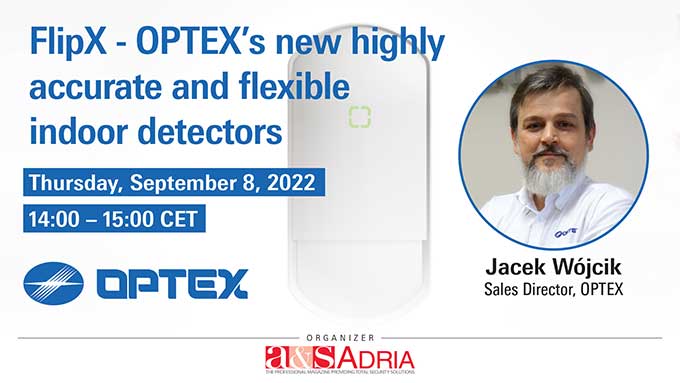
On Thursday, September 8, OPTEX will present FlipX, a new highly accurate, and flexible indoor detector.
Installers and end-users in Europe, the Middle East, and Africa (EMEA) can now take advantage of FlipX, a new range of flexible indoor sensors from OPTEX, the leading global sensor manufacturer. New techonlogy features a bespoke pyroelectric sensor for increased performance that adapts to the human shape, and a unique lens that can be ‘flipped’ to provide both narrow and wide detection in a single sensor.
This ‘flipped’ lens has been designed with flexibility in mind. It effectively gives installers “2 sensors in 1” to satisfy multiple customer demands. It helps installers manage both their inventory and their cashflow while giving them the versatility and confidence of arriving on site with the solution they need to match their customer’s needs.
The new indoor sensor series is built on OPTEX’s extensive track record of providing outstanding sensing performance for intruder detection applications. By simply rotating the lens through 180°, the sensor can be used to protect narrow or long areas such as a hallway up to 18m, or a wide, open area like a living room or retail store up to 12m at 85°.
FlipX Standard, the first to be released from the new series, is a Grade 2 sensor, that also features a digitally enhanced signal recognition logic called Super Multi-Dimensional Analysis (SMDA), which means nuisance alarms caused by changes in light or temperature can be avoided.
Following the FlipX Standard launch, OPTEX plans to release other models in the FlipX series in late 2022/ early 2023.
In the past, IT and Security departments were reluctant to move their systems into the Cloud. Many still are. But things have changed.
The last few years have shown the global community so many reasons why its business critical to leverage Cloud computing as part of their corporate strategy.
Physical security solutions are no exception. As more organizations look to the Cloud, they are looking for a modern solution that gives them greater security, flexibility and interoperability.
On our next webinar we will address topics that are most commonly discussed with customers when considering a move to Cloud-based access control solution.
Which are their most common concerns?
Which functionalities are they looking for and want to understand better?
We will explain all concrete advantages that await you with access control in the Cloud, and also reveal some customer cases that fit perfectly with the Cloud offering.
1) Cloud-based software solutions are often more powerful, convenient, and affordable than locally hosted alternatives, but many people wonder: How secure are they really?
2) Since the beginning of the COVID pandemic, we’ve seen an acceleration in the adoption of cloud-based software solutions. Why they became so popular during pandemic?
3) Organizations are always looking for something new and remarkable when investing in new technology. What kind of business efficiency and new opportunities comes with the Cloud?
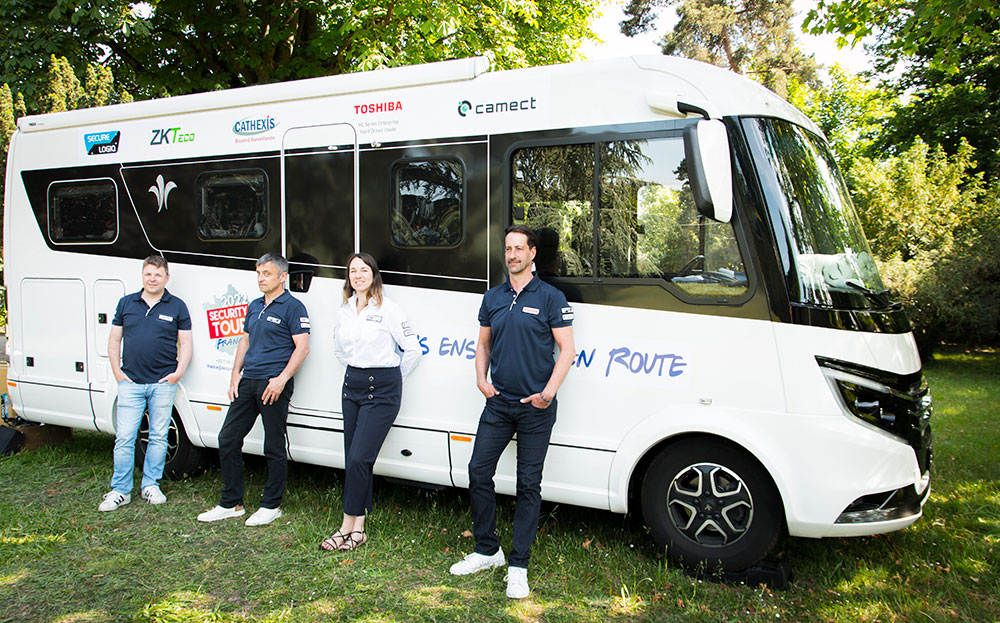
Secure Logiq, Toshiba, Cathexis, ZKTeco, and Camect went on an atypical two-week tour of France. We joined them in the suburbs of Paris to witness the first-hand test of the functionality of a complete integrated solution that these spirited competitors offer in the security market
We caught up with the Niesmann + Bischoff iSmove camper in Chatou, a beautiful town whose looks are sculpted by traditional French architecture and nature. Picturesque houses with high narrow windows, stone and brick facades in the colors of earth minerals, and dark roofs can be found, fittingly, only in this place – the one with much green and quiet. The chirping of birds is the area’s native sound tapestry, and occasional vehicles are just intruders that disturb its peace. While being close to the most visited tourist city in the world, life out there takes place in a completely different timeline: one reserved for yourself and your loved ones, at a bistro surrounded by friends, in intimate gardens surrounded by hedges. Even the hotel where we stayed, although tiny and fused with the panorama of the place, has a small inner stone courtyard, where you can smell the tradition while enjoying your croissant and coffee.
Watch the video reportage:
Integration in practice
We met our hosts in that mini square: Ivan, Jessica, Dominique, and Pierre. Contrary to expectations, thousands of kilometers and a number of visited cities did not leave a noticeable trace on their appearance: we were greeted by a cheerful, open-minded and – as it turned out – a pretty interesting team of people, the memory of who, even now, brings a smile to the face of the author of this text. The four of them work for different companies, which have a variety of products in their portfolio, but which are united by the challenges and willingness to cooperate. Wanting to offer something new to their potential partners and customers, they decided to go on a tour of France together. They branded the camper, equipped it with products, and brought with them their years of experience in business development, sales, and technology with the intention to demonstrate both the individual strength of their companies and the strength that stems from the relationship between various technologies. This is a value that is important to the world of security because the protection of any major facility or location depends on the functionality and reliability of a number of parts that constitute complex security systems. Dedicated servers by Secure Logiq, Toshiba’s hard drives, Cathexis’ VMS, ZKTeco’s access control and Camect’s hub with multiple outputs for multiple cameras, monitors and video walls in fact represent stacked layers of one security croissant of sorts that customers can study on their doorstep as part of a unique tour in this industry.
Dedicated CCTV servers
The entire presented system relies on Secure Logiq’s dedicated servers, the specifics of which we wrote about in one of our earlier issues. A group of experts with many years of experience gathered while working for all well-known manufacturers of video management software came up with the idea to fill in the missing piece on the security puzzle. These are servers specifically designed and built for video surveillance because the use of generic servers did not provide the quality of the recording that could be obtained in the field. The systems were simply not optimized. Secure Logiq has therefore developed a unique Benchmark Pro system to simulate the system that operates in real circumstances. It enters all the specifications that the client submits, from the number and type of cameras to the analytics used. The software then creates virtual streams and simulates what it will look like before the hardware production, i.e. whether the server will withstand the load or not. “Clients often ask us how we can guarantee that our servers will work. The answer is our unique Benchmark Pro software. Since each video system has its own needs, the client provides us with what they need, we make a calculation and deliver a server that is guaranteed to work 100%. If we make a mistake, and so far we haven’t, we’ll fix it at our own expense. And as an added value included in the price of the server, for each client who submits a template and to whom we send a recommendation for the server, we will also provide a complete design. In it, we will describe how many frames per second they get for each camera, what the percentage of the recording is, etc. With that document they can go to the client and ask for a quote”, says Ivan Sval, Secure Logiq’s Regional Sales Manager.
Four-pitched roof
Secure Logiq has several types of servers in its portfolio: from input models 1U with 42 TB, through 2U and 4U, to large workstations of up to 384 TB. The biggest project they completed involved a 1.4 PB server in a single housing. Secure Logiq’s vision is based on four pillars: the largest archive, the fastest data flow, the highest resilience, and the best value for money. “All of our components come with a three to five-year warranty. All servers have two SSDs, with the operating system mapped to both by default, while a redundant power supply is optional. We can run recording servers, workstations used for recording and viewing, or workstation clients used just for viewing recordings,” explains Mr Sval, adding that servers can be upgraded with GPUs and that the last one they worked on had as many as 30 GPU ports.
In addition to Benchmark Pro, Secure Logiq offers two other value-added pieces of software. One of them is Healthcheck, to which the user can connect via the cloud and immediately get information about the status of their server. This does not require an application, but rather online access via any browser. Thresholds can be set in the software, the crossing of which activates the sending of notifications. All communication is protected by SSL encryption and 2-factor authentication. There’s also the Logical Core which allows you to make a copy of one server to another without using licenses for a VMS manufacturer’s redundancy services. The complete Windows is mapped to another server. When the first one fails, the second takes over at no extra cost.
A new challenger in the storage market
Secure Logiq buys all hard drives used in its servers from Toshiba. This is a seemingly unusual move because those who follow this industry know that this renowned Japanese manufacturer, although globally known for its quality, hasn’t operated in the video surveillance market until recently. Toshiba entered the global security industry only five years ago, while its presence in the European security industry was established in 2019. For this purpose, Toshiba had to design completely new products. “We had to develop a special technology because all-day work is demanding for this type of disc. In order to withstand a workload of 180 TB per year, the device must be of great quality. Although we faced strong competition from Seagate and Western Digital, Toshiba is an established Japanese manufacturer which can offer high value in terms of quality, design, price-quality ratio, and investment in research and development. Of course, we had to start from scratch, present our solutions and products and convince customers to trust us,” says Pierre Andrieux, Key Account Manager. It is with this goal that they embarked on this tour in order to establish themselves on the French market together with other brands.
Toshiba has developed a special series of hard drives, firmware, and designs for video surveillance applications so that their products can record videos 24 hours a day, every day of the week. The new series of 3.5-inch discs optimized for storing video with 64 cameras have been named the S300 and is rounded off with the S300 Pro model with a capacity of up to 10 GB. At the same time, they promote an even more resilient and reliable, but more expensive enterprise MG series of hard drives, which can withstand an annual load of 550 TB. It is intended for industrial servers, data centers, and cloud infrastructures. All Toshiba discs come with a five-year warranty, be those the cheapest or the most expensive ones.
Multipurpose open architecture software
The “mind” that manages the entire system backed up by Secure Logiq’s and Toshiba’s hardware is the video management software by the South African company Cathexis. It is software with sophisticated open architecture with multiple possibilities, used for a number of projects around the world. From single installations with over 4000 cameras to customers with over 65,000 cameras spread over 1,500 locations. CathexisVision is not just a VMS in the classic sense: it integrates and manages other 3rd party systems, from intrusion detection and access control to fire alarms, elevators, etc., which makes it very flexible and multifunctional. It comes in several editions: Lite, Core, Professional, and Premium. The difference is in the number of cameras it supports (a maximum of 48 in the first two versions, 150 in Professional, and an unlimited number in Premium), and single servers for Lite and Core and no restriction on servers in the remaining two editions. The cost of the required server platform is considerably lower than the main competitors. In this way, the company can adapt the software to the needs of an individual project. If, for example, you have 10 cameras, one of which is ANPR-enabled, and the two come with on-board analytics, it is not necessary to upgrade to a more expensive version, but rather keep the basic server licence and merely purchase additional camera licenses. There is no limit on the camera functionality supported. Subsequent changes are also easy to make, e.g. moving analytics from one camera to another.
Find objects quickly
The CathexisVision interface is classic, with a video display, timeline, playback and search controls, a feature resource tree,, etc. As we have seen, the software is easy to use and helps you find the clips you need. “Personally, I think that the most important thing in VMS is to quickly find the segment in the video that we need. In our software, this is made simple. We display various activities and other useful information on an intuitive timeline. It includes a graph, often referred to as a Manhattan, which is indicative of the motion throughout the image. The timeline also includes information from other triggers and time based recordings.
If, for example, you want to know when the vehicle entered the parking lot, you can click on the time when it probably did not arrive, e.g. early in the morning, and load that image, and then you go to a time when it’s already there and share the frames between those two time points until you get the one we need,” explains Dominique Debusschere, Cathexis’s Business Development Manager for Europe. Another useful feature is the Activity Trail, which employs different colors, similar to heat maps, to represent movements in the monitored area in relation to the time when they occurred. There is also Adjacent Camera Mapping which offers ease of navigation from one camera to another and by using arrows similar to those in Google Street View.
Easier addition of analytical functions
One of the strengths of CathexisVision is the rapid deployment and fine tuning of multiple types of analytics. The ease of configuration was one aspect of the VMS that helped Cathexis win the Innovation award from the UK security magazine, Benchmark, three out of the last four years. “Once the threat has been identified, one or multiple analytics in the library, including artificial intelligence based object classification, can be used to combat the intrusion,” says Mr Debusschere. The real challenge with intrusion analytics is the large number of false alarms, usually solved by having a technician go to the site and adjust all the parameters, potentially multiple times, requiring both time and money.
To avoid this, Cathexis developed an analytics simulator were recorded footage from the false alarm can be processed remotely allowing an “off-line” inexpensive way of fine-tuning analytics. Integration provides an expansive connection with multiple types of 3rd party devices. For example, a camera detects movement, it would be possible to set the lights to turn on immediately, play an audio warning, check if all the doors are locked, etc. Cathexis now offers a completely revamped, feature rich and highly configurable Android and iOS mobile app. Everything is visible to the mobile security and which can be tailored to their needs. As a novelty for our readers, we learned that just before our arrival, Cathexis launched their new Carbon user interface, an improved and modernised user app with great new functionality. We have also found out that they are currently working on an Enterprise app that will give an estate owner visibility of all his assets, how they are performing, what’s working and what isn’t and be able to control in detail who access to what resources via the corporate Active Directory.
Focus on a new strategy and partner selection
After staying at the European headquarters of ZKTeco in Madrid, which I wrote about in detail in issue No. 178 in May, I was not surprised by the presence of this multinational company on this tour. Back then, I asked them about their development plans in Europe and learned that they opened a number of new offices and were planning for more, that they operated profitably and actively even during the pandemic and that they significantly expanded their product portfolio compared to 10 years ago when they had celebrated their first presentations at local security fairs in a more modest manner. The European market is their focus now and they will maintain that course in the coming years, given the growth in all countries. “Large European market is traditionally a great challenge. Since we have so far been oriented towards project tenders in Europe, we now want to focus on strategy and partner selection, not trying to focus on everything but rather on a few key needs. We want to build a relationship based on trust, so my job is to train our partners to more easily find their partners, bring them in and help them grow,” says Jessica Perret, the company’s Business Development Manager whose goal is to strengthen its presence in French and Belgian markets and draft accompanying strategy.
Client’s trust, among other things, will be built by demonstrating the ability to integrate, and this tour across France is just a great opportunity to do so. “The reason we are participating in this mobile presentation is to show the extent to which we can integrate with all brands. Here, we not only play the role of an independent company but rather show that we are available for integration and communication with other solutions. It’s a new way of marketing. The idea of this presentation is to attract customers, find new partners, and present new ways of getting to know the brand. This type of communication is much more comprehensive. I think that top brands joined together in this way make this presentation stronger and better,” explains Mrs Perret.
A solution for small and medium enterprises
In the park, the “green” company presented us with an affordable and comprehensive Atlas series of access control devices, intended for small and medium enterprises. It is a simple solution, consisting of the main controller to which up to 20 secondary controllers can be connected, together with two types of readers – RFID cards and fingerprints – that can be used simultaneously. The system also supports contactless reading of QR codes from mobile phones, as well as PINs and bar codes. Atlas comes with Linux software installed, which does not require a license. Just enter the IP address of the controller as the URL of the web page. On the main screen of the software, you can monitor the activities of the controller, e.g. how many devices are connected, and how many doors are controlled, with real-time monitoring supported. “You can easily determine if someone is a user and if that person has the right to access a specific door. If you enter a random code, the system reports that someone is trying to enter at a certain time. You can, for example, identify individual doors and readers and connect to the desired door. Also, with the help of the menu, you can get a map of the installation, the location of the controller, as well as information about which door is connected to which type of reader,” ZKTeco’s business development manager told us.
The simplicity of the Atlas series is reflected in its plug & play connectivity, which makes it easier for installers, because they no longer have to spend time connecting, configuring, and explaining the system. The same goes for the users because it is now easy to create new users and give them access. Of course, ZKTeco also offers solutions for much larger installations, such as ZKBioSecurity, which supports more than 200 doors and an unlimited number of users, whereby ANPR, elevator control, time & attendance, etc. can be added to the software. The system can be integrated with any third-party product. They offer communication via SDK to other companies, so they can use the information stored in the controllers and communicate with third-party software.
All analytics in one device
Although their representative could not join us, our interlocutors eventually presented us with a solution from the American company Camect, which is used in more than 30 countries. It is a smart camera hub that offers high-precision object detection in a compact and affordable local system that requires minimal configuration. As obtaining accurate video analytics from a surveilled location remains a challenge, Camect has created a platform that sends detailed and informative notifications about a detected object, which it can send to a monitoring center or other application. This way, it eliminates false alarms caused by smaller moving objects, animals, shadows, or weather conditions. Even simple adjustment makes it possible to detect objects over long distances, which is suitable for construction sites or car parks, for example. The Camect hub is compatible with all IP cameras that support ONVIF profiles or the RTSP protocol, and by combining analytics in one hub, excellent results can be obtained even with cheaper cameras. Integrators can also unlock advanced analytical settings such as increased sensitivity or detecting loitering or unauthorized tampering with the device. The hub itself also has 1 TB of internal memory, where it stores and processes video data, so only alarm notifications are sent to the monitoring center. This significantly reduces bandwidth compared to cloud analytics services for filtering false alarms.
Representatives of the G4S company and Igigi startup held a presentation as part of a series of a&s Adria webinars on the marketing platform, and a virtual character called Igigi.
Igigi character uses artificial intelligence algorithms based on which it is able to interact with the approaching people, monitor the behavior of people, and based on that give recommendations for further action.
The Igigi is mostly in shopping malls or in banks where it can provide certain information on request.
In addition to the above possibilities, Igigi is an ideal security solution with regard to the possibility of acting in emergency situations through automatic incident detection.
a&s Adria magazine organized a webinar in cooperation with Zodax and Teledyne FLIR companies on the benefits of using dual vision cameras in surveilling critical infrastructures. Hesham Enan, Key Account Manager for the Middle East, focused on the benefits of using dual vision cameras in tunnels and highways.
Dual-vision cameras integrate thermal vision that is able to detect fire incidents and see through the smoke. These features make them more efficient in the early detection of fire incidents. Additionally, cameras are equipped with AI technology which enables them to easily create alerts, distinguish fire incidents from hot spots, and reduce false alarms. Full webinar recording is available in the video below.
Venturing on a unique opportunity to showcase its extensive product portfolio, Secure Logiq is taking part in a two-week ‘Security Tour France’ road trip this month.
From 23 May to 6 June, Secure Logiq, along with along with Cathexis, ZKTeco, Toshiba and Camect will be visiting 130 security companies between Paris and Lille, with a target of two site demos per day, driving the team’s reliable Niesmann+Bischoff iSmove motorhome.
Using the van’s live setup to provide real-time demos no matter what the weather brings, the team be showcasing CCTV system solutions, enhanced video security, integrated VMS solutions and positive ROI, accompanied by croissants and coffee.
“This is a really exciting opportunity to connect with the French security market,” says Ivan Sval, Regional Sales Manager EU of Secure Logiq. “When planning these types of visits, they are arranged well in advance, or it will just be cold visiting. The goal of this trip is to surprise the customer with our presence, and I think having our real-time demos on the road with us will provide a perfect chance not only to present our portfolio, but to network in a unique and memorable way.”
Demonstrating the power of an integrated security solution, the ‘Security Tour France’ team are excited to begin their journey – spearheading an innovative concept within the security sector that brings solutions directly to people’s doorsteps.
“It’s incredible to be involved in a road trip experience like this with a brilliant team of experts in their field,” says Robin Hughes, Sales Director, Secure Logiq. “No manufacturer in our business has ever done a trip like this before and with each site visit and demonstration, we hope to make a lasting impression on our customers.”
Motorola Solutions has introduced its cloud access control solution as part of the a&s Adria series of webinars.
It is an Openpath company acquired by Motorola Solutions in 2021, which designs and manufactures access control solutions for various sectors.
The lecturers were Mario Kolovrat, Avigilon Regional Sales Manager, and his colleague Saša Ćorić, Sales Engineer.
In his presentation, Mario mentioned the advantages over other solutions highlighting two advantages, quick and easy implementation and easy management of the system itself.
Slavoljub Stevanović, MOBOTIX Business Development Manager at Konica Minolta Business Solutions, presented the new MOBOTIX 7 platform cameras, modules and applications built into the cameras on this platform.
In addition, the presenter showed the openness of the MOBOTIX 7 platform delivering ultimate individuality and changing video surveillance with an infinite number of possibilities. The platform already includes specialized apps that cover several industry-specific, individual requirements.
Certified Apps are professional, deep learning-based MOBOTIX camera apps from renowned partners explicitly verified and certified by MOBOTIX. Thanks to the high modularity, users can use the apps they exactly need in their video system to meet their requirements.
The presentation was wrapped by use cases demonstrating how the solution saves time and money.
Michael Byrden, Business Development Strategic Partnerships Manager at Vanderbilt & Comnet, delivered a presentation on three different solutions for the transportation and logistics sectors.
Cloud security solutions successfully manage multiple sites coordinated from one center. In addition, the presenter emphasized OSDP protocol as a solution against card cloning at airports and how to protect against it. The third solution is about pre-booking and optimizing car parking using ANPR technology.