Trionda: The Most Advanced Smart Match Ball Ever Developed
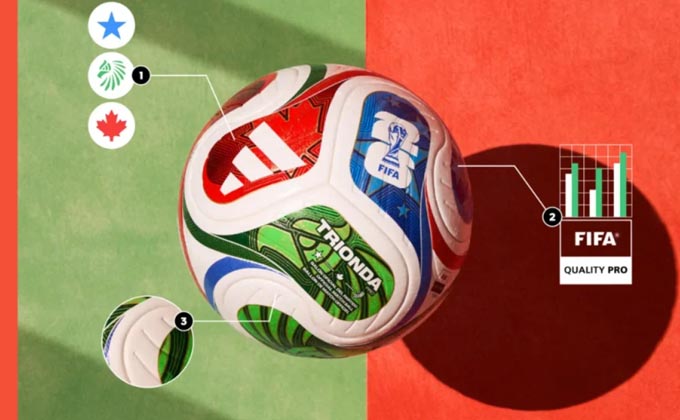
The upcoming FIFA World Cup 2026 will introduce a new generation of sports technology through the Adidas Trionda match ball, which is already being regarded as the most technologically advanced football ever produced. At its core is an electronic module developed in collaboration with the German company KINEXON, a specialist in precision tracking and sports analytics systems.
Trionda features Connected Ball technology, using an integrated sensor to collect movement data and transmit it to analysis systems up to 500 times per second. This data enables the precise determination of the exact moment a player makes contact with the ball and is linked in real time with optical player-tracking systems and VAR technology.
This approach significantly enhances semi-automated offside detection and the analysis of controversial match incidents. Rather than relying solely on video footage, officiating systems now use a combination of sensor data, computer vision, and artificial intelligence. The new four-panel construction also represents the most radical redesign of an official FIFA World Cup match ball to date. According to Adidas, this design improves aerodynamics, flight stability, and trajectory accuracy, while a specially developed surface texture provides better control in a variety of weather conditions.
The ball also contains a rechargeable battery that powers the sensor system throughout a match, while all data is transmitted wirelessly to infrastructure systems installed around the pitch. In this way, Trionda becomes an active part of the match’s digital ecosystem rather than simply a piece of sporting equipment.
By combining sensor technology, wireless communications, advanced analytics, and artificial intelligence, Trionda represents one of the most compelling examples of IoT technology being applied in sports. Many experts therefore consider it not only the best football ever created, but also an indication of the direction in which sports technology will evolve in the years ahead.