Trionda Knocked Croatia Out of the World Cup: How Does the Sensor Work?
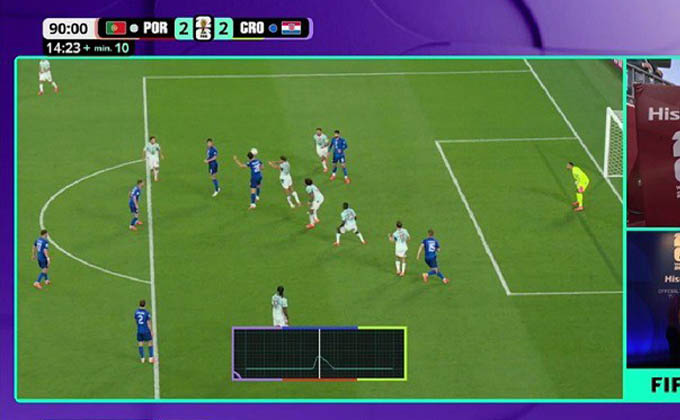
The technology embedded inside Adidas’ official match ball has once again demonstrated how important it has become in modern football. The so-called Connected Ball Technology played a decisive role in disallowing Croatia’s late equaliser against Portugal at the FIFA World Cup after confirming that the ball had made contact with Igor Matanović before reaching Mario Pašalić, who was in an offside position.
Although the referee initially awarded the goal, the VAR review, supported by data from the sensor embedded inside the ball, detected an almost imperceptible header. That single piece of evidence was enough to trigger the semi-automated offside system and ultimately deny Croatia an equaliser and extra time, bringing the team’s World Cup campaign to an end—to the disappointment of football fans across the region.
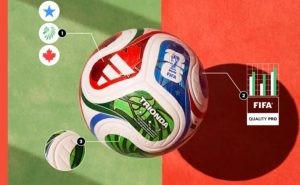
At the heart of the system is an IMU (Inertial Measurement Unit), a miniature inertial sensor embedded inside Adidas’ Trionda match ball. The sensor records acceleration, rotation, and the ball’s three-dimensional movement 500 times per second—ten times faster than a standard television broadcast, which typically captures around 50 frames per second. This extremely high sampling rate allows officials to determine the exact moment a player touches the ball with exceptional precision.
The sensor data is transmitted in real time to the VAR operations room, where it is combined with information collected by 16 cameras positioned around the stadium. These cameras continuously track the positions of both the ball and the players, recording 29 body reference points for each player. Artificial intelligence algorithms then merge all available data and automatically alert the video officials to potential infringements.
The technology delivers its greatest value in semi-automated offside decisions, as it accurately determines the exact moment the ball is played. It is also used to confirm handball incidents and identify the last player to touch the ball in disputed situations. Despite this advanced level of automation, the final decision always remains with the referee after reviewing the available video footage and system data.
Connected Ball Technology was jointly developed by FIFA and Adidas and was first introduced at the 2022 FIFA World Cup in Qatar, which we covered in greater detail in our magazine HERE. It has since been used at UEFA EURO 2024 and the 2025 FIFA Club World Cup, demonstrating that sensors, artificial intelligence, and data analytics now play just as important a role in refereeing decisions as traditional video footage.