Interview: Cristina Andreoni, CEO, ELAN
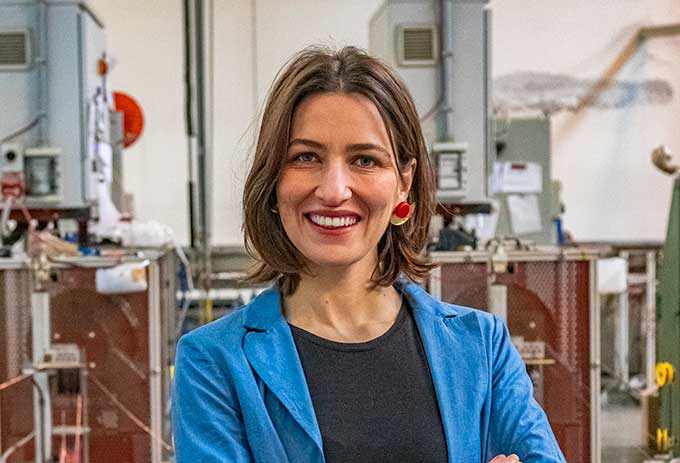
a&s Adria: To begin with, could you briefly introduce your professional background, your current role at ELAN, and the areas of the business you are responsible for?
I am Cristina Andreoni, CEO of ELAN. My role covers the overall development of the company, with particular attention to strategic decisions, commercial activities, international markets and the evolution of our product portfolio.
ELAN was founded by my father, Adrio Andreoni, and I have followed its development closely, contributing to its internationalisation and product evolution.
By: Damir Muharemovic; E-mail: editorial@asadria.com
a&s Adria: ELAN is celebrating 40 years in business this year. Could you take us through the company’s development from its founding in 1986 to the present day?
Andreoni: ELAN was founded in 1986 in Camerano, in Italy’s Marche region, initially focusing on cables for security and alarm systems.
Over the years, we expanded our portfolio to reflect the evolution of the market. Cables for intrusion and alarm systems were joined by solutions for fire detection, video surveillance, data networks and automation. We also developed a second important business area with BIGBAT, our range of rechargeable batteries for backup-power applications.
The industry has moved from traditional alarm systems towards increasingly connected infrastructures, with IP video surveillance, structured cabling, PoE, building automation and integrated control systems.
We consequently developed dedicated solutions such as ELANDATA for networking, ELANFIRE for fire-safety applications, RS485 cables for automation and our own KNX range. ELAN has been a member of the KNX Association since 2018.
We combine standard products available from stock with customised manufacturing for specific technical requirements.
Internationalisation has also been fundamental: from our Italian industrial base, we now serve more than 50 countries.
a&s Adria: Cables are the foundation of almost every security installation, although attention is often focused on cameras, control panels and software. How important is the correct selection of cables, and what can happen when the wrong product is chosen?
Andreoni: A cable should not be treated simply as a commodity. Selection depends on the application, electrical characteristics, installation environment, interference, mechanical stresses, fire requirements and regulations.
This is particularly important with data cables. Two CAT6 products are not necessarily equivalent: conductor quality and section, pair geometry, insulation, shielding and transmission performance all matter.
A proper CAT6 cable uses 23 AWG solid pure copper conductors. Lower-cost products may use smaller conductors or CCA – Copper Clad Aluminum – instead of pure copper. These can increase attenuation and signal loss and create additional risks in PoE applications, where the cable also carries power. CCA conductors are also mechanically more fragile.
Actual performance must therefore be measured. FLUKE testing verifies parameters such as attenuation, crosstalk and transmission performance.
An unsuitable cable can cause communication errors, unstable signals or premature deterioration. In fire-safety applications, the consequences can be much more serious. Cable selection should therefore be part of the system design, not an afterthought.
a&s Adria: Your portfolio covers intrusion detection, fire alarm, TVCC, LAN networks and automation, with PVC and LSZH options and customised solutions. How has demand changed in recent years?
Andreoni: The growth of IP video surveillance has been particularly significant. Network infrastructure is now an essential part of the security system, while smart buildings and industrial automation are generating demand for increasingly specialised communication solutions.
Our RS485 range is a good example. These cables are designed for reliable communication in automation systems, where electromagnetic interference can be a significant issue. Their balanced and shielded construction, together with high-quality shielding and tinned copper conductors, helps maintain stable transmission over longer distances and reduce errors and downtime. They are available with PVC or LSZH jackets, including LSZH versions with Cca-s1a, d0, a1 classification.
At the same time, specialised cables for particular environments remain important: fire-resistant solutions, LSZH products, outdoor cables and cables with specific mechanical or environmental characteristics.
Our objective is to maintain a broad portfolio while remaining flexible enough to develop customised solutions.
a&s Adria: The ELANFIRE range includes PH120 solutions compliant with EN 50200 for fire alarm and EVAC systems. What does it mean for a cable to maintain its functionality during a fire, and how does this differ from reaction-to-fire performance?
Andreoni: This distinction is extremely important because several different concepts are often grouped under the generic term “fire-resistant”.
A fire-resistant cable is designed to maintain its intended function for a defined period when exposed to fire. In a fire alarm or emergency voice communication system, this means continuing to transmit the required signal or power, allowing the safety system to operate when it is most needed.
This differs from reaction-to-fire performance, which concerns how a cable behaves when exposed to fire: flame propagation, smoke production, flaming droplets and the acidity or corrosivity of gases.
Our ELANFIRE range includes PH120 solutions tested according to EN 50200 for fire alarm and safety applications.
The European CPR classification addresses reaction to fire. Its Euroclasses range from Fca to Aca and are complemented by classifications for smoke production (s1–s3), flaming droplets (d0–d2) and acidity/corrosivity (a1–a3).
For example, Cca-s1a,d0,a1 indicates defined reaction-to-fire performance, very low smoke production, no flaming droplets and low acidity of emitted gases.
a&s Adria: How have IP video surveillance, PoE and increasing data volumes changed the requirements placed on cabling infrastructure?
Andreoni: The transition from analogue to IP has fundamentally changed the role of the cable. Network infrastructure now carries large amounts of data and, with PoE, can also provide power to connected devices. As cameras become higher resolution and systems more integrated, transmission performance and installation quality become increasingly important. A high-performance camera or switch cannot compensate for inadequate cabling.
Our ELANDATA range includes Cat5e and Cat6, U/UTP and F/UTP, indoor and outdoor solutions, with CPR-certified and FLUKE-tested products. Our ELANDATA CAT6 UTP uses 23 AWG solid pure copper conductors, twisted pairs and an internal separator designed to reduce interference. HDPE insulation and LSZH options provide additional protection.
FLUKE testing provides an objective verification of attenuation, crosstalk and transmission capability. The key principle is to consider cabling as an infrastructure investment: not only for today’s requirements, but also for future bandwidth, PoE loads and system expansion.
a&s Adria: One of the newer ELANDATA solutions is a Cat6 outdoor cable with UV protection and rodent-deterrent technology. How much do real-world installations and customer requirements influence this type of development?
Andreoni: Real-world experience is one of our most important sources of innovation. Many specialised products originate from a practical problem identified by an installer, distributor or customer.
Outdoor cables may be exposed to UV radiation, humidity, temperature variations, mechanical stress or rodents. Our ELANDATA U/UTP CAT6 outdoor solution has a double LSZH jacket, UV resistance and a waterproof construction suitable for indoor and outdoor use, including exposed installations, tunnels and industrial environments.
It also incorporates a rodent-deterrent formulation in the outer jacket. In certain environments, damage caused by rodents can lead to cable failure and service interruption. Addressing this problem at the cable level can therefore provide an important additional layer of protection.
Custom manufacturing is an important part of this process. We can adapt an existing product or develop a cable according to specific technical requirements when a standard catalogue solution is not sufficient.
a&s Adria: ELAN has capabilities for cable inspection and testing, including electrical, mechanical and fire-resistance testing. What does your quality-control process involve?
Andreoni: Quality control begins with the raw materials and continues throughout production and final testing. Depending on the product, we perform electrical measurements, dimensional checks, mechanical tests and specific fire-performance testing. For data cables, transmission testing is particularly important because physical connectivity alone does not guarantee the required network performance.
We also place strong emphasis on conductor quality. Using 100% pure copper rather than alternatives such as CCA is important for stable electrical performance, particularly in applications involving PoE.
Traceability and regulatory documentation are equally important. Under the CPR framework, products must be supported by the appropriate Declaration of Performance and CE marking, with clear product identification and applicable assessment and verification procedures. Our ISO 9001:2015 quality-management system supports this approach. Quality should not be treated as a final inspection, but as a process covering the entire product lifecycle.
a&s Adria: BIGBAT is another important part of ELAN’s portfolio. How has this segment developed, and what are its main applications in security and fire protection?
Andreoni: BIGBAT is a natural complement to our cable business because security and fire-protection systems require reliable backup power.
An alarm panel, fire detection system, emergency light or access-control system must continue operating when the main electrical supply is interrupted. BIGBAT products are used in these applications as well as in UPS, telecommunications, generators and other backup-power systems.
A significant part of the range consists of VRLA – Valve Regulated Lead Acid – batteries using AGM, or Absorbent Glass Mat, technology. The electrolyte is immobilised within porous glass-fibre separators. This sealed construction reduces leakage risk and allows a high degree of gas recombination, making the batteries maintenance-free under normal operating conditions.
a&s Adria: BIGBAT includes both VRLA lead-acid and lithium technologies. How is demand evolving for the two?
The two technologies currently have complementary roles.
Andreoni: VRLA lead-acid batteries remain extremely important in security and fire protection because they are proven, reliable, widely available and well suited to standby applications. Their established technology and broad range of capacities make them practical for many traditional security installations.
Lithium technology is becoming increasingly interesting where weight, energy density, service life and available space are particularly important. It can offer advantages when more energy needs to be stored in a smaller and lighter package.
Different applications require different solutions, and our role is to provide the technology that matches the technical, operational and economic requirements of each installation.
a&s Adria: European regulations are becoming increasingly demanding, from CPR requirements for cables to EU Regulation 2023/1542 on batteries. How are these developments affecting ELAN?
Andreoni: Regulation has become an increasingly important part of our everyday business. For cables, CPR provides a harmonised European framework for products permanently installed in buildings and infrastructure. Cable reaction-to-fire performance is classified from Fca to Aca, with additional parameters covering smoke production, flaming droplets and acidity of gases. Compliance involves testing, documentation, traceability and applicable assessment procedures.
We have developed our labelling and documentation systems to make this information clear for installers and other operators in the supply chain. This is important not only from a regulatory perspective but also for market transparency: professionals should be able to compare products on the basis of declared and verified performance rather than simply price.
The battery sector is undergoing a similar transformation with EU Regulation 2023/1542, which introduces increasingly demanding requirements concerning sustainability, safety, traceability and information throughout the battery lifecycle.
a&s Adria: Battery logistics can be particularly complex, especially for lithium products. How does ELAN manage storage, international transport and availability?
Andreoni: Availability has always been an important part of our service. Customers often work on projects where delays are not an option, so maintaining adequate stock and organising deliveries efficiently are essential.
Battery logistics require additional attention because storage, packaging and transportation requirements vary between technologies. Lithium batteries, in particular, require careful management of packaging, documentation and applicable transport regulations.
Logistics is not simply an operational function for us; it is part of the service we provide and an important element of our competitiveness.
a&s Adria: ELAN operates in more than 50 countries. Which markets offer the greatest potential, and what role do the Adria region and Southeast Europe play?
Andreoni: International markets have become increasingly important for ELAN, and today our products reach more than 50 countries.
There is no single global market: standards, installation practices, purchasing habits and customer expectations vary considerably. Strong local relationships and an understanding of each market are therefore essential.
Southeast Europe and the wider Adriatic region are particularly interesting because of continued investment in security infrastructure, construction and technological systems. We see opportunities in traditional security and fire protection as well as IP video surveillance, structured cabling and building automation.
Our approach is based on long-term relationships with distributors, installers and industry professionals. Sustainable international growth comes from understanding the market and building trust.
a&s Adria: After 40 years in business, what is the next stage in ELAN’s development?
Turning 40 is an important milestone, but for us it is much more a starting point for the next phase than a moment to look back.
Andreoni: We intend to continue investing in our core areas while responding to technological and regulatory changes. This means further developing our cable portfolio, particularly in fire safety, data transmission, specialised outdoor applications and industrial automation.
The battery sector will also continue to evolve. Established VRLA solutions remain essential for backup power, while new energy-storage technologies are creating additional opportunities.
At the same time, we want to preserve the characteristics that have defined ELAN for 40 years: technical competence, flexibility and reliability.
The security industry is changing rapidly, but the fundamental requirement remains the same: systems must work when they are needed. Our role is to provide the communication and power infrastructure that makes this possible – whether a fire-resistant cable maintaining circuit integrity during an emergency, a data cable transmitting large volumes of information reliably, an RS485 or KNX cable ensuring stable communication, or a battery providing backup power when the main supply fails.
Forty years after our foundation, that remains at the centre of what ELAN does.