TOA’s new horn speaker uses IP audio and common industry standards to make Public Address (PA) as easy as possible
Looking at the rather unassuming IP-A1SC15 loudspeaker from the Japanese audio specialists TOA, you wouldn’t guess the number of features this product has to offer.
For the sake of accuracy, the product description would have to be changed from “loudspeaker” to “integrated audio system”, because nothing less than that is hidden under the robust and plain white housing of the IP-A1SC15. All components of a Public Address system are contained in the unit: the audio source (80 MB memory for pre-recorded messages, live paging via network), the amplifier (15 W, powered via PoE+) and finally, the loudspeaker. The latter is based on the model TOA SC-615, which is known for its reliability and installed in numerous factories, warehouses, railway stations and more.
The combination of video surveillance and building communication with PA systems has been widespread for years, and the IP-A1SC15 has been designed to simplify these applications drastically, as well as adding many useful functions.
A single standard network cable is required to start working with the device. In comparison: in a traditional PA system, you would need several cables to provide the source signal, the amplified signal, control signals and power.
If the operator plans to use the loudspeaker in combination with CCTV, it can be easily done by adding the speaker inside the Video Management System (VMS). This is possible thanks to the ONVIF Profile S Standard, which is supported by the IP-A1SC15. The speaker has been certified by Genetec for their platform Security Center. More certifications are planned, and it was confirmed through in-house testing and customer feedback that the unit can be quickly integrated with other VMS as well.
If the use case is to flexibly broadcast voice announcements in an office building or similar environments, the operator can take advantage of the SIP technology, which is a part of modern networks in almost every commercial building. The IP-A1SC15 supports SIP, which means that the loudspeaker can be added to the network just like a normal (IP) phone. To make an announcement, the user can “call” the loudspeaker from their desk or even from mobile phones. The speaker can also receive Multicast, which means that not only individual loudspeakers, but also groups of loudspeakers can be addressed.
Another way to operate the speaker is by triggering functions automatically, which can be done through the remote API Protocol (HTTP) and/or 2 x contact inputs. This offers many possibilities for individual control: adapt the volume to the environmental noise level, to the time of the day and the degree of emergency; trigger announcements by motion detectors or temperature sensors, for example.
Security industry professionals are not always familiar with audio technology. The IP-A1SC15 makes it easy for this target group to add audio functionality to their solutions and thus expand their offer to the end customers. The network-enabled horn loudspeaker can already be seen on mobile surveillance towers, in perimeter surveillance and at traffic junctions. And we´ll probably see it even more often in the future, as there is no shortage of possible applications.
For more information, datasheets, videos and 3D views of the product, please visit
All Bosch cameras support remote configuration, management, and planning. System integrators can work remotely with customers to perform services such as changing configuration settings or installing firmware updates. Remote health checks ensure systems meet the highest reliability standards. This approach minimizes the number of commutes, resulting in sustainable business practices that are economically viable, socially responsible, and environmentally friendly. Here we present three examples of how Bosch delivers on the Green Way promise.
Work remotely from the start. Project Assistant makes it possible
With the Project Assistant software, project set-up and pre-configuration can start in the office without the physical camera needing to be present. Only the project plans, IP addresses, and the client’s password are required for the system integrator to create a new project via the software. There is also an option to set up each camera individually or multiple cameras at once. Designed and developed to assist system integrators, the Project Assistant software is available for installation on desktop, tablet, and smartphone devices and works on Apple, Windows, and Google platforms. It is accessible to everyone, so everyone can benefit from the control, transparency, and efficiency made possible by the Project Assistant app at every phase of a video systems project. Creating a set of virtual cameras within the software eliminates the need for unboxing and re-boxing of products for labeling and pre-configuration in the system integrator’s office and has been found to deliver significant time savings of up to 30%. And it reduces the logistic efforts involved in shipping the goods from the manufacturers warehouse to the system integrators office and subsequently to the customers premises, which helps reduce CO2 emissions.
Remote device management for environmentally friendly operation
Remote device management is a combination of Bosch tools, like Project Assistant and Configuration Manager, and services for secure, transparent, and cost-effective device management throughout product life cycles. From anywhere in the world, system integrators can organize and monitor device status across sites and check if they work properly and securely after they have been deployed. If there is an issue, system integrators get a notification. They can act immediately to troubleshoot the problem by accessing a camera’s web interface from the Remote Portal or by logging in to their Remote Portal account from the Configuration Manager to interact with the devices as if they were on-site. Online device management can reduce or eliminate travel and the associated carbon emissions.
The next step toward more sustainability: Remote commissioning
FLEXIDOME IP starlight 8000i and FLEXIDOME IP indoor 8000i cameras, like all Bosch cameras, offer remote off-site project planning and product setup via Project Assistant, Configuration Manager, or Remote Portal. Once cameras are physically installed on-site, the setup, adjustment, reporting, and management can be performed remotely.FLEXIDOME IP starlight 8000i and FLEXIDOME IP indoor 8000i cameras go the extra mile. Together with the Project Assistant software, their remote commissioning concept enables the required field of view to be set without physically having to touch the camera or lens.
Dahua Technology, a world-leading video-centric smart IoT solution and service provider, is bringing new AI features to its WizSense family. Adopting an independent AI chip and deep-learning algorithm, the newly introduced WizSense integrates SMD 4.0, Quick Pick, AI Scene Self-adaption (SSA), AI Coding and other extended AI functions to deliver accurate detection, fast target search, simplified operation and inclusive AI products to customers.
“User demands are becoming more and more diverse, with higher requirements for AI accuracy and better image quality in different scenarios,” said Eaden Xie, IP Camera Product Director at Dahua Technology. “That’s why we have brought four major upgrades, including optimization of alarm accuracy, search efficiency, etc. We believe that the development of high-end WizSense will bring more value to our customers.”
SMD 4.0: Focus on real alerts and color information
Thanks to an optimized AI algorithm, SMD 4.0 futher reduces false alarms caused by large and small animals. Compared with SMD 3.0, the false alarm rate for large animals (cattle, horses, deers, etc.) is greatly improved from the previous 5% to 2%; while the false alarm rate for small animals (cats, dogs, etc.) is further enhanced from 1% to 0.5%. Filtering out false alarms caused by non-target objects enables users to receive valid alerts for human/vehicle targets that may pose a real threat and to respond as early as possible. At the same time, the powerful AI capability of SMD 4.0 can detect the color information of clothing and vehicle, like exterior color of a vehicle, top clothing color of a person, etc., which provides data support for evidence-based backtracking after an event.
Quick Pick: Quick search for human/vehicle targets
This year’s WizSense brings a brand new Quick Pick feature that comprehensively enhances the efficiency of post-event retrieval by 90% compared to SMD Quick Target Search. Quick Pick (with AI NVR) allows users to quickly search for the target of interest (human or vehicle) using AI algorithm-based extraction and comparison of clothing and vehicle color, rather than searching from massively categorized “human” and “vehicles” playbacks. It significantly narrows down the search results to only present the video footage of the targets selected by users, which greatly saves search time and labor costs. It is ideal for various verticals such as retail stores and shopping malls to quickly locate a specific target during or after an event.
Smart recognition of multiple scenes with optimized image quality
With its capability to recognize monitored scenes with changing weather and lighting conditions such as rain and fog, backlight, etc., the AI SSA technology of the new Dahua WizSense can intelligently adjust the camera settings (e.g. brightness, color, contrast and white balance) to capture clear and high-quality image output that matches the actual indoor and outdoor scenes. This way, installers no longer need to manually adjust various parameters of each camera – which often requires additional time and labor costs – to improve video performance. AI SSA supports multi-scene recognition, making it suitable for both indoor scenarios (e.g. warehouses, offices, museums) and outdoor sites (e.g. villas, schools, factories, shopping malls).
Save storage while ensuring the image quality of targets
The increase in monitoring resolution has prompted the demand for more storage space. Based on CBR (Constant Bit Rate), the AI Coding function of WizSense for IP Solutions dynamically allocates the bit rate to provide clear target images and saves bandwidth up to 25% compared with H.265. At the same low bit rate, WizSense AI Coding prioritizes bit rate allocation over people and vehicles to ensure clear and detailed images of human/vehicle targets, while saving storage costs for users.
With the addition of the aforementioned new features of Dahua WizSense, users can now receive instant alerts during an event, quickly review and search through volumes of SMD video footages for specific targets after an event, prioritize matching for the best image quality, as well as saving storage with AI coding, facilitating post-event evidence collection while adhering to privacy protection. Additionaly, it creates an opportunity for systems integrators to provide comprehensive security solutions through Dahua’s WizSense portfolio that can transform video into actionable intelligence while saving users’ time and money.
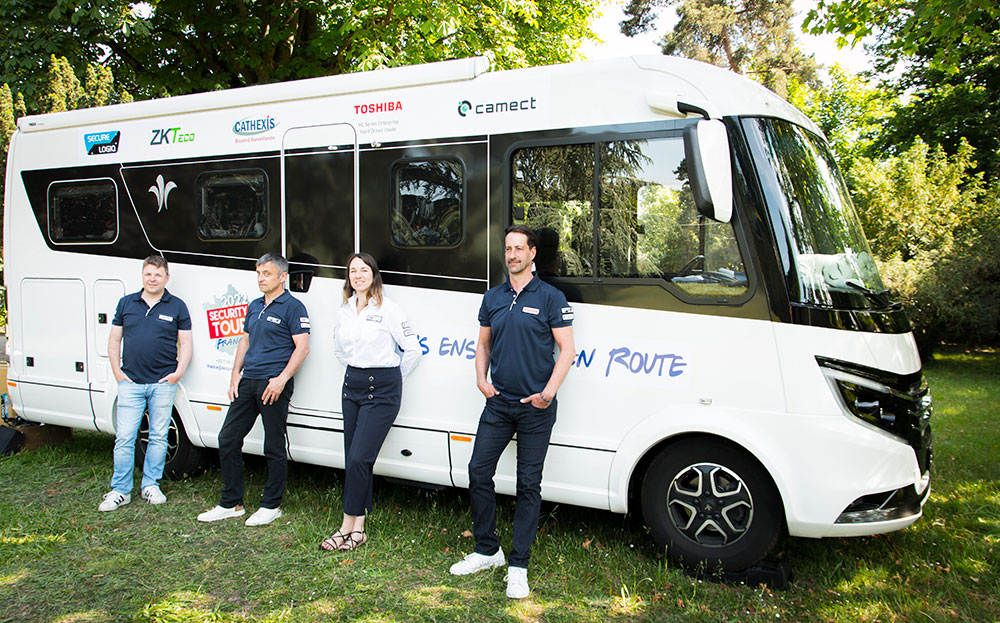
Secure Logiq, Toshiba, Cathexis, ZKTeco, and Camect went on an atypical two-week tour of France. We joined them in the suburbs of Paris to witness the first-hand test of the functionality of a complete integrated solution that these spirited competitors offer in the security market
We caught up with the Niesmann + Bischoff iSmove camper in Chatou, a beautiful town whose looks are sculpted by traditional French architecture and nature. Picturesque houses with high narrow windows, stone and brick facades in the colors of earth minerals, and dark roofs can be found, fittingly, only in this place – the one with much green and quiet. The chirping of birds is the area’s native sound tapestry, and occasional vehicles are just intruders that disturb its peace. While being close to the most visited tourist city in the world, life out there takes place in a completely different timeline: one reserved for yourself and your loved ones, at a bistro surrounded by friends, in intimate gardens surrounded by hedges. Even the hotel where we stayed, although tiny and fused with the panorama of the place, has a small inner stone courtyard, where you can smell the tradition while enjoying your croissant and coffee.
Watch the video reportage:
Integration in practice
We met our hosts in that mini square: Ivan, Jessica, Dominique, and Pierre. Contrary to expectations, thousands of kilometers and a number of visited cities did not leave a noticeable trace on their appearance: we were greeted by a cheerful, open-minded and – as it turned out – a pretty interesting team of people, the memory of who, even now, brings a smile to the face of the author of this text. The four of them work for different companies, which have a variety of products in their portfolio, but which are united by the challenges and willingness to cooperate. Wanting to offer something new to their potential partners and customers, they decided to go on a tour of France together. They branded the camper, equipped it with products, and brought with them their years of experience in business development, sales, and technology with the intention to demonstrate both the individual strength of their companies and the strength that stems from the relationship between various technologies. This is a value that is important to the world of security because the protection of any major facility or location depends on the functionality and reliability of a number of parts that constitute complex security systems. Dedicated servers by Secure Logiq, Toshiba’s hard drives, Cathexis’ VMS, ZKTeco’s access control and Camect’s hub with multiple outputs for multiple cameras, monitors and video walls in fact represent stacked layers of one security croissant of sorts that customers can study on their doorstep as part of a unique tour in this industry.
Dedicated CCTV servers
The entire presented system relies on Secure Logiq’s dedicated servers, the specifics of which we wrote about in one of our earlier issues. A group of experts with many years of experience gathered while working for all well-known manufacturers of video management software came up with the idea to fill in the missing piece on the security puzzle. These are servers specifically designed and built for video surveillance because the use of generic servers did not provide the quality of the recording that could be obtained in the field. The systems were simply not optimized. Secure Logiq has therefore developed a unique Benchmark Pro system to simulate the system that operates in real circumstances. It enters all the specifications that the client submits, from the number and type of cameras to the analytics used. The software then creates virtual streams and simulates what it will look like before the hardware production, i.e. whether the server will withstand the load or not. “Clients often ask us how we can guarantee that our servers will work. The answer is our unique Benchmark Pro software. Since each video system has its own needs, the client provides us with what they need, we make a calculation and deliver a server that is guaranteed to work 100%. If we make a mistake, and so far we haven’t, we’ll fix it at our own expense. And as an added value included in the price of the server, for each client who submits a template and to whom we send a recommendation for the server, we will also provide a complete design. In it, we will describe how many frames per second they get for each camera, what the percentage of the recording is, etc. With that document they can go to the client and ask for a quote”, says Ivan Sval, Secure Logiq’s Regional Sales Manager.
Four-pitched roof
Secure Logiq has several types of servers in its portfolio: from input models 1U with 42 TB, through 2U and 4U, to large workstations of up to 384 TB. The biggest project they completed involved a 1.4 PB server in a single housing. Secure Logiq’s vision is based on four pillars: the largest archive, the fastest data flow, the highest resilience, and the best value for money. “All of our components come with a three to five-year warranty. All servers have two SSDs, with the operating system mapped to both by default, while a redundant power supply is optional. We can run recording servers, workstations used for recording and viewing, or workstation clients used just for viewing recordings,” explains Mr Sval, adding that servers can be upgraded with GPUs and that the last one they worked on had as many as 30 GPU ports.
In addition to Benchmark Pro, Secure Logiq offers two other value-added pieces of software. One of them is Healthcheck, to which the user can connect via the cloud and immediately get information about the status of their server. This does not require an application, but rather online access via any browser. Thresholds can be set in the software, the crossing of which activates the sending of notifications. All communication is protected by SSL encryption and 2-factor authentication. There’s also the Logical Core which allows you to make a copy of one server to another without using licenses for a VMS manufacturer’s redundancy services. The complete Windows is mapped to another server. When the first one fails, the second takes over at no extra cost.
A new challenger in the storage market
Secure Logiq buys all hard drives used in its servers from Toshiba. This is a seemingly unusual move because those who follow this industry know that this renowned Japanese manufacturer, although globally known for its quality, hasn’t operated in the video surveillance market until recently. Toshiba entered the global security industry only five years ago, while its presence in the European security industry was established in 2019. For this purpose, Toshiba had to design completely new products. “We had to develop a special technology because all-day work is demanding for this type of disc. In order to withstand a workload of 180 TB per year, the device must be of great quality. Although we faced strong competition from Seagate and Western Digital, Toshiba is an established Japanese manufacturer which can offer high value in terms of quality, design, price-quality ratio, and investment in research and development. Of course, we had to start from scratch, present our solutions and products and convince customers to trust us,” says Pierre Andrieux, Key Account Manager. It is with this goal that they embarked on this tour in order to establish themselves on the French market together with other brands.
Toshiba has developed a special series of hard drives, firmware, and designs for video surveillance applications so that their products can record videos 24 hours a day, every day of the week. The new series of 3.5-inch discs optimized for storing video with 64 cameras have been named the S300 and is rounded off with the S300 Pro model with a capacity of up to 10 GB. At the same time, they promote an even more resilient and reliable, but more expensive enterprise MG series of hard drives, which can withstand an annual load of 550 TB. It is intended for industrial servers, data centers, and cloud infrastructures. All Toshiba discs come with a five-year warranty, be those the cheapest or the most expensive ones.
Multipurpose open architecture software
The “mind” that manages the entire system backed up by Secure Logiq’s and Toshiba’s hardware is the video management software by the South African company Cathexis. It is software with sophisticated open architecture with multiple possibilities, used for a number of projects around the world. From single installations with over 4000 cameras to customers with over 65,000 cameras spread over 1,500 locations. CathexisVision is not just a VMS in the classic sense: it integrates and manages other 3rd party systems, from intrusion detection and access control to fire alarms, elevators, etc., which makes it very flexible and multifunctional. It comes in several editions: Lite, Core, Professional, and Premium. The difference is in the number of cameras it supports (a maximum of 48 in the first two versions, 150 in Professional, and an unlimited number in Premium), and single servers for Lite and Core and no restriction on servers in the remaining two editions. The cost of the required server platform is considerably lower than the main competitors. In this way, the company can adapt the software to the needs of an individual project. If, for example, you have 10 cameras, one of which is ANPR-enabled, and the two come with on-board analytics, it is not necessary to upgrade to a more expensive version, but rather keep the basic server licence and merely purchase additional camera licenses. There is no limit on the camera functionality supported. Subsequent changes are also easy to make, e.g. moving analytics from one camera to another.
Find objects quickly
The CathexisVision interface is classic, with a video display, timeline, playback and search controls, a feature resource tree,, etc. As we have seen, the software is easy to use and helps you find the clips you need. “Personally, I think that the most important thing in VMS is to quickly find the segment in the video that we need. In our software, this is made simple. We display various activities and other useful information on an intuitive timeline. It includes a graph, often referred to as a Manhattan, which is indicative of the motion throughout the image. The timeline also includes information from other triggers and time based recordings.
If, for example, you want to know when the vehicle entered the parking lot, you can click on the time when it probably did not arrive, e.g. early in the morning, and load that image, and then you go to a time when it’s already there and share the frames between those two time points until you get the one we need,” explains Dominique Debusschere, Cathexis’s Business Development Manager for Europe. Another useful feature is the Activity Trail, which employs different colors, similar to heat maps, to represent movements in the monitored area in relation to the time when they occurred. There is also Adjacent Camera Mapping which offers ease of navigation from one camera to another and by using arrows similar to those in Google Street View.
Easier addition of analytical functions
One of the strengths of CathexisVision is the rapid deployment and fine tuning of multiple types of analytics. The ease of configuration was one aspect of the VMS that helped Cathexis win the Innovation award from the UK security magazine, Benchmark, three out of the last four years. “Once the threat has been identified, one or multiple analytics in the library, including artificial intelligence based object classification, can be used to combat the intrusion,” says Mr Debusschere. The real challenge with intrusion analytics is the large number of false alarms, usually solved by having a technician go to the site and adjust all the parameters, potentially multiple times, requiring both time and money.
To avoid this, Cathexis developed an analytics simulator were recorded footage from the false alarm can be processed remotely allowing an “off-line” inexpensive way of fine-tuning analytics. Integration provides an expansive connection with multiple types of 3rd party devices. For example, a camera detects movement, it would be possible to set the lights to turn on immediately, play an audio warning, check if all the doors are locked, etc. Cathexis now offers a completely revamped, feature rich and highly configurable Android and iOS mobile app. Everything is visible to the mobile security and which can be tailored to their needs. As a novelty for our readers, we learned that just before our arrival, Cathexis launched their new Carbon user interface, an improved and modernised user app with great new functionality. We have also found out that they are currently working on an Enterprise app that will give an estate owner visibility of all his assets, how they are performing, what’s working and what isn’t and be able to control in detail who access to what resources via the corporate Active Directory.
Focus on a new strategy and partner selection
After staying at the European headquarters of ZKTeco in Madrid, which I wrote about in detail in issue No. 178 in May, I was not surprised by the presence of this multinational company on this tour. Back then, I asked them about their development plans in Europe and learned that they opened a number of new offices and were planning for more, that they operated profitably and actively even during the pandemic and that they significantly expanded their product portfolio compared to 10 years ago when they had celebrated their first presentations at local security fairs in a more modest manner. The European market is their focus now and they will maintain that course in the coming years, given the growth in all countries. “Large European market is traditionally a great challenge. Since we have so far been oriented towards project tenders in Europe, we now want to focus on strategy and partner selection, not trying to focus on everything but rather on a few key needs. We want to build a relationship based on trust, so my job is to train our partners to more easily find their partners, bring them in and help them grow,” says Jessica Perret, the company’s Business Development Manager whose goal is to strengthen its presence in French and Belgian markets and draft accompanying strategy.
Client’s trust, among other things, will be built by demonstrating the ability to integrate, and this tour across France is just a great opportunity to do so. “The reason we are participating in this mobile presentation is to show the extent to which we can integrate with all brands. Here, we not only play the role of an independent company but rather show that we are available for integration and communication with other solutions. It’s a new way of marketing. The idea of this presentation is to attract customers, find new partners, and present new ways of getting to know the brand. This type of communication is much more comprehensive. I think that top brands joined together in this way make this presentation stronger and better,” explains Mrs Perret.
A solution for small and medium enterprises
In the park, the “green” company presented us with an affordable and comprehensive Atlas series of access control devices, intended for small and medium enterprises. It is a simple solution, consisting of the main controller to which up to 20 secondary controllers can be connected, together with two types of readers – RFID cards and fingerprints – that can be used simultaneously. The system also supports contactless reading of QR codes from mobile phones, as well as PINs and bar codes. Atlas comes with Linux software installed, which does not require a license. Just enter the IP address of the controller as the URL of the web page. On the main screen of the software, you can monitor the activities of the controller, e.g. how many devices are connected, and how many doors are controlled, with real-time monitoring supported. “You can easily determine if someone is a user and if that person has the right to access a specific door. If you enter a random code, the system reports that someone is trying to enter at a certain time. You can, for example, identify individual doors and readers and connect to the desired door. Also, with the help of the menu, you can get a map of the installation, the location of the controller, as well as information about which door is connected to which type of reader,” ZKTeco’s business development manager told us.
The simplicity of the Atlas series is reflected in its plug & play connectivity, which makes it easier for installers, because they no longer have to spend time connecting, configuring, and explaining the system. The same goes for the users because it is now easy to create new users and give them access. Of course, ZKTeco also offers solutions for much larger installations, such as ZKBioSecurity, which supports more than 200 doors and an unlimited number of users, whereby ANPR, elevator control, time & attendance, etc. can be added to the software. The system can be integrated with any third-party product. They offer communication via SDK to other companies, so they can use the information stored in the controllers and communicate with third-party software.
All analytics in one device
Although their representative could not join us, our interlocutors eventually presented us with a solution from the American company Camect, which is used in more than 30 countries. It is a smart camera hub that offers high-precision object detection in a compact and affordable local system that requires minimal configuration. As obtaining accurate video analytics from a surveilled location remains a challenge, Camect has created a platform that sends detailed and informative notifications about a detected object, which it can send to a monitoring center or other application. This way, it eliminates false alarms caused by smaller moving objects, animals, shadows, or weather conditions. Even simple adjustment makes it possible to detect objects over long distances, which is suitable for construction sites or car parks, for example. The Camect hub is compatible with all IP cameras that support ONVIF profiles or the RTSP protocol, and by combining analytics in one hub, excellent results can be obtained even with cheaper cameras. Integrators can also unlock advanced analytical settings such as increased sensitivity or detecting loitering or unauthorized tampering with the device. The hub itself also has 1 TB of internal memory, where it stores and processes video data, so only alarm notifications are sent to the monitoring center. This significantly reduces bandwidth compared to cloud analytics services for filtering false alarms.
Needless to say, security is of paramount importance in commercial buildings, where we work, get business done or visit clients. People and assets need to be well protected. Accidents and mishaps can cause financial losses and reputational damage to building owners. To provide a safe and secure environment for tenants and visitors, building managers turn to smart technologies, some of which are discussed as follows.
Smart cameras
Smart cameras can play a key role in building security and safety. They are also called AI cameras. Typically deployed on the edge, smart cameras are equipped with AI analytics to detect objects and abnormalities, for example flames and weapons.
“One vital use of smart cameras in building security is the role they can play in fire and safety prevention through the early detection of flames, smoke or spills in buildings. Video analytics combined with AI and computer vision are able to detect incidents in an early state and trigger alarms faster and more reliably than humans. This can lead to the lowering of insurance costs for a facility as well,” said Casey Rawlins, Technical Solutions Consultant at Security & Safety Things. “Smart cameras can also offer early and real-time detection of weapons, such as knives and guns, identify potentially suspicious behaviors such as lurking or loitering in certain areas or detect a suspicious package left behind.”
Smart cameras can also perform people counting functions to make buildings more efficient. “The same set of analytics can also detect a large crowd of people at the base of an escalator or analyze other building foot traffic patterns, produced by people counting or flow detection video analytic apps. This information can be useful to building decision-makers and owners to improve building design through the removal of obstructions that cause bottlenecking, or chokepoints at access points,” Rawlins said.
Finally, smart cameras can help with disease control and prevention, amid and post-pandemic. “The first and most obvious solution (amid COVID) is probably touchless and contactless technologies. For smart cameras, this can be facial recognition for employee entrance into a workplace. In parking garages, it can be license plate recognition for barrier-free entry and automated payments – resulting in a touch-free and contactless experience. These types of entry and exit solutions I anticipate seeing become more and more in demand, as they not only promote safe hygiene practices, but also an optimized experience,” Rawlins said.
Hybrid cloud
A hybrid cloud approach is increasingly seen in building security. Conventionally, building security entails an onsite architecture. Yet more and more, building managers turn to hybrid cloud for more scalability and flexibility.
“The misconception often is that smaller businesses are looking to make the switch to cloud but that’s not always true. We are seeing a number of large enterprise end users deploying cloud for some of their smaller sites or locations for a more hybrid, mixed approach between on-premises and cloud. While on-premises will never fully go away, cloud does offer ease-of-use and less infrastructure that is really attractive to some businesses,” said Chris Sessa, Director of Key Accounts at Salient Systems.
Integration and open platforms
Building security can benefit a lot from integration and open platforms. Managers can view on a single dashboard data generated from various systems. These can be both security- and non-security.
One example is integration between security and a building’s HVAC system. “HVAC systems can be programmed to minimize power demand charges and equipment cycling times by adjusting temperature to live traffic and occupancy. HVAC systems can also be integrated with the building’s security system to adjust room temperature to a specific person’s preferences using facial recognition and historical data on that person,” Rawlins said.
End users from various industries may want to integrate their vertical-specific systems with security to streamline their business. “For example, in healthcare environments, many end users want the ability to integrate cameras and their video management system with software that allows them to track assets, such as patients, staff, medical goods and pharmaceuticals. They also want to integrate medical scope management, which is everything doctors log into a system – from surgeries, COVID tests and more, into the video management system,” Sessa said. “Financial institutions might use a VMS for security purposes, but they can also tie different platforms into it to see what’s happening in their other locations across different states.”
This, then, underscores the need to have open platforms, which have become increasingly important in building security. “In an ideal scenario, all security devices would be integrated into one single VMS, access control system or a larger platform; but having worked with systems integrators for quite some time, we know that many systems are still set up as silos. This is due to a large number of proprietary security systems that all use different protocols and standards,” Rawlins said. “However, end user demand continues to grow for custom solutions and unique integrations to solve their specific pain points. This will no doubt increase the popularity of open platforms and standardized approaches, such as what we offer at Security & Safety Things.”
Integrating all types of systems into one platform, including building management for large enterprise end customers, is becoming more prevalent, as they invest more into other software to streamline processes. VMS manufacturers have to be open to what can be integrated into a platform, from video surveillance and facial recognition, access control badging – it’s all fed into one system,” Sessa said.
Integrator’s role
Amid the latest building security trends, systems integrators should be aware of the latest technologies and solutions to provide tenants and customers with what they need. Cybersecurity, meanwhile, is another issue SIs need to look at. “When working with an end user, integrators should ensure building security is scalable, open and easy-to-use. Complex systems tend to worry customers and present more opportunities for things to go wrong,” Sessa said. “Cybersecurity is a main concern across all sectors right now, as it should be. If you’re an integrator, you should plan for and have certifications to ensure you’re up to date on all best practices. Integrators should make sure they work with manufacturers that take cyber security seriously and offer hardened products.”
Benefits of integrating various technologies into a smart building ecosystem
Reopening commercial office buildings in the midst of COVID-19 requires careful consideration of new health and safety guidelines. Adoption of more smart building technologies is expected to help enforce these rules.
As a driving force behind smart buildings, the IoT has brought with it the ability to optimize all areas of building operations, from HVAC to video surveillance, and offers massive potential for building owners to create added value for customers, according to Adam Wynne, Software Engineering Manager at Security & Safety Things.
“While many facilities are still pursuing goals, such as reducing energy consumption and utilizing space, they have shifted to solutions that help make workspaces and common areas safe, and usable. Building managers must now focus on finding technologies that allow for contactless access control, remote monitoring, management of building occupancy and maintaining of social distancing guidelines, while ensuring proper facial protection is being worn,” Wynne said.
Integrating various systems for maximum efficiency
Entelec Control SystemsWith all the newly drafted safety and health protocols, it is important to see how different building systems can help correctly carry them out. In many cases, insights from an integrated system can be used to understand what visitors were on the premises, who came into contact with who, the airflows from the HVAC, etc.
Koen Schoofs, Marketing and Communications Specialist at Entelec Control Systems, explained the benefits of having visitor management at entrances in combination with video surveillance software integrated in the same platform. He emphasized that doing this centrally is very helpful and eliminates the need to invest in more employees doing checks on the premises.
Schoofs also pointed to centrally managing HVAC units with a PSIM platform, something that has gained more interest recently. “In case of an outbreak for example, you want to minimize the spread of the virus, and must thus be able to quickly stop certain units from spreading the virus with their airflow,” he said.
Optimizing workspaces with building data
Many people are working remotely because of COVID-19, and it’s possible remote working will continue even after the pandemic ends. Add on top of this social distancing and office buildings as we know it will need to be reshaped and reimagined. One way of doing this is with technologies that will enable office and building managers to optimizing their spaces.
The number of enterprise-level buildings expected to connect data from building management system (BMS) platforms to space utilization and optimization software is expected to grow, according to research from Omdia. Investment in standalone solutions is also expected to grow, with the ultimate objective to consolidate space and reduce costs across an entire portfolio of buildings.
“This software primarily uses occupancy sensors to track occupied/unoccupied areas in an office building, and further data is collected related to the numbers of employees present, employees’ habits during working hours, and the times of days these rooms are available. Collecting and analyzing data from multiple sensors and sources within a building to deliver actionable insights enable businesses to better use, optimize and prioritize building spaces while ensuring high levels of comfort for employees in the building,” reported Omdia.
Integrating health and wellness data
Building managers and employers are expected to focus even more on creating safe, healthy and hygienic workplaces for employees and visitors to return to in the post-COVID-19 world. This can be achieved by collecting health and wellness data from different systems.
For example, Omdia addressed the deployment of “smart technologies that can detect fevers or other key symptoms, and help offices create different working ‘zones’ in case of contamination.” This includes devices such as thermal cameras and frictionless security equipment. They also point to investment in workplace hygiene solutions such as smart restroom systems.
Open BMS is not just about protocols
The term “open” has become quite popular in recent years. From open architecture in VMS to open protocols that allow integration of different brands, the concept suggests inclusiveness, which is good both for businesses and customers.
But in the building management systems industry, the word open refers to something much more than protocols, according to Wendy Torell, a Senior Research Analyst at Schneider Electric’s Data Center Science Center.
“The term “open” is often used to describe desired functionality of a Building Management System (BMS),” explains Torell in a blog post on the company website. “It is thought to be essential in achieving the ambition of a smart building. But interestingly, that term itself, while often used by building owners/operators as requirements for their system, as well as by vendors to describe attributes of their systems, generally creates much confusion and ambiguity since the industry lacks a standard definition.”
Developing a framework for open BMS
In a recent white paper published along with her colleagues at Schneider Electric, Torell proposes a logical framework that would help businesses better understand open BMS. This framework consists of three layers that define the concept of open. Each of these layers presents certain expectations that an open BMS needs to meet and build on top of one another.
“This means the capabilities from layer 1 are pre-requisites for achieving the capabilities of layer 2, and layer 2 are pre-requisites for achieving layer 3,” Torell says. “For each of the three layers in the framework, we have defined three criteria for assessing how open the system is: (1) Interoperability, (2) Engineering complexity, and (3) Who performs the work.”
As the name suggests, interoperability evaluates how well one component of a BMS operates seamlessly with another or how well one system works with another. Engineering complexity refers to the level of difficulty to achieve this interoperability. The third criterion checks if the people who operate the BMS need specialized training, making things difficult for customers.
Torell added that there are often tradeoffs with these criteria. For instance, you might be able to achieve a highly open system in terms of interoperability by sacrificing engineering simplicity; or work can be done without engineering complexity, but only by a vendor’s certified technician. Having this construct for discussing a BMS’s degree of “openness” brings these important topics and tradeoffs into the picture.
The three layers
The first layer of the proposed framework is data acquisition and sharing. This is critical to any BMS because sensors that send data and receivers that capture and process them form the foundation of a smart building.
“Controllers require protocols to communicate,” Torell said. “More and more, controllers use open protocols, and to consider a BMS open, it should be interoperable across multiple OT protocols (i.e., BACnet, LonWorks). But just because it uses an open protocol doesn’t mean it is interoperable. The needed data must be exposed by the vendor. The system should also support the extension of native protocols, in order to limit the number of gateways required to serve as “translators” to the sensors, actuators, and controllers.”
The second layer is integration, as BMS solutions extend beyond their conventional role to work alongside security, safety, and other segments. An open BMS solution should allow standard protocols that enable integrators and customers to unite all their solutions and operate them together. Finally, the third layer is building orchestration, which refers to the efficient coordination of all systems under the BMS.
Conclusion
As systems like BMS continue to develop, there is definitely a need to define their role and functions clearly. Knowing what constitutes an open BMS would help customers make better purchase decisions. Other segments like surveillance and access control would also benefit from considering this kind of framework.
Suprema has successfully integrated its Biostar 2 security platform with Mantech Continuous Cluster Server(MCCS), a high availability(HA) solution provided by Korean IT service provider Mantech.
Biostar 2 is a comprehensive access control management platform that manages mission-critical security data. Through integration with MCCS, Biostar 2 is able to enhance system stability and expand service continuity. This also ensures greater cost-efficiency, productivity, and availability for Biostar 2 customers by minimizing unnecessary waste of resources to manage failure, such as manpower, applications, and extra storage.
MCCS, the failover system of Biostar 2, uses automated failover and real-time replication to help prevent server downtime, data loss, and system failure. It can detect the failure of servers, storage, networks, application services, and operating systems. When failure occurs, it automatically switches to a backup system and replicates data in real-time so the company can protect mission-critical data 24/7 with no downtime.
“Integrating with MCCS has enabled Biostar 2 to provide an even safer and more secure platform service than ever for our enterprise customers,” said Suprema CEO Hanchul Kim, “Suprema will continuously make efforts to enhance Biostar 2 capabilities, meeting the needs of all our customers, from small offices to the largest organisations.”
SALTO and Kohost technology announced partnership that enables contactless smart access and guest room control on guest phones without downloading an app.
SALTO hospitality solutions and Kohost combines easy access, digital key and smart guest rooms, with unified property management systems that protect individuals and assets. With the addition of the SALTO network dongle, older SALTO locks integrated with the Kohost app can become digital keys without having to replace the locks.
Smart-hotel convenience. Provide the modern, easy access option guests increasingly expect with digital keys or key cards giving convenient, instant and safe access.
Seamless keyless experiences. Extend smart access beyond the guest room across your property. Provide seamless access from back-of-house to entrances, perimeter access doors, elevators, gyms, business areas, parking and any other hotel facilities.
Exceed expectations. Enable guest service innovations creating value-add opportunities to drive business for your hotel, enhancing guest experiences and delivering operational efficiencies.
“With over 40 million daily users of SALTO smart locks worldwide, we are providing a safe and secure environment for guests while at the same time delivering energy savings, safe and efficient lodging when combined under the SALTO- Kohost platform. Offering our customers integration with the innovative Kohost Guest Experience “GX” App is an easy way for those properties to add the conveniences their guests want, right in the palm of their hand,” said Beth Kahwajy, SALTO Director of NA Hospitality.
In addition to providing the smartphone interface to the SALTO locks and access controls, Kohost and SALTO new integration and technology partnership delivers remote digital room keyless access on a guest’s phone, total room control together with smart guest room systems, including HVAC, Lighting, Window Shades and TVs in addition to concierge guest services, two-way communications and local F&B ordering.
The global physical security market size is expected to reach USD 137.99 billion by 2028 according to a new study by Polaris Market Research in a new report which gives a detailed insight into current market dynamics and provides analysis on future market growth.
Significant factors of the market such as increasing smart city projects by the government deploying various physical security systems coupled with the improving infrastructural development with the robust access control measures are impelling the market demand. In addition, growing awareness regarding the availability of numerous IP-based cameras for video surveillance is further boosting the market demand across the globe.
Based on end-use, the residential segment holds the largest share globally. This is, according to Polaris, due to rising concern for safeguarding lives and protecting assets from any potential risks. The transportation segment is projected to rise at the second-fastest CAGR over the forecast period due to the growing demand for the equipment to be deployed in the overseeing of traffic congestion and monitoring crowds.
G4S, Anixter, Axis Communications, Cisco Systems, Dahua Technology, Genetec, ADT, Hikvision Digital Technology, Stanley Convergent Security Solutions, Honeywell International, Pelco, Dahua Technology, Robert Bosch, Johnson Controls are some of the key players operating in the global market.
Securitas has established a new global entity called Securitas Digital – it will be led by Martin Althén. Hillevi Agranius will be appointed Chief Information Officer (CIO) and added as a new member of the Group Management team. The changes are set to be effective from July 1, 2022.
It is planned that the Securitas focus on client centricity, digitalisation, and innovation will now further increase as the company creates this new, global function: Securitas Digital, focusing on the accelerated growth of the digital products and services from the Group.
“I am excited that we now have reached the point where we are ready to accelerate our digitalisation and client experience journey. Martin has been instrumental in building our digital foundation, and I am confident that he will succeed in leading Securitas Digital,” says President and CEO Magnus Ahlqvist.
“At the same time, I couldn’t be more excited to promote one of our successful leaders to CIO. Hillevi has extensive experience, both during her years in Securitas and as the previous CIO at Husqvarna.”
As the President of Securitas Digital, Martin Althén will own Securitas’ digital business strategy, drive innovation and grow the digital business. He will ensure that Securitas’ overarching technology strategy enables the business optimally.
As CIO, Hillevi Agranius will continue to drive and refine the IT transformation and efficiency agenda throughout the Securitas Group. She will take on the overall responsibility for Global IT, including Divisional IT operations, Digital Security, Platform teams and Enterprise Architecture.