Home 2022 (Page 9)

A Finnish sailing club saves members’ time by securing premises with cloud-managed, energy-harvesting locks

London, September 2022 – Many businesses know this problem. Securing dispersed sites poses specific problems for facility managers. Cylinder replacements when a key goes missing often involves travel and high expense. Any alternative access control system which relies on electricity can be hard or impossible to use in remote locations. Battery-free, wireless electronic locks, managed remotely via cloud software, help meet these challenges.

 Näsijärvi Sailing Club in Finland has multiple bases all over Lake Näsijärvi, some located up to 2 hours’ sail from each other. Many mechanical “skipper keys” were in circulation, which allowed club members to unlock and use these facilities. However, keyholder registers and many traditional mechanical keys’ whereabouts were no longer up to date. This presented a security challenge which neither mechanical security nor traditional access control could solve. The sailing club were seeking a solution to increase their security and at the same time save  effort and costs.

For a new, more efficient solution, the Sailing Club sought a programmable digital key system to help them regain control over facilities’ security. They needed wire-free locking devices suited to the club’s remote locations, with power provided by the user key.

To manage everything, they required software which enables system management tasks to be completed from anywhere: a system which makes it easy to remove access rights from any missing keys and audit trail capabilities, so security administrators can check access logs if an issue arises.

More control with programmable smart keys

Näsijärvi Sailing Club chose PULSE key-operated access control solution from ASSA ABLOYs group brand ABLOY for securing their premises and managing access for club members. Around 55 PULSE cylinders have been deployed across various Sailing Club locations. Authorized members now carry an individual key which opens all their permitted PULSE locks around the lake.

Why is PULSE the best fit for clubs with remote sites?

PULSE locks are ideally suited to an environment like Lake Näsijärvi, where access points are scattered. They generate all the electricity they need to power lock electronics from the key thrust. This innovative energy harvesting technology means neither cabling nor batteries are needed, which saves running and maintenance costs for the Sailing Club.

The PULSE cylinder range includes door locks, cam-locks, furniture locks and padlocks which can operate outdoors in the harshest climates. Almost any cylinder can be switched for a PULSE device and connected without wires or drilling.

Another advantage is that a PULSE system is so easy to manage. The club administer it for themselves, saving them additional management costs, too.

Secure facilities may be hours away by boat: PULSE saves wasted journeys. “The PULSE system allows keys to be updated and disabled at any time via readers and the cloud service,” says Ari Karjalainen, CEO of Ajan Lukko Lock and a member of Näsijärvi Sailing Club.

Incidents are easy to investigate by consulting key or lock audit trails: “In cases of vandalism, the access register can be used to check whose key has been used to visit the premises and when,” adds Karjalainen.

Advancis agrees technical partnership with Motorola’s Avigilon

Whereas Avigilon has been a Premium Technology Partner of Advancis ever since last year already, Advancis is vice versa now also part of the Technology Partner community of Avigilon.

Avigilon Control Center (ACC) video management software is completely integrated in the Winguard open PSIM platform from Advancis, so that it is possible to observe live streams, control cameras (PTZ), request playback videos, and more. Advancis’ Winguard ACC integration is compatible with ACC6 and ACC7 versions.

Laura Flamm Technology Partner Manager at Avigilon, states: “With this integrated solution, situational awareness is enhanced for the end users and provides efficient and intuitive security information management capabilities.”

Split-type Camera System For Project With Limited Space

VIVOTEK’s VC9101 is a high-performance split-type camera system. Its discreet design, rich functionality and ability to be flexibly integrated into even the tightest spaces, make this camera ideal for indoor or covert surveillance of ATMs, banks, stores and offices. The VC9101 features a separate camera unit (CU series) and video core design, enabling the tiny camera unit (with 5-meter long cable) to be easily and flexibly installed into any decoration or interior design, thus preserving stylish appearances while dramatically saving on installation time and cost.

Key Benefits:
· The camera unit that can be connected to the core unit can be positioned up to 5 meters away, enabling the tiny camera unit to be easily and flexibly installed into any decoration or interior design.
· The split-type camera system can be used to monitor spaces such as ATM’s, elevators, a single large space, or to provide different types of views, among other possible usage scenarios.

VC9101 Lens Installation: https://www.youtube.com/watch?v=e5Qi_cy53lY

For More Information: https://www.vivotek.com/VC9101

Contact our Sales: https://vivotek.futuresimple.com/  or email: djordje.bacic@vivotek.com

#vivotek #security #iot #surveillance #ipcamera #ai #surveillancetechnology #surveillancesystems #surveillancecamera #networkcamera #vca #analytic #ndaa


Video surveillance market set to register $76 billion by 2027

The video surveillance market is projected to grow from USD 48.7 billion in 2022 to USD 76.4 billion by 2027, at a CAGR of 9.4% during the forecast period. A number of factors, including increased camera capabilities, maturing technology, features, and customised systems, are making it easier for integrators to meet the demand from end users willing to upgrade legacy surveillance systems to meet their security and operational needs. This is according to the latest information coming out of the research company, Marketsandmarkets.

Security concerns and advancements in technologies demand real-time remote monitoring on any device at any time by end users such as retail stores, manufacturing sites, enterprises, warehouses, and banks to detect unusual events on their premises.

Storage devices hold the largest share

While DVR’s are considered as cost effective storage solutions, NVR’s provide an IP based recording solution over a centralised network providing more flexibility than DVRs. With the growth of IP cameras that record videos at higher resolutions and framerate, some of these cameras simultaneously record sound alongside the video. These factors have increased the storage requirements; hence, storage devices are projected to grow at the highest CAGR during the forecast period compared to cameras, monitors, and other accessor.

IP surveillance systems to show the highest growth

Along with the basic features, advanced IP cameras have enhanced filtering capabilities that can monitor the image and video data even in low light conditions. The network interface and PoE interface are used to transmit the data over a network. For advanced camera features, such as PTZ and PWM, motor drivers can be used to rotate the camera with PTZ capabilities. Although the upfront cost of IP video surveillance systems is higher compared to an analogue CCTV system, the total cost of ownership (TCO) over time is lower compared to analog video surveillance systems. Analysts found that some of the strongest players in this field include Hikvision, and Dahua Technology, Axis Communications, and Bosch Security and Safety Systems are among the major players providing IP video surveillance systems consisting of cameras, storage, and software.

City surveillance boosts infrastructure vertical

City surveillance is the dominant application for the video surveillance infrastructure market and is projected to grow at a high rate. An increase in investments by governments of various countries to increase safety levels in public places is also projected to boost market growth. The increasing number of smart city projects will require the implementation of various security and surveillance systems, thus driving the growth of the infrastructure market during the forecast period.

Fastest growth comes from APAC countries

Asia Pacific is projected to be the fastest-growing region in the video surveillance market owing to heavy investments in infrastructure and smart city projects. The use of security cameras in Asia Pacific is expected to increase owing to the massive deployment of city surveillance networks in China to monitor millions of citizens across the country. The increasing urbanisation in Asia Pacific has led to the development of new cities and manufacturing and retail industries, among other application areas in other countries. The rising penetration of surveillance cameras in small and medium-sized enterprises, hospitality businesses, airports, ATMs, banks, residential buildings, and religious places, among other places, is also expected to drive the video surveillance market growth. According to Marketsandmarkets, the major players in this region include Dahua Technology, Hikvision, Hanwha Techwin, and Uniview.


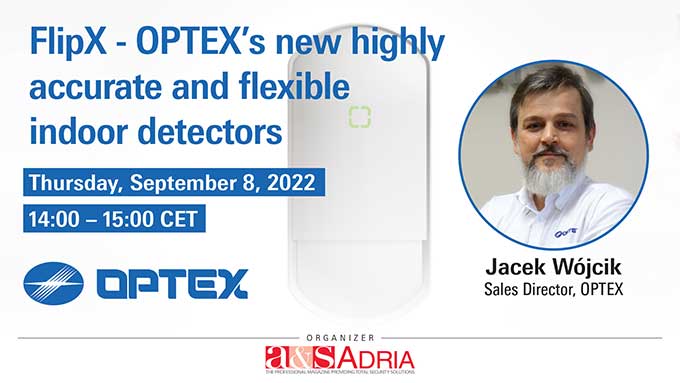
FlipX – OPTEX’s new highly accurate and flexible indoor detectors

On Thursday, September 8, OPTEX will present FlipX, a new highly accurate, and flexible indoor detector.

Installers and end-users in Europe, the Middle East, and Africa (EMEA) can now take advantage of FlipX, a new range of flexible indoor sensors from OPTEX, the leading global sensor manufacturer.  New techonlogy features a bespoke pyroelectric sensor for increased performance that adapts to the human shape, and a unique lens that can be ‘flipped’ to provide both narrow and wide detection in a single sensor.

This ‘flipped’ lens has been designed with flexibility in mind. It effectively gives installers “2 sensors in 1” to satisfy multiple customer demands. It helps installers manage both their inventory and their cashflow while giving them the versatility and confidence of arriving on site with the solution they need to match their customer’s needs.

The new indoor sensor series is built on OPTEX’s extensive track record of providing outstanding sensing performance for intruder detection applications. By simply rotating the lens through 180°, the sensor can be used to protect narrow or long areas such as a hallway up to 18m, or a wide, open area like a living room or retail store up to 12m at 85°.

FlipX Standard, the first to be released from the new series, is a Grade 2 sensor, that also features a digitally enhanced signal recognition logic called Super Multi-Dimensional Analysis (SMDA), which means nuisance alarms caused by changes in light or temperature can be avoided.

Following the FlipX Standard launch, OPTEX plans to release other models in the FlipX series in late 2022/ early 2023.

Link to join: https://pro.connect2bnet.com/live-stage/6210

Top surveillance industry players expand their lead

Genetec, Motorola Solutions and Milestone Systems continued to grow their combined global share of the market for video surveillance software and service agreements in 2021, according to a new report from Novaira Insights. The research shows that this global market was worth $2.4 billion in 2021 with around 68% of this outside China. The, so-called, “big 3” grew their combined share of the market for video surveillance software and managed services to over 35% in the world excluding China.

The supply base for video surveillance software outside China remains very different to that of the Chinese domestic market. China continues to be mainly served by large domestic vendors. In contrast, the world excluding China is served, not only by the big 3, but also by a multitude of other suppliers, each with a small market share of less than 3%.

Novaira Insights’ latest report, “The world market for video surveillance hardware and software”, shows that, outside China, the market for video surveillance software and managed services grew quickly at 10.1% in 2021, as restrictions on movement due to the Covid-19 pandemic eased and pent-up demand for video surveillance equipment was served.

According to Jon Cropley, principal analyst at Novaira Insights, “An important factor in the big 3 continuing to grow market share in future will be their strategies for cloud. We are forecasting that the market for cloud video management software will grow much faster than the market for on-site video management software licenses. So far, each of the big 3 has adopted a different approach to cloud so it will be interesting to see how these approaches evolve going forward”.

The pandemic appears to have catalysed interest in cloud video surveillance. 53% of respondents in a Novaira Insights 2022 survey of North American end-users indicated that the pandemic had either started, accelerated, or greatly accelerated their organisation’s cloud strategy specifically related to video surveillance. Furthermore, 68.3% of respondents thought their organisation will move to managing or storing more of its video surveillance data in the cloud in the next two years.

According to lead analyst and founder of Novaira Insights, Josh Woodhouse, “The medium-term future for many video surveillance installations will be largely a hybrid approach in which software is hosted off-premise in the cloud but a primary tier of video storage is on-premise. Cloud storage will likely be increasingly used but this will be often in conjunction with on-premise storage tiers.”

Strengthen protection and control with Unified Security Solution

Over the last decade, the security landscape has been evolving in fundamental ways. Where once security systems were primarily based on cameras, access readers and other electronic devices focused on protecting physical spaces, they have become software-based, securing both physical and digital spaces. Today, for most organizations, security encompasses even more – it’s now also about bringing added value to the organization.

Unified systems make operations more secure

When your video and access control security systems talk to each other, you have the potential to increase protection levels exponentially. The seamless sharing of data significantly improves your ability to keep your people and assets safe. Siemens unified security makes this happen. By connecting our SiPass integrated Access Control and Siveillance Video Management systems, we provide a smart, highly transparent way to manage security systems.

When our SiPass integrated and Siveillance Video systems interact with each other, events from both systems are analyzed as a single data set. The information you need for seamless alarm management is delivered immediately – all on a single screen.

Gone are the days of toggling between two screens and learning two or more systems. With centralized monitoring and operations, you’ll have situational awareness from one user interface. You minimize the possibility of missing important events while increasing response times when events occur.

Greater efficiency 

Handling and reviewing events is easier and faster with a Unified Security approach. When access events occur, a security operator receives an associated live or recorded event video to better understand the situation in order to respond to the event. Unification enhances the security system process by combining operations into one interface to better manage and review events onsite or remotely – at desktop workstations or on mobile (Android or iOS) devices.

Flexible and scalable

Most set ups are easy and require minimal onsite configuration. As security needs change,

you can easily add video and access control enhancements. You can also integrate with other building applications, such as visitor registration, elevator management, gunshot detection, intercoms, license plate recognition (LPR), forensic search platforms and various types of video analytics.

Reap the rewards

If you choose to fully implement our unified access and video solution, you’ll be able to:

  • Control on one screen: Manage events, stream and state changes, and trigger rules and actions from both video and access control systems through one interface
  • Search by identity: Receive and search by cardholder information and compare to live video
  • Customize alarms: Create alarms based on access control events and associate alarms with video feeds
  • Intrusion integration: Monitor and control video, access and intrusion systems from a single all-purpose security interface by adding Siemens intrusion stations
  • Manage technology: Display video cameras, access points, intrusion points, alarms and events on a graphical map in a single platform
  • Leverage powerful APIs: Allows open integration of systems and products, including third-party offerings
  • Select preferred equipment: Leverage open integration capabilities and choose from a variety of video cameras, biometric readers and mobile credential readers
  • Implement system easily: Get started without complex integration, scripting or APIs
  • Secure by design: Increased connectivity and interoperability without increasing vulnerability

False alarms make up 98% of automatic fire alarm confirmed incidents in 2020/21

In new data released by the Home Office, statistics show that the vast majority (98%) of confirmed automatic fire alarm incidents are false alarms, while only 2% were a result of an actual fire in 2020/21. This is down from 3% from 2019/2020.

The majority of false alarms (90%) are due to ‘false apparatus’, with 2% deemed as malicious. 6% are a result of ‘good intent’.

The overall number of fire incidents from automatic fire alarms in 2020/21 was 129,221 – a decrease of over 6.5% on the previous year. Of those that were confirmed fires, 1,855 were from dwellings, 740 from ‘other buildings’, 52 from secondary fires, nine from ‘other outdoors’, five from road vehicles and four from chimney fires.

Automatic fire alarms are designed to sent a signal once a fire is detected via the fire alarm panel straight to an Alarm Receiving Centre (ARC) for the local fire and rescue service to respond to. Some fire and rescue services now also require a confirmed fire before responding, due to the high number of false alarms received, though many do not, such as the London Fire Brigade, who will response to every alarm unless a false alarm is confirmed beforehand.

(IFSEC)

The right Door Closer is critical for building fire safety

London, September 2022 – No one needs a reminder of the devastation caused by fire in a large building. One result of recent tragedies is that fire doors now receive the attention and regulation they deserve. Just as importantly, however, any fire door must be properly closed to be effective. This is where a building manager’s choice of door closer technology can make the difference.

“Historically, fire doors and their components have often been overlooked in building fire safety,” says Richard Wilson, Door Closer Product Manager at ASSA ABLOY Opening Solutions EMEIA. “But over the last few years, their vital importance has been recognized. Doors are critical safety features. They provide fire protection and compartmentation.”

However, he warns: “Like any door security technology, fire protection will only work if the door is fully closed, preventing the spread of fire and smoke. Relying on building users to do this 100% of the time is not realistic.”

Door closer technology can help. A certified door closer which is properly fitted helps to build a barrier to aid escape and slow a blaze’s progress with compartmentation. After analysing one recent tragedy in New York, city officials said the death toll would have been lower if doors were properly closed1.

Door closers and fire safety

Every element on a fire door, not just the leaf, must be tested to industry standards and certified. This includes door and architectural furniture. Among these components, door closing devices are of vital importance.

“Companies which supply life-critical building equipment must be confident in its performance in real-world situations,” explains Richard Wilson. “Most architects and building specifiers now request product datasheets with primary fire test data from an accredited third-party testing house.”

The added value when building managers choose ASSA ABLOY

The broad portfolio of ASSA ABLOY door closing solutions is fully tested and certified to meet the needs and regulations of new buildings and retrofit projects.

“There is an effective, efficient ASSA ABLOY Door Closer available for almost any opening, of any door size or type,” adds Richard Wilson.

Besides full test coverage, correct installation is of course critical, as Fire Safety Week advice for landlords highlights2: “Fire doors are not ordinary doors. They’re a carefully engineered fire safety device. They must be fitted correctly.” To support installers, all ASSA ABLOY product labels include QR codes which link directly to installation walk-through videos.

To assure ongoing performance, every ASSA ABLOY model has a long warranty and is supplied with maintenance instructions.

Cam-Motion guiderail vs. rack and pinion door closing technology

Cam-Motion Door Closers provide an ergonomic opening experience for everyone who passes through the door. The necessary user push-force falls rapidly on opening, which enhances comfort.

Because ASSA ABLOY Cam-Motion devices’ closing force and latch speeds are independently adjustable, the door can be configured to close reliably each time. Thermo-resistant valves with metal heads, rather than plastic, ensure adjustments are dependable: Once door speeds are set, they stay set. Even with wind pressure, draughts or air suction effects, doors shut tight.

In comparison, rack and pinion door closers are more common and cost-effective, but do not tend to operate as efficiently for fire doors, according to the UK’s Fire Protection Association3.

All ASSA ABLOY Cam-Motion devices are tested to EN 1154 standard for fire and smoke protection. The door closers’ symmetric cam is designed to fit to either frame or door, and on hinge or non-hinge side: Whatever suits the opening best with no compromises or workarounds needed from the installer.

“The degree of so-called ‘passive fire protection’ given by a fire door is greatly enhanced by the intelligent technology inside an ASSA ABLOY Door Closer,” says Richard Wilson.

To learn more about the benefits of an ASSA ABLOY Door Closer, visit https://campaigns.assaabloyopeningsolutions.eu/doorclosers

Face recognition – the new standard for new generation systems

By Artem Arifov, Suprema Business Manager; sales_eu@supremainc.com

Traditionally if we look at Access Control systems, we would find touch solutions either with RFID cards, keypads or fingerprint sensors. For many years, these technologies have conquered the market over all its verticals. But as time passed, the technological breakthrough introduced in our everyday life such features, that no one had ever thought of before.

The IFSEC Global Physical Access Control Trend report found that 43% of respondents listed contactless capabilities as one of the top three features they would require of any new access control system. Touchless access becomes the gold standard and the face recognitions technology becomes the cornerstone of the new generation access control systems.

Open the door by walking up to the system? Get access granted even when staying in motion? Gain access without having to lift a finger or do anything ? – This isn’t any more a science fiction dream, but our daily life. Today the Facial Recognition allows to confirm “in motion” individual’s identity at affordable price by providing the highest security level. How did we get there and how will look like the next generation industry standard tomorrow? Artem Arifov, Business Manager at Suprema, the company that has been moving the entire industry for more than 20 years, will talk about the new door access experience and latest market requirements for access control solutions.

The cradle of Face Recognition technology

The interest in Face Recognition has been increased specifically for the last couple of years. However, the technology is more than 50 years old. The earliest pioneers of facial recognition were Woody Bledsoe, Helen Chan Wolf and Charles Bisson. In the 1960s, this research team ran the first experiments in machine facial recognition. The working group used a database of 800 pictures of people in different angles.

The challenge was to find automatically matches by running the first face recognition algorithm. The experience was based on the idea of using distances between human face landmarks. By the way, this basic concept is still fundamentally relevant even for the new generation algorithms.

The scientists marked manually various “landmarks” on the face such as the person’s hairline, eyes, and nose. Even if in the end, the computer coped 100 times faster than a human, the experience wasn’t successful because of the technology of the era.

Outstanding development

Face Recognition has come of age only at the beginning of 2000s. Mostly thanks to high-resolution cameras, mapping processes, machine learning, artificial intelligence and processing speeds.

To demonstrate the advancements in facial recognition technology over the past decades, we should mention that the face recognition algorithms in 2006 were 10 times more accurate than the ones of 2002 and 100 times more accurate than those of 1995. And the same exponential growth continues still now. According to the National Institute of Standards and Technology (NIST) test, between 2014 and 2018 there was a twenty times improvement in algorithms performance over four years.

NIST computer scientist Patrick Grother says: “The accuracy gains stem from the integration, or complete replacement, of prior approaches with those based on deep convolutional neural networks. As such, face recognition has undergone an industrial revolution.”

Face recognition implementation in smartphones

While outstanding technology development, Face Recognition has been considered for a long time as “”luxury” product for the most critical security sites. A watershed moment arrived in 2017, when Apple announced the new “Face ID” features on iPhones. Suddenly Face Recognition stopped being viewed as fantastic technology and came out in a large public.

However, the phone’s solution isn’t the most secured, especially when based on basic optic camera technology that can be spoofed with photos and 3D mock-ups. It’s not something reliable when trying to secure the most critical data. It’s one of the reasons why professionals still recommend using fingerprint scanner rather than the face unlock feature on smartphones. Similarly, the basic algorithms running in most phones today doesn’t adapt to changes in clothing habits, such as wearing new glasses, hat or a face mask.

Rather than using color camera image data like traditional face unlock methods, the modern facial recognition system combines classic optical and infra-red images of the face. AI-based visual recognition makes a fusion of both images together, which analyses this unique enhanced spectrum facial data for key facial profile features. So it can’t be spoofed by pictures, sculptures, etc., and works well in all lighting conditions. It’s also designed to work with hats, scarves, glasses, contact lenses, and many sunglasses and automatically adapts to changes in someone’s appearance, such as wearing cosmetic makeup or a beard. It can even work in total darkness due to the IR camera.

For example, FaceStation F2 Fusion Multimodal Terminal optimizes IR and visual face recognition to produce exceptional authentication results, achieving extremely low false acceptance rate (FAR) of 1 in 10 billion.

Covid-19 and spread of contactless payments

 The main manufacturers started tracking touchless Access Control solutions even before 2019. But the pandemic has changed especially the European way of thinking. Before the COVID-19, most of payments in Europe used to be cash. COVID19 has accelerated the Credit Card payments and contactless technologies by card or on your smartphone. Mastercard reported that 75% of all transactions in Europe are now contactless.

Similarly Face recognition and Mobile Access have been gaining traction with physical and cyber security professionals. Practically, this trend contributed to commercial activity with Suprema’s facial recognition products deployed by Nomura Real Estate Development in Japan, Kuwait National Petroleum Company, and Samsung Electronics.

Suprema’s world-leading facial recognition access control business grew at three times the industry compound annual average reported by Omdia from 2018 to 2021. A 2021 report from Omdia says Suprema has the largest share of the biometric access control market in the world outside of China.

“Suprema and our partners have made a breakthrough during the COVID-19 pandemic by responding to the needs of the market with advanced technology and innovation.” says Suprema Inc. CEO Hanchul Kim, “This year, with our upcoming facial recognition solution, Suprema will also lead the fast-growing global facial recognition market.”

The new industry standards

Improved accuracy and benefits provided by today’s facial recognition leaders make it an ideal primary access control authentication tool. In line with the new paradigm of post-COVID access control, facial recognition is now the preferred access credential over fingerprints. In the contactless era your face is now your key. Furthermore, the technology is becoming more affordable for few reasons :

“First, Technological advancement in the field of sensors and processors has increased the performance of Facial Recognition and decreased it cost. For example, by adopting fast and smart AI processor called a Neural Processing Unit (NPU), Suprema achieved lower power consumption. Secondly, thanks to Artificial Intelligence and Machine Learning, our algorithms have become more complex, improving the performance of the devices”, explains Baudouin Genouville, Suprema Europe’s Sales Director.

Another recent Face Recognition’s revolution was a launch of algorithms that are increasingly tolerant of poor-quality images. A benefit is that empowers the algorithm by reducing the number of neurons an algorithm needs to measure image variations at the pixel level.

All the security experts know well that the highest security level of identity confirmation is to use multi-factor authentication combining RFID or mobile cards, PIN or QR-codes with biometrics (Face or/and fingerprint). This enhanced level of security is suitable for the most critical sites (banks, military areas, police, airports, etc).

But the vast majority of access control systems are used for everyday purposes at business offices, factories, universities, hospitals, construction sites or fitness studios. All these customers require cost-efficient, flexible solutions to use for fast and accurate access control identity authentication. Today the Facial recognition as a credential is the ideal solution for organizations looking to deploy the most current, accurate, and rapid technology while simultaneously enhancing the user experience in most access control applications. What are the new requirements on the market ?

1. GDPR-designed systems

 For many years people have been really concerned about anything related to tracking or biometrics in general, because of the privacy. This issue was mostly driven by people not understanding the technology. However, a big part of responsibility is now on the side of manufacturers. Since the new GDPR-regulation, the European privacy world-leading standard was adopted, all manufacturers take very seriously the data protection.

ISO/IEC 27001 certification is a fundamental of each reliable system. It includes more than a dozen standards for any sensitive information management such as financial information, intellectual property, employee details or information entrusted by third parties. All stored data must be encrypted, in addition, the delete option of all relevant information must be available. Furthermore, the communication between access control products uses AES-256 encryption or TLS protocol. Of course, any reader where the data is stored should support Secure Tamper feature : if a product is detached arbitrarily and forcibly, it detects this and provides a function to entirely delete all information within the product. The high-end products are also embedded with Secure Element(SE) to prevent cyber-attacks.

The European market sets up the worldwide highest level of privacy protection. Using biometrics in Europe is strictly regulated by GDPR-laws and only few manufactures in the world as Suprema can guarantee the requested data protection level. To be clear, in spite of the well-known concern, during the enrollment process the reader doesn’t store any image neither on device, nor on server. The algorithms take in account distances between unique landmarks by transforming them into Face template or face profile, a mathematic model of your face. This matrix is irreversible, however, is also considered by GDPR-law as private data. Very few readers today can support Template-on-Card feature that enables identification with biometric data saved on RFID cards.

Since September 2022, Suprema is a pioneer of ‘Face Template on Mobile’ technology for facial recognition authentication. It lets users enroll into an access control system and store their biometric face profile directly on their own mobile devices so the biometric data is not saved in the company’s database. This feature embedded in the new BioStation 3 Fusion terminal will surely change the entire industry, at least in Europe. 2. Cost-efficiency and social responsibility

The most responsible manufacturers understand all risks related to the global warming and are engaged in a world’s fight against this issue. As part of the company’s environmental initiative, we can mention the cut down on plastic waste produced by RFID cards.

A nice example of realization would be Stonyhurst College in the United Kingdom. Sam Moore, facilities director at Stonyhurst, says the school went through “vast, vast amounts” of access cards with an estimate of around 100 per week due to losses and damage. But the Suprema Mobile Access app and FaceStation F2 biometric terminals eliminate the need for cards entirely, which Moore says is saving on costs and reduces the amount of disposed plastic, thus being greener.

“BioStation 3, being the first release in Suprema’s third generation product lineup, is expected to offer an enhanced experience for operators, installers and end-users. Moreover, Suprema will continue to play its duty in environmental protection by minimizing pollution caused by plastic access cards through emphasizing the advantages of using biometric and mobile access solutions,” states Suprema Inc. CEO Hanchul Kim.

Of course, the systems must support basic human rights values and not running the algorithms on ethnical criteria. For example, Suprema industry leading face recognition terminals recognize all people the same way regardless of user ethnicity, skin color and face changes. Today this is a big issue, especially for cheap providers, mainly coming from non-democratic countries.

Another challenge is to face the actual energy crisis. The size of terminals becomes more and more compact that reduces the energy-consumption of screens. So, it not only fits well on small office doors, but provide cost-effectiveness and energy saving improvement. Finally, PoE+ features enable less wiring and quick installation.

3. Supporting VoIP Intercom, RTSP and SIM slots for multitasking

 New generation demands request the highest flexibility of the hardware. To make access control easy, manufacturers equips their hardware with VoIP Intercom feature and RTSP (Real Time Streaming Protocol) for supporting video monitoring and using device as a camera. It enables seamless communication with all doors at anywhere and anytime. Wi-Fi feature is also required in modern sites. Also as custom USB hosts for additional SIM Slots is a kind of requirements for critical infrastructure without network. The Access Control hardware is becoming more universal trying to respond to the increasing multitasking of our everyday life.

 4. Flexibility of integrations

 Integrations with 3rd party software is a “must have” feature for any product today. The systems is becoming more complex involving more and more tools and features. The bright example is Video Management systems, when VMS can control access control readers and cameras at the same time by creating a complex interconnecting environment, when all events are related. Cameras film Access Control events and the hardware sends video streaming through RTSP allowing to manage intercom requests through SIP line. The more performed systems are integrated with alarms, fire detectors, emergency buttons, by assuring the full security of the site.

 5. Leads time

The last important criteria that is becoming critical nowadays is the leads time. The sensitive question of respecting engagement and project realization for each installer or integrator. At the era when the delivery time from some manufacturers exceeds 5-6 and sometimes 10+ months, the priority is to choose manufacturers who are producing the most of components ‘in-house’  and in large quantities, assuring sufficient stock of chips and external components and providing reasonable and transparent delivery calendar. For example, Suprema continues delivering the whole portfolio without any interruption even for large quantity projects.