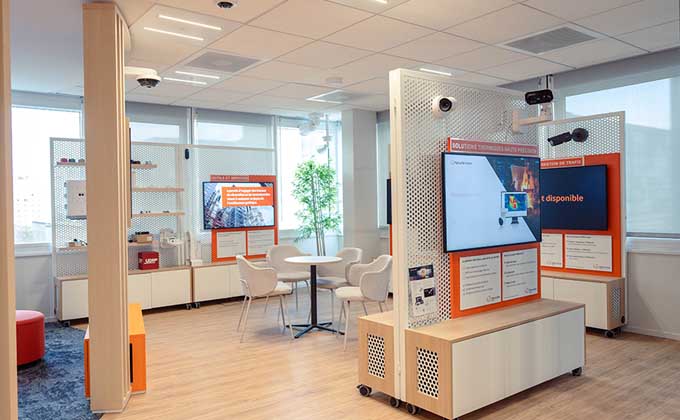
VuWall, a global technology leader in video wall control systems and unified visualization solutions, is proud to announce the opening of its new office and Experience Centre in London, UK. Located in Salisbury House, adjacent to Moorgate Station in the heart of the city, this strategic expansion strengthens VuWall’s presence in the UK and surrounding regions.
As the demand for mission-critical visualization and control room solutions continues to grow across the UK and Europe — driven by increasing investments in public safety, transportation, utilities, and corporate security — VuWall’s expansion reflects the company’s commitment to providing local expertise, faster support, and deeper collaboration with regional partners and customers.
“This new space brings us closer to our partners and customers across the UK, offering a hands-on environment to explore the latest in control room technology, including our certified integrations with Genetec Security Center and Milestone XProtect,” said Paul Brooks, VuWall’s Business Development Director for the UK, Ireland & Nordics.
The London Experience Centre provides visitors with a real-time, interactive showcase of VuWall’s innovative solutions, including video wall management, AV-over-IP, and KVM technology. Visitors can also explore the award-winning TRx software platform and comprehensive video wall ecosystem. The facility enables system integrators, consultants, and end users to discover how VuWall solutions simplify control room deployments, enhance operations, and increase situational awareness in mission-critical environments.
The Experience Centre features a Samsung video wall display, generously provided by Samsung, and B-Tech AV mounts, offering robust, flexible mounting. Visitors can also experience the fully integrated Advancis solution, running seamlessly with VuWall’s TRx software. This setup demonstrating advanced incident management and situational awareness capabilities.
“VuWall’s Experience Centre is an impressive showcase of technology collaboration,” said Chris Ault, Business Development Lead for Samsung Electronics UK. “We are proud to support them with our industry-leading display technology and to see it brought to life alongside their powerful control and visualization platform.”
The Experience Centre also highlights VuWall’s seamless integrations with leading video management systems (VMS) such as Genetec, Milestone, and Synectics — delivering robust, scalable, and efficient visualization and control solutions that are improving operational efficiency in Security Operation Centers (SOC) worldwide.
VuWall’s continued growth in the UK underscores its dedication to supporting local markets with regional expertise and resources, ensuring faster service, stronger partnerships, and accessible customer support.
To schedule a visit, please contact Paul Brooks or the VuWall team at uk@vuwall.com.
The world’s first Chief AI Officer reveals how to navigate AI’s hype, lead effectively, and integrate cybersecurity into growth strategies.
In an exciting move for attendees of the world’s most innovative pro AV and systems integration event, Integrated Systems Europe (ISE) has secured Sol Rashidi as a Keynote Speaker for ISE 2026. Sol will take the stage at 13:00 on Wednesday, 4 February. Her participation perfectly mirrors ISE’s 2026 theme, ‘Push Beyond,’ inviting the industry to explore every opportunity and redefine what’s possible.
Rashidi’s keynote, titled ‘The AI Reality Check: What It Takes to Scale and the Future of Leadership’, will take a deep dive into how AI is no longer just a buzzword – it’s a battlefield of hype, half-truths, and hard realities. Executives are under pressure to act quickly, yet many make decisions based on noise rather than fact. In this keynote, Sol will cut through the fiction to reveal what’s truly happening in the AI marketplace, sharing frameworks, models, and the essential role of AI Governance and cybersecurity as core enablers for scaling. Drawing on her experience, she will outline how to evaluate AI initiatives and safeguard data, workforce, and competitive advantage.
Rich experience
Widely known for her groundbreaking work in the field of business innovation and technology, Sol’s career has spanned 4 C-suite roles across Fortune 500 companies. As the world’s first Chief AI Officer for enterprise in 2016, she led AI and data initiatives at Sony Music, Merck and Estee Lauder, before moving to Amazon as the company’s tech executive. She holds 10 patents and is the best-selling author of ‘Your AI Survival Guide’ which is listed as one of the ‘Top 50 AI’ books. To date, Sol has participated in 3 TEDx speaker sessions with accumulated views of over 1 million and voted FORBES’ ‘AI Maverick & Visionary of the 21st Century,’ as well as ‘Top 5 Leaders Taking AI to Everyone’.
Alongside her pioneering career, Sol developed ‘The Human Amplification Index’™ – a new way to measure ROI to determine how well companies are strengthening their business and workforce through AI. She also offers ‘Intellectual Atrophy’™ education to ensure companies and organisations outsource tasks and not critical thinking in the age of AI. Sol played a pivotal role in developing and launching IBM’s Watson in 2011 and now has over 200 deployments under her belt. As both a practitioner and an executive, Sol has earned accolades including ‘50 Most Powerful Women in Tech,’ ‘Top 100 AI Thought Leaders,’ and ‘Top 100 Data & Analytics Leaders’.
Sol Rashidi says “The challenge isn’t adopting AI, it’s leading with it. I look forward to ISE 2026 to show how separating hype from fact, implementing strong governance, and integrating cybersecurity makes all the difference.”
“We are honoured to host Sol Rashidi and we can’t wait to hear her Keynote at ISE 2026,” adds Mike Blackman, Managing Director of Integrated Systems Events. “Sol’s visionary approach, extensive experience and deep understanding of the evolving business landscape will undoubtedly inspire and empower our attendees to push beyond the general realms of AI. We’re looking forward to Sol bringing her expertise to ISE as she sits at the intersection of top-tier leadership in AI, technology and corporate strategy while bridging innovation with business impact.”
Don’t Miss Your Chance to Be Part of What’s Next
Registration for ISE 2026 is now open, so take your place among the visionaries, trailblazers, and creative minds from every corner of the globe. Reserve your spot at the event where tomorrow’s innovations are unveiled, and let’s Push Beyond what’s possible – together. Register here to Push Beyond.
Cattewater Harbour in Plymouth is harnessing the power and performance of 360 Vision Technology’s Invictus cameras, to protect and secure operations across the challenging and changing conditions at the harbour’s extensive shoreline.
The UK manufacturer of ruggedised HD, radar and thermal PTZ imaging cameras, was selected to provide their industry leading camera technology after a comprehensive on-site evaluation.
Located on the south coast of Devon, Plymouth is the largest city on the southwest peninsula and the port is also home to the largest naval base in Western Europe. As well as civilian pleasure traffic from paddleboards to yachts, the Port of Plymouth handles a variety of cargo vessels through its commercial terminals at Cattedown Wharves, Victoria Wharf and Corporation Wharf. Freight includes liquid and dry bulk, as well as specialist project consignments for construction and heavy industry.
Safe operation
The Cattewater Harbour Commissioners are responsible for the smooth and safe running of the port. They are required to maintain and order safe navigation for all manner of craft, maintain and survey dredging channels, maintain navigation marks and lights, provide pilotage services and traffic regulation within the Cattewater Harbour and remainder of the civil port.
At the port, nationally agreed standards for the safety of marine operations are required to be applied with a commitment to both local and international security measures, with the port’s own pilots boarding and guiding vessels with a 24/7 essential safety service – ensuring that all vessels over 50m complete their passage safely. The harbour covers an expansive coastline, with limits to the east of a line joining Mountbatten Breakwater to Fishers Nose, bounded by Sutton Lock Gates to the North, and Laira Bridge to the East.
The Harbour Master’s role is to ensure the safety of navigation for all harbour users – whether military warships, cross-channel ferries, UAVs, underwater research vessels, small fishing boats, fuel tankers, large cargo ships, jet skis, or paddle boarders – and to take preventative measures to avoid incidents.
“We are responsible for the safety of vessels, people and operations,” says Capt. Richard Allan, CEO & Harbour Master, PFSO (Port Facility Security Officer), Cattewater Harbour Commissioners. “We need to know what’s happening in the port at all times”.
Effective surveillance coverage
To achieve this, a camera system covering the port was deemed invaluable, with requirements for total coverage of the water and shoreline, combined with economy, performance and longevity of the camera equipment in the harsh seaport environment.
To bring the project to fruition, Outersight (UK), a ‘hands-on’ consultancy dedicated to delivering innovative technical solutions were brought on board.
Working with the Cattewater Harbour Commissioners and 360 Vision on previous projects for over ten years, and with experience working with universities, government departments, broadcasters, nature conservation bodies, natural heritage visitor centres, as well as port authorities – Cattewater Harbour Commissioners knew that Outersight (UK) were the people with the experience required for the project.
“We have worked with 360 Vision on many projects and have relied on the manufacturer’s surveillance camera experience and technological expertise before,” says Peter Barlow, Managing Director of Outersight (UK). “It was no different with this project. Right from the start, the team at 360 Vision helped us to demonstrate the advantages of using a network of their Invictus cameras at the port – primarily with an on-site demonstration to the port management team – so they could get real ‘eyes-on’ experience of the Invictus camera within the environment in which it would be used.”
The Outersight (UK) team installed a network of 360 Vision Invictus cameras around the port to cover the water and shoreline, including cameras high on the marker light poles that signal the entrance to the port.
“The camera locations were selected based on the most economical way to cover the area required,” continues Peter. “The flexibility of mounting options and visual performance of the Invictus cameras really paid dividends, allowing us to provide the port with the coverage they required, allied to the most economical cost.
“The fact that we have access to the navigation light towers which by default have a great view of the water, allied with the brilliant zoom function of the Invictus cameras means we do not need many cameras to cover a really large area. By specifying really great cameras and optimising each camera position, we have managed to cover an extensive area with only a small amount of equipment – giving us great return on investment and the lowest possible running costs.”
The 360 Vision cameras cover the entire harbour area, including Cattewater Berths, Barbican Landing Stage, marina areas, slipways and the vast shoreline. They are located on navigation lights dotted around the estuary and on top of the harbour master’s building, with all having good open aspects to the water for maximum surveillance coverage.
Additionally, The Cattewater Harbour Master provides the Kings Harbour Master with access to the cameras to oversee operations in the MoD dockyard and Plymouth Sound.
360 Vision Invictus cameras feature 32x zoom and a 5-year guaranteed marine-grade paint – an essential attribute for use within the harbour’s corrosive saline environment. Additionally, several Invictus cameras with PoE option were used – greatly simplifying installation at the more remote reaches of the system.
Optical clarity
“The 32x zoom capability and stable image quality of the Invictus camera provides wide area coverage and excellent zoomed-in image results,” explains Peter. “This is especially advantageous to identify small vessels at distance – an essential requirement at the port.”
“The Invictus camera has everything we need and at a very competitive price,” adds Richard. “It’s especially reliable in the harsh coastal environment, where we deal with a combination of sea salt, saline air and hot summer sun.”
With essential marine environment features, such as viewing window wiper and low light capability, the network of Invictus cameras is capable of alerting the harbour management team to any operational, security or safety situation, allowing them to take action and suppress the situation before it escalates.
The surveillance system is recorded 24/7 and video footage can be accessed by the Harbour Master in the control room and by mobile login by authorised duty personnel on site, via seamless integration with the Blue Iris VMS.
Optical clarity and zoom capability of the camera network ensures instant visual confirmation, no matter what size of vessel or incident, with members of the harbour management team afforded remote access to the camera network via their phones for instant confirmation of incidents while on the ground or out on the water.
The low power operation of the Invictus cameras also means lower running costs for the port, as certified by the camera’s Elexon charge code compliance for Unmetered Supply (UMS) outdoor powered devices, where electricity consumption is billed at just 30W per camera deployed
Organisations operating CCTV systems can achieve power consumption savings of an incredible 70%. This is a significantly lower power draw versus peer PTZ cameras with generic Charge Codes which are typically billed at 100W, and helps to lower daily running costs at the port.
Using 360 Vision’s Invictus cameras as its backbone, Cattewater Harbour Commissioners now have an electronic surveillance system that is reliable, future-proof, rugged, economical and delivers the high performance required to meet the demanding daily operations of the busy seaport.
“Making things safe and secure for everyone using the port is greatly aided by the surveillance camera system,” says Richard. “The port keeps watch on a wide variety of vessels, including those carrying oil, gas, cattle feed and aggregate, to military warships, cross-channel ferries and underwater research vessels. We also see paddle boarders and jet ski enthusiasts out on the waters too. Evidential footage from the system provides us with the power to convict irresponsible users, such as jet ski riders speeding, or illegal bass fishing brought in on small boats at night.
“Since the inception of the new CCTV system, we have been able to solve a vast variety of incidents from the control room – keeping the public safe, ensuring shipping adheres to the rules of the port and preventing crime.”
A fire door is a critical component in any building’s fire safety strategy. Unfortunately, not just any solid door will do the job. Fire doors are tested and certified as complete systems, and each part – from the frame and hardware to seals and glazing – must meet a required specification. Getting the choice of doors right demands manufacturing expertise and a range of specialist solutions
Author: Thomas Schulz, Director & Head of Marketing DAS EMEIA
E-mail: thomas.schulz@assaabloy.com
Fire doors work by containing fire and smoke to one area, keeping escape routes clear for as long as possible. They do not need power or intervention; they just have to be closed and in good condition. Features such as intumescent seals, which expand with heat, and fire-rated cores help to maintain door integrity and slow a fire’s progress.
There are many types of fire door, tailored to different environments and with specific qualities to ensure a building meets the new generation of more stringent safety standards. Many operate manually, but hinged fire doors may instead be automated. In large or open spaces, fire curtains or sliding systems provide the same protection by closing automatically when an alarm is triggered.
Construction materials are another consideration. In hotels, offices and multi-use commercial buildings, timber doors are often chosen for aesthetics and acoustic performance. At industrial sites, data centres or high-security areas, steel doors could be a safer option. Wide openings in warehouses, airports or car parks may need sliding fire gates or curtains instead. To identify the best solution for a space, specification support when a building is at design stage – or during retrofit planning – is critical.
As with many complementary building technologies and systems, digitalization is a growing concern – and may be beneficial in the right environment. Smart building systems can keep track of fire doors, showing if they are closed, blocked or need maintenance, for example. Fire doors and curtains can link to alarms so they close automatically when needed or connected with access control to maintain fire compartmentation. In complex environments like hospitals or data centres, smarter or integrated systems provide useful auditing and maintenance records, ensuring doors are always ready to perform.
The importance of certification and expertise
Third-party certification of a fire door reassures building owners, architects and insurers about compliance. It proves the door has been tested, audited and manufactured consistently to meet safety standards – and that it will do its job in any emergency. Certification applies to all fire doors, timber or steel, and to larger solutions like fire gates and curtains. Certification also helps to smooth the approval process with building code enforcement and demonstrates compliance with legal requirements.
Across Europe, fire doors are covered by EN 16034, with testing done under EN 1634-1 for fire resistance and EN 1634-3 for smoke control. Hardware is tested separately under EN 1634-2. In the UK, BS 476 is still recognized alongside EN standards. Fire curtains are tested to EN 1634-1, and where smoke control is needed, to EN 12101-1 or EN 1634-3. EI-rated curtains block both fire and heat transfer, while EW-rated systems, often used in the UK, focus on integrity with reduced heat radiation. Testing is always carried out on the complete system, including the door, frame and hardware, to make sure everything performs as intended. To maintain this performance, installation must follow certified details exactly. If the door is not installed properly, it may not meet its fire rating, even if all components are correct.
Expert maintenance is another key to reliable performance. This means checking that seals, hinges, and closers perform properly and are undamaged. Automatic fire curtains, sliding doors or hinged doors need motors and controls tested. Many regulations call for checks every six months. A fire door is only as good as its maintenance: a small fault can make a big difference in an emergency.
Specialist fire safety solutions from ASSA ABLOY
ASSA ABLOY’s portfolio of fire doors provides customers in a broad range of verticals with a choice of security door to match their precise needs, without making compromises.
“Martech focuses on engineering high-performance fire curtains for a range of applications,” explains Daniel Swannack, Chief Commercial Officer for the Door Business Segment at ASSA ABLOY Opening Solutions EMEIA. “In different ways, and for different types of building, Mercor, Portafeu, Metalind, Fichet, and HSD deliver industry-leading fire and technical door solutions tailored to their respective markets.”
“Choosing the right door and keeping it properly maintained is essential,” he adds. “Our role is to make the customer’s life easier in terms of compliance, performance and design flexibility. All our fire-specialist manufacturers share ASSA ABLOY’s deep commitment to safety, quality, reliability, and innovation. Their portfolio scale and expertise gives customers the convenience of a one-stop-shop for fire doors and peace of mind that their solutions are compliant.”
Landmark 45th edition of GITEX GLOBAL brings together the world’s most advanced AI and tech enterprises and leaders from 180 countris, from 13-17 October at Dubai World Trade Centre. Expand North Star celebrates its 10th edition from 12-15 October at Dubai Harbour
With capabilities of AI advancing every year, its potential to address challenges once thought unsolvable is rapidly expanding, from the possibility of curing genetic diseases to transforming urban mobility or enabling green data centres. With the global AI market set to reach $4.8 trillion by 2033 (UNCTAD), the race to deploy AI for critical sectors has never been more urgent. Against this backdrop, GITEX GLOBAL 2025 convenes as the world’s largest tech and AI event, with this year’s edition highlighting significant developments in biotech, physical AI, quantum computing, semiconductors, and data centres.
From 13-17 October at Dubai World Trade Centre, the show unites over 6,800 tech enterprises and 2,000 startups, with participation from 180 countries, bringing together the companies leading the world’s most ambitious AI infrastructure expansion. Global tech enterprises including Alibaba Cloud, AMD, AWS, Dell, e&, G42, Google, HPE, Huawei, IBM, Microsoft, Oracle, Salesforce, Siemens, and Snowflake anchor the showcase, with new incoming innovations from Cerebras, Datadog, Mitsubishi, Qualcomm, Rital, ServiceNow, Tata Electronics, Telecom Italia, and Tenstorrent.
Trixie LohMirmand
Running in parallel is GITEX’s startup showcase, Expand North Star, from 12-15 October at Dubai Harbour, hosted by the Dubai Chamber of Digital Economy. Celebrating its 10th edition, the show connects 2,000 of the world’s most promising startups, with the highest percentage of growth & late-stage startups anywhere, with over 1,200 investors managing US$1.1 trillion assets.
Trixie LohMirmand, EVP of DWTC, the organiser of GITEX globally, shared, “Future-critical sectors including data centres, biotech, quantum, and robotics are where AI ingenuity is converging with humanity’s most pressing challenges. GITEX GLOBAL 2025 gives new impetus to these transformative technologies, while continuing to being the harbinger of innovation-led progress across industries and global economies.”
Record Participation from Fast-Emerging Tech Economies – Brazil, Serbia, Chile
The show marks a record year for international participation, with Brazil joining as Country Partner with its largest-ever tech delegation, alongside the Serbian Chamber of Commerce and Industry and Tech Destination Pakistan as key partners. New pavilions debut from Canada, Chile, Ecuador, Spain, and Türkiye, in addition to expanded representation from Europe, Central Asia, LATAM, Africa, and the Levant.
Tatiana Riera, COO, ApexBrasil, shared: “ApexBrasil is excited to be at GITEX GLOBAL and Expand North Star with over 50 incredible startups and innovation hubs. It’s a great opportunity to show how Brazil is driving innovation and creating tech solutions for global challenges.” Marko Čadež, President, Serbian Chamber of Commerce and Industry, added: “In the age of ubiquitous AI solutions, Serbian startups at this year’s edition demonstrate practical examples of AI applications across diverse fields: from well-being and energy to sentiment diagnostics on social media, showcasing the full depth and breadth of Serbian tech.”
Super Data Centres – The AI Factories of the Future
With global data centre investments set to exceed $500 billion in 2025 (BofA Research), GITEX GLOBAL welcomes one of the biggest global investors in this sector, O’Leary Ventures, building the world’s largest AI data centre industrial park in Canada. Paul Palandjian, CEO & Co-General Partner, O’Leary Ventures, commented: “The UAE has become the crossroads and a world leader in the development of technology and AI. No other place has the leadership vision, resources and commitment to attract a world-class cohort across every industry.”
Adding a regional perspective, Hassan Alnaqbi, CEO of Khazna, MENA’s largest hyperscale data centre provider and a G42 company, leads the discussions on whether infrastructure, energy and policy can scale fast enough to keep pace with giga AI factories.
GITEX Digi Health & Biotech – The Next Frontiers of Medicine
Breakthroughs in gene editing, mRNA vaccines and AI-led drug discoveries are driving biotech spending towards $1.7 trillion in 2025 – setting the backdrop for the fastest AI deployment in this sector. At GITEX GLOBAL, Trevor Martin, CEO of Mammoth Biosciences, presents how CRISPR, their Nobel winning gene-editing technology, is using AI to potentially cure genetic diseases.
Matt Angle, CEO of Paradromics, the company behind the world’s first successful computer-brain implant, dives into decoding thought with AI and neurotech. Adding to this momentum, South Korean startup HurayPositive unveils AI-powered SaaS to deliver precision medicine for one million patients with chronic conditions.
Physical AI in Motion
At GITEX GLOBAL, Tensor unveils the world’s first personal robocar – globally applauded as “agentic AI on wheels”. Whilst K2 introduces new humanoids and a concept vehicle designed to extend robotics into industrial environments. With the robotics AI market projected to quadruple to $94 billion by 2031, these innovations illustrate how Physical AI is becoming an essential pillar of industry productivity and business edge.
On the show floor, IBM unveils Quantum System Two, a major step towards large-scale fault-tolerant systems capable of solving computing scale challenges. Shukri Eid, VP and General Manager of IBM Gulf, Levant, and Pakistan, shared “GITEX GLOBAL is a global stage, but more importantly, it is a platform for action. It brings together the ecosystems that matter: policymakers, business leaders, and innovators driving AI forward.” Prof. Mark Thompson, Co-Founder of PsiQuantum, a $6 billion unicorn, outlines the path towards quantum sovereignty. Among the headline exhibitors is also IONQ, the world’s first public pure-play quantum computing company trading at the New York Stock Exchange.
Ai Semicon – The Chips Behind Sovereign AI
Global leader in high-performance processors, AMD presents its Instinct™ GPUs and EPYC™ CPUs, built to handle the most demanding AI workloads and energy-efficient data centre deployments. Jim Keller, CEO of Tenstorrent, the $2.6bn AI chipmaker on the Forbes AI50 List, expands on this theme with his talk on “Taking Control of Your Sovereign AI Future,” as semiconductors become a geopolitical lever.
Startups, Scaleups & Unicorns Lead in AI Supercomputing
Expand North Star features more than 40 unicorns this year, reinforcing the UAE’s position as a hub for global scale-ups. Among them, Cerebras presents the world’s largest AI supercomputer (built in partnership with G42), Fluidstack unveils the world’s first 1GW decarbonised AI supercomputer, and Xpanceo introduces five prototypes of AI-powered smart contact lenses -advancing AR, healthcare, and consumer hardware simultaneously.
ONVIF®, the leading global standardization initiative for IP-based physical security products, announces that it will end support for ONVIF Profile S, and is recommending the use of its successor, Profile T.
Profile S, the first-ever profile ONVIF introduced in 2011, provides a standardized set of specifications that enable basic video streaming capabilities between conformant devices (like IP cameras) and clients (like video management software) from different vendors. Profile S, however, specifies authentication mechanisms that are no longer consistent with current cybersecurity recommendations.
“After 14 years, Profile S has served its purpose of enabling basic video streaming interoperability for more than 33,000 conformant devices and clients from different vendors,” said Leo Levit, Chairman of the ONVIF Steering Committee. “As ONVIF profiles do not change to preserve the interoperability of conformant products, we recognize the need to phase it out in line with today’s security recommendations. We encourage instead the use of Profile T, which better supports the needs of video surveillance applications.”
Although the deprecation of Profile S has no effect on the operation of deployed Profile S-based systems, ONVIF strongly encourages, if possible, the discontinuation of the use of the username token authentication in Profile S.
ONVIF also recommends the adoption of more secure authentication methods, such as using TLS (Transport Layer Security)/HTTPS, or Profile T. The majority of ONVIF conformant devices and clients available on the market today support both ONVIF Profile S and Profile T. Introduced in 2018, Profile T contains virtually all the features of Profile S, in addition to other advanced features for video surveillance.
ONVIF recommends that system integrators and end users follow manufacturers’ product hardening guides, industry best practices, and local regulations, and stay informed about technology changes in the market. The ONVIF Network Interface Specifications have defined network protocols that include security elements such as TLS, which allows ONVIF devices with that feature to communicate with clients across a network in a way that protects against eavesdropping and tampering. ONVIF specifications also cover the ONVIF Default Access Policy, which specifies that there should be different access classes to services based on different user roles. Manufacturers can implement these ONVIF specifications regardless of whether the specifications are included in a profile or not.
The June 2026 version of the ONVIF conformance test tools, which have a 9-month validity period, will be the last test tool version that enables manufacturers to claim product conformance to Profile S.
As ONVIF adapts to new cybersecurity requirements, the specifications of the current ONVIF TLS Configuration Add-on will also be upgraded at the end of 2026. Unlike profiles, add-ons are adaptable to changing technology/specification requirements due to version handling.
Founded in 2008, ONVIF is a leading and well-recognized industry forum driving interoperability for IP-based physical security products. The organization has a global member base of established camera, video management system, and access control companies, and more than 33,000 profile conformant products. Besides Profile S and Profile T, ONVIF offers Profile G for video recording and storage; Profile C for physical access control; Profile A for broader access control configuration; Profile M for metadata and events for analytics applications, and Profile D for access control peripherals. ONVIF continues to work with its members to expand the number of IP interoperability solutions that ONVIF conformant products can provide.
Prepare for the unforgettable. Integrated Systems Europe (ISE), the world-renowned annual tech show for the audiovisual and systems integration industry, is back – and registration for ISE 2026 is officially open.
Step into a world unlike any other, where boundaries are meant to be pushed and imagination comes alive. ISE 2026 makes its grand return, 3-6 February at the Fira de Barcelona, with a theme that invites the industry to explore every opportunity and redefine what’s possible.
Push Beyond: The Next Chapter of ISE Arrives
ISE 2026 will transform the Fira de Barcelona into the epicentre of innovation and discovery for attendees to experience the truly remarkable. This year’s theme, Push Beyond, challenges visitors to leave the ordinary behind and embrace a new standard of excellence. Step away from the expected, refresh your mindset, and indulge your senses in an event that promises an almost unimaginable experience.
“At ISE, we are dedicated to inspiring the community and exploring what’s possible,” says Mike Blackman, Managing Director of Integrated Systems Events. “Each year, we aim to deliver an experience that fuels creativity and drives innovation. ISE 2026 will open new horizons, ignite fresh ambition, and bring together the global AV and systems integration community for an unforgettable celebration of innovation – where ideas take form and the future begins to unfold.”
Where Industries Converge and New Ideas Spark
It’s not just one industry. ISE 2026 throws open its doors to an incredible spectrum of verticals, from education, enterprise, live events, and hospitality to retail, healthcare, and beyond. Wherever you fit in the global landscape, ISE is the destination where every sector finds fresh inspiration and ambitions meet opportunity.
To make every experience count, ISE 2026 features dedicated Technology Zones designed to serve the unique needs of each market. Whether visitors are seeking the latest in digital signage, unified communications, smart building solutions, or residential technology, you’ll discover immersive spaces tailored to your interests.
Each Zone is a launchpad, fuelled by innovation, brimming with solutions, and ready to connect you with the partners and insights that matter most.
Secure the Best Rates with bnetwork
To ensure every attendee enjoys a seamless experience in Barcelona, ISE has once again partnered with bnetwork, its Official Accommodation & Logistical Services Partner for ISE 2026.
Through bnetwork’s dedicated platform, visitors can book hotels at competitive rates and choose from a wide range of accommodation options, all with personalized customer support. Beyond hotel reservations, bnetwork also offers transportation solutions and venue-booking services, making it easier than ever to coordinate every aspect of the trip.
Attendees are encouraged to plan early and take advantage of these exclusive services at isehotels.bnetwork.com
Don’t Miss Your Chance to Be Part of What’s Next
Registration for ISE 2026 is now open, so take your place among the visionaries, trailblazers, and creative minds from every corner of the globe. Reserve your spot at the event where tomorrow’s innovations are unveiled, and let’s Push Beyond what’s possible – together. Register here.
As part of ISE’s continued commitment to attendee security, all attendees are asked to provide a valid passport or national ID number during the registration process. In partnership with the Catalan police, this measure helps us deliver a safe and seamless experience for everyone participating in ISE.
This is your invitation to Push Beyond, don’t just witness the extraordinary, come and be part of it: https://www.iseurope.org/.
Ruijie Networks, through its Reyee brand, has introduced new routers RG-EG406XS and RG-EG406XS-P, designed for networks that require stable performance and flexible integration. These models deliver up to 2.5 Gbps throughput and are equipped with Multi-G WAN/LAN ports as well as a 10GE SFP+ port for expansion and connection to high-speed backbone systems.
The routers support up to 400 concurrent clients and allow the creation of 100 VPN tunnels, making them a reliable choice for business networks. The RG-EG406XS-P version also includes PoE/PoE+ functionality, enabling power delivery to endpoint devices such as surveillance cameras, wireless access points, or IP phones directly through the network cable. A key feature of these devices is multi-WAN load balancing, which combines and balances multiple internet links to ensure stable and uninterrupted connectivity.
Ruijie Networks is a globally recognized company with more than two decades of experience in developing networking infrastructure and digital solutions.
These routers find their application in small and medium-sized businesses, hotels, educational institutions, security centers, and corporate offices, where it is essential to manage a large number of users and devices with high reliability and security.
With the launch of the RG-EG406XS and RG-EG406XS-P models, Ruijie Reyee reaffirms its commitment to delivering networking solutions that combine multi-gigabit performance, cloud management, and adaptability to modern business needs.
Being the smartest access control in the cloud means that we can do some amazing things. One of such things is granting access via web link.
Key Link is a very convenient solution for granting temporary access, especially at a distance as nothing material needs to be sent or received. The recipient does not need to be Door Cloud user, does not need to install or run any special app, does not need to memorize anything and everything can be set well in advance.
It goes like this:
User creates a web link for opening a certain door.
User sends the link via mail or chat.
The recipient opens the door by clicking on the link.
Which seems like a bit too simple, does it? So, let’s just go in and answer some immediate questions:
How do we open the door once we receive the link?
The door can be opened using a smartphone or any other online device with a browser. Clicking the link will open the browser and land you on the door opening page. The door is then opened by clicking the button on the page.
How do we prevent the link to be further distributed and used by other people?
We don’t. Think of the link as of the ordinary mechanical key or the PIN code. The key can be easily copied, the PIN can be revealed.
How do we know that the link has been used by the intended recipient and not by someone else?
We don’t, see the previous answer.
How do we keep track of who made the link, for whom and why?
The link name and description, its validity period, and the user who made it – all that is automatically logged by the system. If the link is sent by email, the email will be logged too. For any other data, it is up to the user what he will choose to record using the name and description. It may be the recipient name, the link purpose, or anything else of importance to the user.
How do we keep track of the access events made using the link?
Just like any other access using cards or mobile app. All access events made via links are logged in the event log.
How can we limit the link use?
We can set the link validity from – to. We can change or cancel it at any later time. We can also limit the number of times the link can be used down to single use.
Can we send the link to multiple recipients?
Yes. Also, links can be forwarded, copied, published or otherwise distributed to any number of secondary recipients.
What are the technical requirements?
Access via Key Link can be performed on any Door Cloud access point (door). Link can be issued online on the web or using the Door Cloud web app. For opening doors, any smartphone or similar device with browser and internet connection will do
Link access can be seen as a high-convenience, yet low-security access feature. What are the security considerations?
It really depends on the use case. Key Link is not meant as a replacement for card access or smartphone app access. It is intended for use cases where the lack of user identification is acceptable, such as apartment rent.
BENEFITS
Access right can be granted easily and instantly from the web or the mobile app.
Access right can be granted with delayed start and automatic expiration (from – to, from – duration).
Access right can be modified or revoked easily and instantly.
Access right recipient can be anyone with a smartphone and internet connection.
Access right recipient can easily and instantly share the access right further to other recipients.
No cards or card readers required.
USE CASE: APARTMENT RENT
The best use case is apartment rent. The apartment owner is a Door Cloud user, the guest is anyone with a smartphone and internet connection. The owner creates the link and sends it to the guest. The guest opens the apartment door with his smartphone, and the owner sees that the guests have arrived. If cards are preferred, they can be left in the apartment for guest’s convenience. In that case, the link duration may be set for some initial period only.
If there are more guests, they can share the link between themselves. Or, the owner can send multiple links. If the guest cancels or leaves early, the owner simply revokes the link.
Smart buildings take a connected approach to managing and monitoring who is coming into and going through them. For almost every user, whether visitor, staff or contractor, the building journey begins with a door.
A 2025 report by analysts Memoori suggests that the global IoT market in commercial buildings will grow to $101 billion (€87.5 billion) by 2030, at a baseline predicted CAGR of 7.9%1. Memoori identify offices, retail premises, datacenters, and hospitality businesses as probably early adopters of smart building technology.
The smart building will streamline the experience for both users and managers. When fully implemented, it promises buildings which are more secure; that make better use of energy; and which will make data-driven decisions in real time. On the basis of these concrete benefits, analysts forecast rapid growth. According to Fortune Business Insights, the market will grow from a value of $143 billion (€122 billion) in 2025 to $548.5 billion (€469.5 billlion) by 2032, at an estimated 21.2% CAGR2. Security systems and technologies will be a significant component of this growth.
It starts at the door
In a world of smart sensors, building management dashboards and real-time analytics, the door closer is easy to overlook. Yet in creating tomorrow’s generation of intelligent buildings, this device will play a critical role. Modern high-spec door closers do far more than simply shut a door. They help preserve climate zones, reduce noise, support fire safety and accessibility, enhance security and convenience, throughout the wider building.
For security, the door closer is essential. A door left ajar – whether by wind, human error or wear and tear – undermines access protocols and protections. Intelligent closers work alongside digital locking and access systems to ensure doors shut reliably behind every authorized user, reducing the risk of tailgating. A certified door closer is also a key component in fire safety strategy. When integrated with fire alarm systems, closers allow fire doors to remain open during normal use, but close automatically in an emergency. This supports safer evacuations and regulatory compliance without compromising day-to-day convenience.
From a sustainability standpoint, the contribution is also tangible. A closed interior door helps to maintain temperature differentials, between an office and the corridor, for example, or a server room and an atrium exposed to climate variations. Fully closed interior doors help reduce stack pressure – the unwanted inflow of air at lower levels, caused by rising warm air within the building – which can otherwise disrupt HVAC performance. Even a single poorly closed door can force HVAC systems to work harder, leading to unnecessary energy waste. A door closer ensures these doors shut gently but securely every time, supporting improved energy efficiency metrics.
Smart door, smarter building
In a connected building, integration is everything. ASSA ABLOY intelligent door closers are designed to work as part of a broader Building Management System (BMS). They integrate seamlessly with access control, fire alarm and HVAC platforms, helping the building to become more responsive, more secure, and more efficient.
“Every model in our range of award-winning door closers is engineered for performance, durability and aesthetics. As you would expect, they meet or exceed critical EN 1154 compliance requirements and in most cases, are certified for use on fire doors” says Andreas Gmelin, Product Management and Business Development Director from ASSA ABLOY Opening Solutions EMEIA. “Increasingly, they are also designed, from the ground up, by paying attention to their growing role within an intelligent building environment. They can be responsive and be used together with other components in a smart building, focusing upon access, energy and life safety.”
“In short, they are no longer just robust, convenient hardware working in isolation to perform a single important task. Door closers are now a key enabler of improved smart building performance, which benefits every user and makes life easier for building managers.”
To explore the intelligence inside every ASSA ABLOY Door Closer, and how it benefits your building, visit: