Home News Archive by category World (Page 9)

World

MarketsandMarkets: AI Video Analytics Market for Smart Cities to Surpass $28 Billion by 2030

A new report by MarketsandMarkets forecasts that the global AI video analytics market for smart cities will grow from USD 8.5 billion in 2025 to USD 28.76 billion by 2030, representing a compound annual growth rate (CAGR) of 27.6%.

According to the report, market growth is being driven by increasing investments in smart city infrastructure, public safety modernization, and intelligent transportation systems. Cities around the world are increasingly deploying AI-powered video analytics to enable real-time threat detection, traffic optimization, public space monitoring, and critical infrastructure protection.

The public safety and law enforcement segment is expected to maintain the largest market share, while edge-based analytics solutions are projected to experience the fastest growth due to their low-latency processing capabilities and ability to support real-time decision-making.

MarketsandMarkets notes that the industry is rapidly evolving from traditional video surveillance systems toward intelligent platforms that combine artificial intelligence, edge computing, cloud infrastructure, and advanced computer vision technologies. These solutions provide greater operational visibility, process automation, and more efficient urban management.

Among the leading companies in the market are Motorola Solutions, Genetec, NEC Corporation, Hikvision, and Axis Communications, while innovative AI video analytics specialists such as BriefCam, Vaidio, Axon AI, and Graymatics are also highlighted as emerging players in the sector. The report concludes that AI video analytics is set to become one of the foundational technologies of future smart cities, integrating public safety, traffic management, and critical infrastructure protection into unified digital ecosystems.

Innovation Park at ISE Opens Doors for AV Startups Worldwide

Innovation Park, one of the key features of Integrated Systems Europe (ISE), continues to strengthen its role as a platform connecting startup companies with investors, systems integrators, and leaders of the AV industry. Following a successful 2026 edition, organizers have confirmed the return of the program at ISE 2027, which will take place in Barcelona from 2–5 February.

This year’s edition brought together 130 exhibitors and provided startups with opportunities for international exposure, investor discussions, and the development of new distribution partnerships. One of the highlights was the Plug and Play Pitching Stage, which hosted 84 startup presentations in front of investors and industry professionals.

Additional momentum came from networking events, guided tours, and the Matchmaking Area, which facilitated more than 160 direct meetings between startups, investors, and industry stakeholders.

“Innovation Park helps shape the future of the AV industry by giving startups direct access to investors, partners, and industry experts. By connecting emerging companies with the right people and organizations, we create real commercial opportunities and support the next generation of industry growth,” said Mike Blackman, Managing Director of Integrated Systems Events.

Following strong demand and high engagement at ISE 2026, applications for Innovation Park 2027 are already open, with organizers expecting an even larger number of companies looking to expand internationally.

More information is available on the event’s website: Integrated Systems Europe (ISE).

ASSA ABLOY Marks Its 400th Acquisition Milestone

During May, ASSA ABLOY celebrated an important milestone by completing its 400th acquisition since the company was formed in 1994. The landmark acquisition is Portugal-based Rollerdoor Group, which has become the newest member of the global ASSA ABLOY organization.

Acquisitions have been a key pillar of the company’s growth strategy ever since the merger of ASSA and Abloy more than three decades ago. Through the acquisition of local brands, new technologies, and skilled teams around the world, the company has continuously expanded its presence and portfolio of access control and security solutions.

According to ASSA ABLOY, each new company brings valuable expertise, local market knowledge, and innovative solutions that strengthen its overall offering and enhance customer support. “Reaching our 400th acquisition marks an important moment in our growth journey. We continue to combine our strengths and develop innovative access solutions that help people feel safe and secure while enabling a more open world,” the company said.

ASSA ABLOY added that it will continue pursuing its growth strategy through acquisitions, with the goal of further advancing technologies and strengthening its global presence in the security and access control market.

Salto Brings Digital Hotel Room Keys to Apple Wallet

Salto Systems has introduced support for Room Keys in Apple Wallet, allowing hotel guests to use their iPhone and Apple Watch as digital keys for accessing guest rooms and shared hotel facilities. The new solution is integrated into the Salto Space Hospitality platform and enables guests to unlock doors simply by holding their device near a reader, without the need for additional apps.

Digital room keys are delivered directly to Apple Wallet, enabling remote credential provisioning, mobile guest check-in, and a faster arrival experience. This helps hotel staff reduce reliance on physical keycards and streamline front-desk operations.

Key features include Express Mode for instant unlocking without opening an app, the ability to use a room key for up to five hours after a device’s battery is depleted, and remote access management through the Salto Space platform. The system also allows guests to share digital keys with family members, friends, or colleagues via Apple Wallet, while maintaining precise control over access permissions and enabling instant revocation when required.

Salto emphasizes that privacy has been a core consideration in the development of the solution. Room keys are stored locally on the user’s device, and Apple does not have visibility into the locations accessed by guests. In the event of a lost device, access can be immediately disabled using Apple Find My.

The new integration is expected to help hotels simplify access management, reduce operational costs, and enhance the guest experience through a fully digitalized approach to room and facility access.

More information about the solution is available in the official announcement: Salto Room Keys in Apple Wallet.

Trionda: The Most Advanced Smart Match Ball Ever Developed

The upcoming FIFA World Cup 2026 will introduce a new generation of sports technology through the Adidas Trionda match ball, which is already being regarded as the most technologically advanced football ever produced. At its core is an electronic module developed in collaboration with the German company KINEXON, a specialist in precision tracking and sports analytics systems.

Trionda features Connected Ball technology, using an integrated sensor to collect movement data and transmit it to analysis systems up to 500 times per second. This data enables the precise determination of the exact moment a player makes contact with the ball and is linked in real time with optical player-tracking systems and VAR technology.

This approach significantly enhances semi-automated offside detection and the analysis of controversial match incidents. Rather than relying solely on video footage, officiating systems now use a combination of sensor data, computer vision, and artificial intelligence. The new four-panel construction also represents the most radical redesign of an official FIFA World Cup match ball to date. According to Adidas, this design improves aerodynamics, flight stability, and trajectory accuracy, while a specially developed surface texture provides better control in a variety of weather conditions.

The ball also contains a rechargeable battery that powers the sensor system throughout a match, while all data is transmitted wirelessly to infrastructure systems installed around the pitch. In this way, Trionda becomes an active part of the match’s digital ecosystem rather than simply a piece of sporting equipment.

By combining sensor technology, wireless communications, advanced analytics, and artificial intelligence, Trionda represents one of the most compelling examples of IoT technology being applied in sports. Many experts therefore consider it not only the best football ever created, but also an indication of the direction in which sports technology will evolve in the years ahead.

Ajax Systems’ TurretCam HL Wins ESX Innovation Awards 2026

Ajax Systems has announced that its TurretCam HL solution has won first place in the Video Surveillance Cameras category at the ESX Innovation Awards 2026 in the United States. The award was presented as part of a program that recognizes innovative technologies and solutions for the security industry.

According to the company, the award highlights its approach to developing video surveillance solutions that combine rapid response, seamless integration, and privacy by design. The goal is to help security professionals deliver greater value to end users while reducing installation complexity and simplifying system deployment.

“We are proud that TurretCam HL has received the top award in the Video Surveillance Cameras category. This recognition confirms our commitment to developing technologies that enable security professionals to work more efficiently and deploy advanced solutions more easily,” Ajax Systems said in a statement.

The company also thanked its teams and partners whose expertise, innovation, and dedication contributed to this achievement. The ESX Innovation Awards are widely regarded as one of the leading programs recognizing innovation in the electronic security market across North America.

Avigilon: Virtual golf scales with cloud-native security

PodGolf, an unstaffed virtual golf business, used Avigilon Alta’s cloud-native security for seamless customer access and remote oversight, enabling it to scale rapidly and cut costs.

Challenge: unstaffed operations

PodGolf’s unstaffed, self-service model required a frictionless, automated security solution. They needed an access control system that integrated with their booking and Trackman simulators to provide customers with automated entry codes.

Additionally, the business required a unified platform for remote oversight and troubleshooting across multiple locations to help ensure smooth operations and provide professional customer support without on-site staff.

Solution: cloud-native security

PodGolf uses Avigilon Alta’s cloud security, including cameras, VMS and access control, to manage its growing site network.

  • Smooth operation

    The Alta solution helps eliminate the need for on-site staff, reducing costs and maximizing operational efficiency.

  • Seamless customer experience

    By integrating Alta Access with its booking system, PodGolf provides a seamless customer experience, from booking to site access.

  • Centralized management

    With Alta’s cloud-native platform, PodGolf can centralize management and observe all locations from a single platform

Result: a thriving business

By leveraging Avigilon Alta’s cloud-native access control and video solutions, PodGolf has successfully pioneered a ​forward-thinking” automated business model in the indoor golf industry.

The integration of secure, unmanned access with real-time video oversight has allowed the company to scale rapidly to eight locations while maintaining low overhead and a premium customer experience. As it plans to expand its operations, PodGolf seeks to strengthen its partnership with Trackman and Avigilon.

Blighter To Supply 4D Multi-Mode Radars to Eastern European Army To Protect Land and Sea

Blighter (www.blighter.com), a pioneering designer and manufacturer of ground-based electronic-scanning array (ESA) radars, has won a follow-on contract from an undisclosed Eastern European Army to supply its Blighter A800 Mk 2 4D multi-mode radars. The systems will protect vulnerable borders from ground incursions and hard-to-detect low-flying and one-way attack drones.

Army officials selected the Blighter A800 Mk2 4D radar due to its multi-mode functionality allowing simultaneous detection, classification and tracking of ground, sea, and air targets at ranges up to 20km. As with the previous contract, the A800 radars will be deployed to fixed locations along the country’s borders and integrated onto army reconnaissance vehicles.

According to Blighter, low-altitude drones present a major challenge for the military as their small size, low radar cross section (RCS), and ability to fly close to terrain make them difficult to detect with conventional air surveillance radars. Blighter radars overcome this using advanced Ku-Band sensing, ESA antennas, micro-Doppler signature analysis, and sophisticated clutter-suppression technologies.

James Long, Blighter’s CEO, said: “We are delighted to have secured a follow-on contract for our A800 multi-mode radars from this military customer. Our radars will provide 24/7 all-weather protection against ground incursions and the growing threat of low-altitude drones that have caused such devastation in recent conflicts.

“Our ground-based radars excel in detecting low’n’fast targets including first person view (FPV), fibre-optic and fixed wing drones up to 20km away. We are proud to be one of only a handful of companies offering a sub-US$1m radar that can detect targets at speeds up to Mach 1!”

This contract includes the supply of BlighterNexus software to ensure the radars are seamlessly integrated with the Army’s command-and-control (C2) networks, operator interfaces, and third-party sensors to deliver a unified display or common operating picture (COP) across multiple border regions.

The Blighter A800 Mk2 radar combines electronic beam scanning, next generation monopulse elevation measurement, and target classification using micro-Doppler signature analysis to offer unmatched situational awareness, all in a low size, weight & power (SWaP) format. The radar is also fitted with a Gigabit Ethernet interface for secure and encrypted data transfer.

Blighter radars have been successfully deployed for drone detection at UK and international airports, by the United States Air Force, by multi-national Forward-Operating-Bases (FOBs) in the Middle East, and for various government and military national Counter-UAS systems.

Blighter supports international systems integrators in creating layered, multi-sensor surveillance systems and supports localised manufacture. Over 800 radars have been deployed in more than 40 countries, making Blighter a trusted partner for surveillance projects among defence, homeland security, critical national infrastructure, and energy sectors worldwide.

Euralarm publishes White Paper on Fire safety in a connected world

The European fire safety industry is at a turning point. Digitalization, remote connectivity, and cybersecurity are converging to redefine how buildings are protected and maintained. Euralarm’s new White Paper on fire safety in a connected world covers integrating detection, remote services and cybersecurity. This white paper outlines how fire detection systems are transforming into intelligent, connected infrastructures — and what this means for service providers, building operators, and policymakers across.

Across the continent, false alarms remain a significant burden: studies such as Euralarm’s 2022 False Alarm Study show that in some countries the false fire alarm ratio of FDAS (Fire Detection and Alarm Systems) is over 85% Unnecessary activations disrupt business continuity, erode confidence in fire protection systems and potentially waste emergency resources. At the same time, climate change, energy efficiency targets, and a shrinking pool of skilled labour are reshaping building operations and maintenance practices.

Digital transformation offers powerful answers. Through smart connectivity, cloud-based monitoring, and data analytics, fire detection systems can now provide real-time insights, enabling remote diagnosis, predictive maintenance, and data-driven decision-making. These capabilities reduce downtime, improve safety, and support sustainability goals by cutting travel and optimizing resource use.

However, with connectivity comes a new responsibility: cybersecurity. As fire systems are more often connected via the internet, they must be protected from digital threats that could compromise safety or availability. Standards such as EN 50710:2021 (for remote services), CLC/TS 50136-10 (for Remote Access Infrastructure), IEC 62443 (for industrial OT cybersecurity), and ISO/IEC 27001 (for IT information security management) provide the framework for building and operating secure systems that are  designed to protect information, assets, and operations from unauthorized access, damage, or disruption. Such secure systems that follow Security by Design and Security by Default principles ensure that fire protection remains reliable, even in the connected era.

By integrating fire detection, remote services, and cybersecurity, European stakeholders can achieve safer, more resilient, and more sustainable buildings. Interconnected digital fire safety is already emerging as the new operating model and is expected to become standard practice across many new and modernised buildings during the second half of this decade, as connectivity, remote services and cybersecurity requirements become embedded in building operations and European regulatory frameworks. Those who act now will lead the market transformation, delivering smarter protection and stronger trust in the systems that safeguard lives and assets.

The Euralarm White Paper on fire safety in a connected world can be downloaded here.

Think Alert: Stop Threats Before They Escalate

Most environments are already covered by cameras. The real challenge in modern AI video surveillance is response time. Many incidents are not missed because they are invisible, but because they are noticed too late. Policy violations, unsafe behavior, or suspicious actions often unfold within seconds, and once they are discovered through review or manual checks, the opportunity to intervene has already passed.

Traditional AI alerts help reduce this gap, but only when scenarios fit predefined detection types. In real operations, risks are often more contextual. Policies vary by space, rules change over time, and many behaviors that matter cannot be easily expressed through fixed alert categories. This is where Think Alert becomes valuable.

What Think Alert is and how it fits into existing workflows

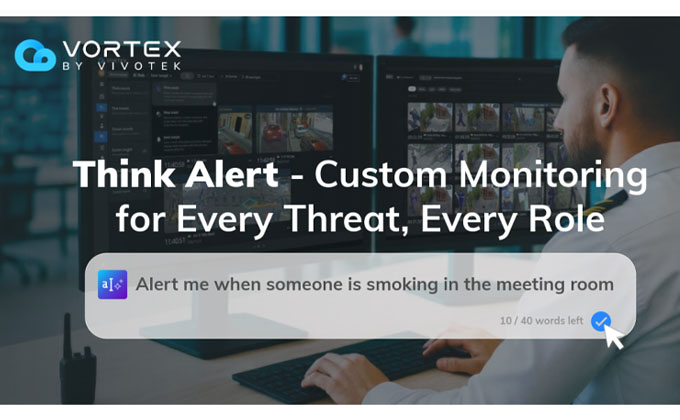
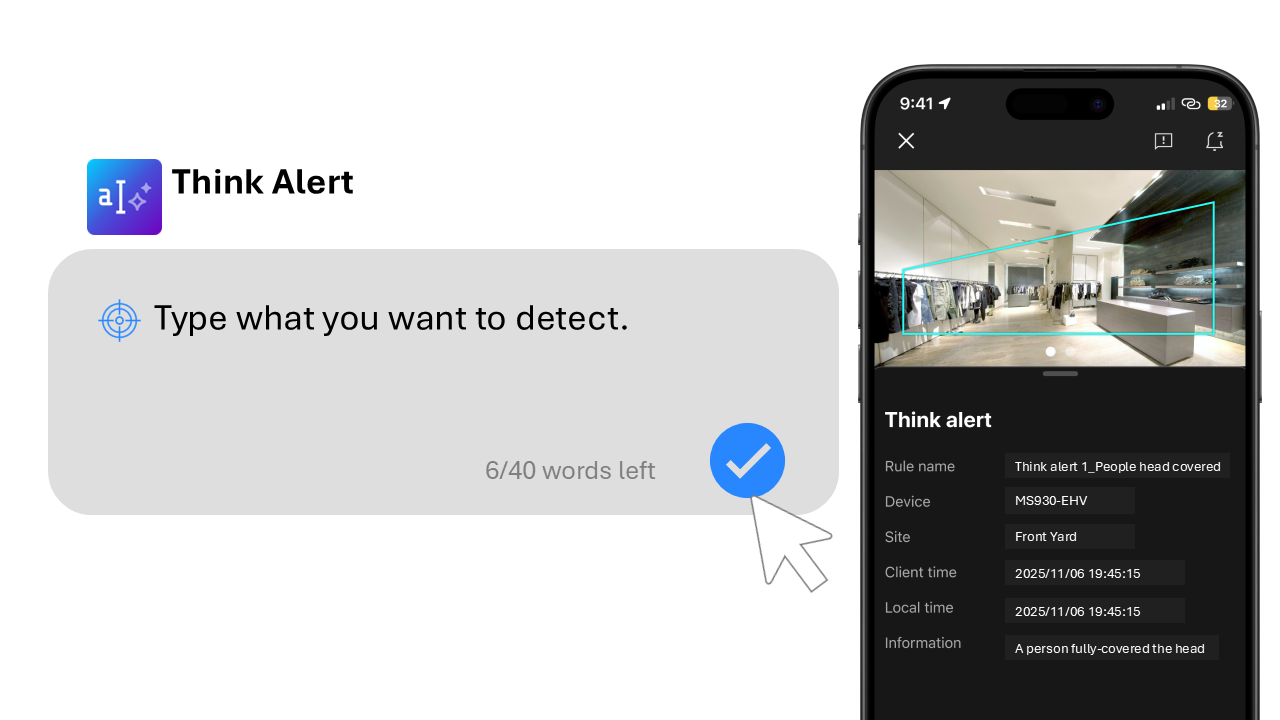
Think Alert is a generative AI–powered alert capability within VORTEX that allows users to describe what action or situation they want to detect using natural language. Built on visual language model (VLM) technology, it enables more flexible real-time video alerts while still defining where detection applies through familiar line or zone drawing—bringing this capability into the broader VORTEX AI video analytics platform.

To see why this matters in day-to-day operations, it helps to look at what Think Alert changes for teams in three practical ways.

  • Act immediately to mitigate losses:
    Theft, accidents, and unauthorized access cost money and endanger people. Think Alert detects these situations in real time, so teams can respond immediately—before damage occurs and before incidents escalate.

  • Set up in seconds, not hours:
    No manuals or training needed. After defining the detection area, simply use natural language to describe what you want to monitor and activate the alert in moments. No technical skills, no complex rule building, and no IT help required.

  • Your alerts, your rules:
    Every person and team has different needs. Think Alert lets each user customize monitoring based on what matters most to them, instead of being limited to fixed, predefined alert rules.

A quick refresher – Think Search: Find What Happened, Faster

Before Think Alert, VORTEX introduced another VLM capability: Think Search. It uses visual language model technology to make investigation feel as simple as searching the web. Instead of scrubbing timelines or guessing which filters might work, users can type what they want to find in plain language, and the system surfaces relevant moments from recorded footage.

This matters because investigation is often where teams first discover patterns—recurring behaviors, repeat problem areas, or situations that consistently create risk. Think Search helps teams find those signals faster and with less effort.

Learn more about Think Search →

Elevating VORTEX from “what happened” to “stop it next time”

Once teams identify what keeps happening, the next question is always the same: how do we stop it earlier? That’s where Think Alert takes what teams learned during investigation and turns it into real-time monitoring. Instead of repeatedly searching for the same incidents after they occur, teams can go directly to the location that matters, define the detection area, describe the behavior, and receive alerts the moment it happens again.

This is what elevates VORTEX into a more complete video intelligence workflow. It supports both sides of the job: understanding the past with faster investigation, and protecting the future with proactive, real-time alerts.

By turning intent into immediate action, Think Alert helps organizations reduce risk, respond earlier, and stay ahead of incidents as they happen.