Home Technology and Products Archive by category Access Control (Page 3)

Access Control

Salto celebrates 25 years of innovation and inspired access

Salto, a global pioneer in smart access technology, proudly celebrates its 25th anniversary in 2025. Marking a quarter century of transformative innovation, Salto continues to lead the industry by redefining how people experience access and secure spaces worldwide.

Founded in 2000, Salto began with a bold vision to create universal, wire-free, and networked smart locking systems. From its early days as a small startup in northern Spain, Salto has grown into SALTO WECOSYSTEM – a global force uniting industry leaders Gantner, Salto, and Vintia – to deliver advanced solutions in smart access, ticketing, identity management, and electronic locking technology.

Today, Salto’s technologies power over 100K installations, 10M access points and secure access for more than 40M daily users across 40 countries. With more than 1,850 employees worldwide, Salto’s ongoing dedication to innovation and human-centered design has made it a trusted partner across numerous industries.

“For 25 years, Salto has been a community of curious, collaborative pioneers committed to staying one jump ahead,” said Marc Gomez, CEO of SALTO WECOSYSTEM. “Our anniversary is both a celebration of the remarkable journey so far and a declaration of our ambitious future. We will continue advancing smart access with cutting-edge technologies to create safer, smarter experiences worldwide.”

Since 2000, Salto has revolutionized how people experience doors and secure spaces worldwide. From a small startup to a global leader, Salto continues to inspire access through a smart ecosystem that opens doors to opportunity, connection, and growth.

Salto has been leading the way in innovative access control by redefining how people experience doors and access spaces globally. More importantly, Salto has been opening doors to opportunity, connection, and innovation. Behind every access point, project, and leap forward in technology, there have always been people who are passionate, persistent, and dedicated; people who believed in Salto when it was still a small startup from a humble apartment; and people who have connected cultures, teams, and countries. Day by day, these individuals have built Salto into what it is today.

The real key to Salto’s success goes beyond products or technology – it’s about people and partners. Each person has unlocked something vital by solving challenges, forging partnerships, addressing client needs, discovering solutions, strengthening teams, helping others, or sharing stories and dreams. Every story deserves to be celebrated – and the Salto team is proud to do so in honor of its 25th anniversary.


Suprema: The Beginning of the Predictive Security Era: How Suprema AI is Transforming Everyday Safety

Every morning at 9 AM., hundreds of employees pass through the busy office lobby. Some nod at familiar faces, others exchange brief greetings, while many keep their heads down and hurry through the access points. Inside the security control room, operators diligently monitor numerous CCTV feeds, but with dozens of screens and countless people moving simultaneously, it becomes impossible to catch every unexpected behavior or anomaly.

According to a study by Matryx Consulting, a single CCTV operator may miss about 45% of anomalies after 12 minutes of continuous monitoring, and the miss rate can reach up to 95% after 22 minutes. In that brief moment, a stranger could slip unnoticed into the elevator, suspicious objects left unattended on the 22nd floor could go undetected, and unusual activity in the parking garage might be ignored entirely. These gaps present real security vulnerabilities.

The challenge is clear: how can we overcome the limits of human attention while keeping security friction-free?

In 2025, the answer is AI. Verified Market Research projects that the global video analytics market will grow at an average annual rate (CAGR) of 21.5% from 2021 to 2030. Facial recognition, in particular, has achieved accuracy rates above 99.7%, according to testing by the U.S. National Institute of Standards and Technology (NIST). Leading this transformation is Suprema’s AI-driven video analytics and facial authentication technology.

AI-Powered Security, Beyond Human Limits

 Suprema’s AI is like a tireless security officer—one who never blinks, never misses an anomaly, and can monitor dozens of locations at once. Imagine a guard who remembers 1,000 faces per day, instantly spots behavioral red flags, and recognizes potential threats before they escalate. That is what Suprema’s AI delivers.

Unlike humans, who can tire or lose focus, AI remains sharp and vigilant 24/7. Developed entirely at Suprema’s R&D center, this proprietary algorithm accurately authenticates authorized users only and detects various behaviors, including intrusion, loitering, collapse, abandonment, and violence. Additionally, it offers advanced features such as tailgating (when unauthorized individuals follow authorized personnel through access points) and weapon detection.

Designed for flexibility, the algorithm can be deployed as a module or plugin, allowing seamless integration into a wide range of industries and existing security infrastructure.

25 Years of AI Innovation at Suprema

Suprema’s journey in artificial intelligence spans 25 years of continuous innovation in biometrics and access control. The company first gained global recognition in the early 2000s by pioneering fingerprint recognition technology and has since invested in developing proprietary biometric authentication algorithms.

Over time, Suprema’s focus expanded from fingerprints to facial recognition and now to advanced multimodal authentication.

Leveraging this extensive experience, Suprema delivers industry-leading AI authentication performance, validated by decades of field deployment and proven reliability across diverse environments.

Notably, Suprema was an early adopter of neural processing units (NPUs) for edge AI devices. NPUs are specialized chips designed to accelerate artificial neural network computations, enabling efficient processing directly on the device rather than relying on cloud-based systems. This approach embeds Suprema’s proprietary deep-learning engine directly into its devices, enabling efficient, high-speed processing of large datasets with lightweight AI, without causing device overheating or slowdowns.

Through this integration of AI expertise, hardware optimization, and unmatched authentication accuracy, Suprema has firmly established itself as a global leader in AI-powered security solutions.

Predictive Security: AI That Predicts, Not Just Responds

The real breakthrough in security comes from the ability to predict threats before they happen, rather than just reacting afterwards. Traditional security systems only respond once an incident occurs, but Suprema’s AI looks ahead. It detects early signs of risks such as unusual access attempts, people scouting the area, or unauthorized movements, and alerts security teams before these lead to problems.

For instance, someone pacing repeatedly around the fence may appear harmless on ordinary CCTV. But AI can flag the behavior as potentially suspicious. If an employee accesses restricted areas at 2 AM or repeats failed entry attempts, AI marks it as abnormal and warns security staff in advance. In urgent scenarios, AI detects weapons or violent acts instantly and triggers alerts.

Where human eyes may falter, AI ensures nothing is overlooked.

By predicting threats early, AI helps prevent incidents before they escalate. This gives security teams valuable time to act proactively, use resources more efficiently, and keep people and property safer. As security challenges grow more complex and sophisticated, relying on AI for predictive security is not just smart—it’s becoming essential for effective protection in the modern world.

Responsible AI, Trusted Security

AI in security requires great responsibility and careful implementation. Suprema adheres to the highest standards, including ISO/IEC 27001 for information security management and ISO/IEC 27701 for privacy information management. These international standards ensure that data is handled securely and privacy is protected throughout the system’s operation.

Compliance with the EU’s GDPR (General Data Protection Regulation), AI Act, and other global regulations is built into the development process from the ground up. This is supported by advanced encryption methods and privacy-by-design principles, meaning privacy protection is considered at every stage of system development rather than added as an afterthought.

This commitment to “responsible AI” ensures that predictive security solutions remain both effective and trustworthy. Organizations can implement these systems with confidence, knowing they meet the strictest international standards for data protection and ethical AI use.

Additionally, Suprema’s AI-powered facial authentication has successfully passed the Presentation Attack Detection (PAD) test conducted by iBeta, an independent testing laboratory. This certification means it meets the ISO/IEC 30107-3 standard, demonstrating robust anti-spoofing capabilities that can reliably prevent attempts to deceive the system using photographs, videos, masks, or other spoofing methods.

The Future Has Already Begun

The security industry is experiencing a fundamental shift from reacting to incidents after they occur to preventing them altogether. By combining more than 25 years of biometric expertise with groundbreaking AI capabilities and an integrated platform approach, Suprema is actively shaping the future of predictive security.

This transformation promises a safer, more convenient future where security systems work intelligently in the background, protecting people and assets while maintaining the smooth flow of daily operations. The technology exists today, the benefits are proven, and organizations worldwide are already experiencing the advantages of predictive security.

The future of security is not just about watching—it’s about understanding, predicting, and protecting before threats become reality.

ASSA ABLOY: Bluetooth programmable digital keys protect staff and fans at major German stadium

With a capacity of 66,500 spectators, the MERKUR SPIEL-ARENA is the largest multi-purpose venue in Düsseldorf and home to the city’s main football team, Fortuna. Regular and constantly changing major events, both matches and concerts, present an ever-evolving security and access challenge.

Stadium managers D.LIVE sought a secure, reliable replacement for their mechanical master key system; comprehensive, flexible security which would no longer create the problems and inconvenience of mechanical keys.

Due to frequently changing event formats and service providers, keys were often lost, causing considerable administrative work and financial expense. Due to the large number and size of the areas to be secured, it became clear that only a digital locking system would combine the required performance features in a convenient solution.

Another critical requirement was for robust devices which did not protrude from doors: football and music events can sometimes be a little rough. The technology installed needed to be tough and reliable enough to withstand the odd kick.

Finally, the solution would also need to simplify the management and rental of multiple private spaces inside the building including the Promenade, Merkur Business Club and boxes in the east wing. These offer additional space for a total of almost 7,000 people for meetings, press conferences or product presentations. One of the key requirements for the new system was therefore the ability to grant and revoke access authorisations individually, especially for external event organisers and operators.

Innovative key-based digital access

Based on these requirements and their experience with other local venues, D.LIVE chose the eCLIQ programmable-key locking solution, part of a suite of Digital Access Solutions from ASSA ABLOY, which scores highly on security, reliability and convenience.

Their new eCLIQ key-operated digital access solution has approximately 2,500 wireless cylinders; around 1,150 programmable eCLIQ Connect keys have been issued.

With this solution, every authorised keyholder carries their own eCLIQ key which can be programmed with tailored access authorisations. For added security, access rights can be individually revoked at any time and lost keys can be blocked.

Convenient management of contractor access

“One of the reasons we chose eCLIQ Connect keys was to enable us to grant or revoke authorisations to external organisers and operators via Bluetooth in a rapid and user-friendly way,” says Lukas Angenendt, VEFK & Project Manager Electrical Engineering, D.LIVE.

Powerful, intuitive software makes it easy for stadium managers to issue temporary authorisations for contractors, cleaning staff and external event service providers, which streamlines site maintenance and management. As an additional layer of security, their eCLIQ Connect keys have to be validated on site by entering a PIN code in the smartphone app.

In addition to the digital security enhancements, eCLIQ’s high degree of flexibility was another big plus: eCLIQ is convenient to handle and program as, for example, the power supply and communication with each cylinder take place via the battery-powered key. There’s no need to visit every door or device to replace its battery.

No wiring is required for the very low-maintenance cylinder which is fitted flush to the door and thus offers no attack surface for vandalism. Cable-free installation was also simpler and quicker: only two weeks, when no events were taking place in the stadium, were available for the conversion of all doors.

To learn more about managing access digitally with eCLIQ, visit: https://www.assaabloy.com/group/emeia/solutions/topics/access-control/cliq/ecliq

Global Access Control Market to Hit $15.8 Billion by 2030, Driven by IoT and Cloud Adoption

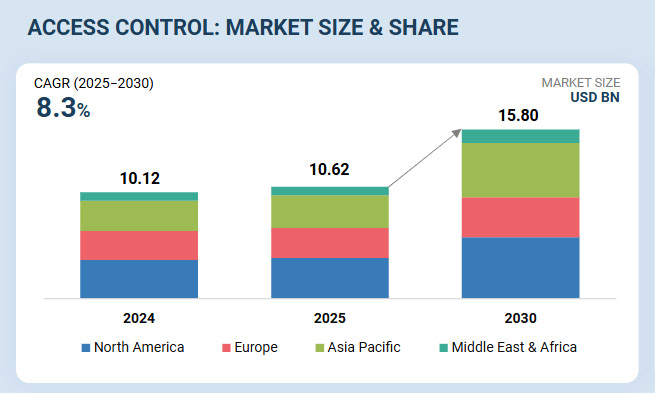
The global access control market is projected to grow from USD 10.62 billion in 2025 to USD 15.80 billion by 2030, achieving a compound annual growth rate (CAGR) of 8.3%, according to new data from MarketsandMarkets. The expansion is fueled by the widespread adoption of IoT-enabled security systems and cloud-based platforms that improve automation, scalability, and cost efficiency.

The shift toward Access Control as a Service (ACaaS) is a major driver of this growth. Hosted ACaaS solutions eliminate the need for heavy on-premises infrastructure, allowing organizations to centrally manage access rights across multiple sites. This model offers greater flexibility, real-time updates, and reduced maintenance costs. Analysts highlight solutions like Identiv’s Freedom Cloud as examples of always-available, resilient systems that ensure uninterrupted operations.

Key sectors fueling ACaaS adoption include oil and gas, pharmaceuticals, power, and water treatment, where secure and scalable access control is essential to protect critical infrastructure.

The residential market also represents a strong growth opportunity, with increasing demand for electronic locks and video surveillance systems driven by home automation trends and rising concerns over burglary and personal safety. Advanced access control systems are becoming integral to smart home ecosystems, offering homeowners greater control and protection.

North America remains the largest regional market, led by robust demand for cloud services, mobile access control, and biometric authentication. Organizations across commercial, government, and enterprise sectors are embracing these technologies to enhance security and efficiency. Major initiatives by U.S. agencies such as the Department of Defense and Department of Homeland Security continue to drive adoption of fingerprint and multi-technology readers.

Leading global players shaping the access control landscape include ASSA ABLOY, Dormakaba, Johnson Controls, Siemens, UTC, Allegion, Honeywell, Hirsch, Nedap, Suprema, Keenfinity, and Thales. Collectively, their innovations are propelling the market toward a more secure, connected, and passwordless future.

ASSA ABLOY: A new report on digital access control shows 12 years of rapid market evolution

The latest edition of ASSA ABLOY’s long-running Wireless Access Control Report has just been published. The 2025 Report paints a picture of a maturing market where digital and mobile solutions are becoming the norm.

With strong momentum behind trends such as wireless adoption, sustainability, and cloud services, the focus now turns to increasingly intelligent integrations and to demonstrating ROI to cement access control’s role in a new generation of smart, secure, and efficient buildings. For the first time in six editions of researching and publishing this biennial Report, ASSA ABLOY’s survey finds that wireless (fully or partly) systems have overtaken wired-only deployments among those who manage access digitally.

“We are delighted to offer a snapshot of the ongoing digitalization of access, which is steadily becoming a wireless-first technology,” says Richard Sharp, VP & Head of Product Unit Wireless Locks, DAS at ASSA ABLOY Opening Solutions EMEIA. “Now running for more than a decade, our Report once again highlights ways for security departments and consultants to contribute to their overall business. Written in clear, business-friendly language, the Report also helps all non-specialist decision-makers to stay on top of what’s happening right now in digital access – and more importantly, what’s ahead.”

Survey results presented throughout the Report, in figures and tables alongside expert analysis, are based on almost 500 responses from those who work in a broad range of roles across security and facilities management, as well as IT professionals with influence over the purchasing or administration of physical access control. Almost half of respondents describe their role as “security/facility manager”.

“This year’s edition of the Report comes direct from the day-to-day sharp end of strategic facilities management,” adds Richard Sharp.

The growing importance of sustainability

According to the International Energy Agency (IEA), buildings consume approximately 30% of global energy*. The Report confirms suggestions that, increasingly, end-users and security professionals are identifying concrete ways in which digital access can help to reduce unnecessary use. For many respondents to the survey, sustainability has gone beyond ‘merely’ a consideration: for 27% of respondents, it is the top factor when considering technology investments to enhance access management reach or capability.

“For many organizations, across multiple and diverse sectors, sustainability is moving from a supporting role to a strategic driver,” says Richard Sharp. “Wireless systems, which reduce the need for cabling and complex infrastructure, are often seen as a ‘greener’ alternative. Battery-powered and energy harvesting devices generally consume much less energy than equivalent wired locks.”

“We also see fast-growing demand for green building solutions and documentation, such as Environmental Performance Declarations (EPDs) which count towards several green certification schemes we support, including BREEAM, LEED, WELL and others.”

“Access Control as a Service reflects a broader convergence trend, with physical security now aligning more closely with IT, sustainability, and workplace experience strategies,” adds Owen Kell, Senior IoT & Security Research Associate at smart-building analysts Memoori. “Organizations increasingly use access data to support occupancy analytics, ESG reporting, and operational efficiency.”


As EU regulations approach, important insights into cyber-security knowledge

The last edition of this Report found significant knowledge gaps between physical and cyber security professionals. Presented with four important regional laws and directives which are (or soon will be) critical to cyber and physical security, 55% of survey respondents did not recognize any. Only 12% of 2023 survey respondents said they were fully prepared for the implications of cyber-security legislation.

“The situation has improved two years on, although the new Report does identify some remaining issues,” says Richard Sharp. “With NIS2 coming into force and obligations under the EU’s Cyber Resilience Act** fast approaching, this remains an area where customers and manufacturers must continue close cooperation.”

The vast majority of 2025 survey respondents (84%) felt their organization was either already compliant, or in the process of ensuring compliance, or that these regulations were not relevant to their situation. Worryingly, when asked directly if their organization was prepared, 16% replied to the survey with a blunt “No”.

In providing commentary for this section, cyber-security governance expert Andy Watkin-Child of Veritas GRC notes, “Cyber security is quickly becoming a regulated risk for companies, either directly or indirectly, requiring boards to address cyber-security risk management or risk civil and/or criminal penalties.”


Accelerated mobile adoption

Adoption of mobile credentials – and mobile access management in general – has boomed, as widely forecasted in previous editions of this Report and elsewhere. Data from the 2025 Report indicates that just over a quarter of respondent organizations are making plans for a future mobile deployment (26% of survey respondents in 2025 versus 39% in 2023). The market is clearly maturing. Fully mobile credential environments now account for 17% of all respondents – more than triple the rate seen in the last edition of ASSA ABLOY’s report, in 2023.

“What’s changed?” asks Richard Sharp. “Many early adopters have already transitioned: mobile digital access is for the now, not just something for the future. These teams are already experiencing the operational agility, convenience, security and sustainability benefits of mobile access. We also see a marked fall in respondents who believe mobile access isn’t an option for them. Mobile digital access is embedded.”

Where the 2023 Report captured strong momentum towards mobile access, the 2025 edition finds increasing market maturity. As so many organizations modernize their security infrastructure, digital access systems are becoming standard, with a clear shift to mobile credentials. Convenience and enhanced security are the key benefits which have driven this adoption – and will continue to do so, the Report suggests.

The 20-page Wireless Access Control Report 2025 also includes data and exclusive expert analysis on the growth of cloud/ACaaS solutions, the rise of biometrics, and much more. To download a free copy, visit: https://www.assaabloy.com/group/emeia/stories/access-stories/wac-report-20251

Real Madrid selects Salto smart access technology to modernize Santiago Bernabéu stadium

Salto’s smart access technology represents a significant step forward in modernizing the Santiago Bernabéu, establishing the stadium as a safe and innovative venue that is prepared to provide unique experiences year-round. 

The iconic Santiago Bernabéu Stadium has taken a major leap forward in security and operational excellence by implementing Salto’s cutting-edge access control platform. This innovative solution eliminates the need for mechanical keys, ushering in a new era of wireless security management. Real Madrid has placed its trust in Salto to modernize the access control system of the renovated stadium, transforming it into a safer, more efficient, and technologically advanced venue. With over 2,500 access points installed, the system enables real-time management of staff and visitor flow, offering flexible adaptation to the stadium’s diverse zones and the varied demands of each event.

The integrated solution, based on the Salto Space access control platform and advanced SVN data-on-card technology, eliminates the need for mechanical keys, thereby enhancing security and optimizing both user and visitor experiences while also improving operational management efficiency.

The Santiago Bernabéu has established itself as a state-of-the-art stadium, completely free of mechanical keys. Thanks to Salto and the collaboration of its partners, Arcón, Sabico, and i-SAI,  security and physical access control management, as well as lockers and rooms, are centralized on a single platform, which simplifies administration and reinforces operational security. This system enables remote monitoring and management of access, with real-time traceability through Salto’s ProAccess Space software. In addition, it optimizes resources and improves efficiency through advanced functionalities, including user registration, incident or security breach control, visitor management, security monitoring, mobile key access, and integrated dashboards, all with full compatibility and integration with other security systems.

With more than 1,000 active users, 50 defined zones, and its integration with the BMS system, this project reflects Real Madrid’s commitment to a stadium that is active 24/7, open to sporting, cultural, and commercial events.

Real Madrid selects Salto smart access technology to modernize Santiago Bernabéu stadium

“The new Santiago Bernabéu Stadium required an innovative wireless system to provide smart access for all users at every access point, eliminating the need for mechanical keys. This solution has greatly enhanced user experience, security, and management efficiency, while seamlessly integrating with the stadium’s requirements and aesthetics.” – Rubén Ramos, Director of Salto Iberia.

The Salto access control system represents a decisive step in modernizing the Santiago Bernabéu, consolidating the stadium as a secure and innovative space ready to offer unique experiences all year round. It improves the security and experience of attendees, visitors and staff at both matches and events, thanks to Salto’s integration with XS4 One electronic locks, Gantner’s electronic lockers and its advanced access control system into the stadium’s management processes. Salto’s solution comprehensively addresses the needs of users at every stage and day of the week, ensuring an exceptional experience and smarter, more efficient management.

Door Cloud: Guest access with Key Link

Being the smartest access control in the cloud means that we can do some amazing things. One of such things is granting access via web link.

Key Link is a very convenient solution for granting temporary access, especially at a distance as nothing material needs to be sent or received. The recipient does not need to be Door Cloud user, does not need to install or run any special app, does not need to memorize anything and everything can be set well in advance.

It goes like this:

  • User creates a web link for opening a certain door.
  • User sends the link via mail or chat.
  • The recipient opens the door by clicking on the link.
  • Which seems like a bit too simple, does it? So, let’s just go in and answer some immediate questions:

How do we open the door once we receive the link?

The door can be opened using a smartphone or any other online device with a browser. Clicking the link will open the browser and land you on the door opening page. The door is then opened by clicking the button on the page.

How do we prevent the link to be further distributed and used by other people?

We don’t. Think of the link as of the ordinary mechanical key or the PIN code. The key can be easily copied, the PIN can be revealed.

How do we know that the link has been used by the intended recipient and not by someone else?

We don’t, see the previous answer.

How do we keep track of who made the link, for whom and why?

The link name and description, its validity period, and the user who made it – all that is automatically logged by the system. If the link is sent by email, the email will be logged too. For any other data, it is up to the user what he will choose to record using the name and description. It may be the recipient name, the link purpose, or anything else of importance to the user.

How do we keep track of the access events made using the link?

Just like any other access using cards or mobile app. All access events made via links are logged in the event log.

How can we limit the link use?

We can set the link validity from – to. We can change or cancel it at any later time. We can also limit the number of times the link can be used down to single use.

Can we send the link to multiple recipients?

Yes. Also, links can be forwarded, copied, published or otherwise distributed to any number of secondary recipients.

What are the technical requirements?

Access via Key Link can be performed on any Door Cloud access point (door). Link can be issued online on the web or using the Door Cloud web app. For opening doors, any smartphone or similar device with browser and internet connection will do

Link access can be seen as a high-convenience, yet low-security access feature. What are the security considerations?

It really depends on the use case. Key Link is not meant as a replacement for card access or smartphone app access. It is intended for use cases where the lack of user identification is acceptable, such as apartment rent.

BENEFITS

  • Access right can be granted easily and instantly from the web or the mobile app.
  • Access right can be granted with delayed start and automatic expiration (from – to, from – duration).
  • Access right can be modified or revoked easily and instantly.
  • Access right recipient can be anyone with a smartphone and internet connection.
  • Access right recipient can easily and instantly share the access right further to other recipients.
  • No cards or card readers required.

USE CASE: APARTMENT RENT

The best use case is apartment rent. The apartment owner is a Door Cloud user, the guest is anyone with a smartphone and internet connection. The owner creates the link and sends it to the guest. The guest opens the apartment door with his smartphone, and the owner sees that the guests have arrived. If cards are preferred, they can be left in the apartment for guest’s convenience. In that case, the link duration may be set for some initial period only.

If there are more guests, they can share the link between themselves. Or, the owner can send multiple links. If the guest cancels or leaves early, the owner simply revokes the link.

ASSA ABLOY: Why door closers matter in smart buildings

Smart buildings take a connected approach to managing and monitoring who is coming into and going through them. For almost every user, whether visitor, staff or contractor, the building journey begins with a door.

A 2025 report by analysts Memoori suggests that the global IoT market in commercial buildings will grow to $101 billion (€87.5 billion) by 2030, at a baseline predicted CAGR of 7.9%1. Memoori identify offices, retail premises, datacenters, and hospitality businesses as probably early adopters of smart building technology.

The smart building will streamline the experience for both users and managers. When fully implemented, it promises buildings which are more secure; that make better use of energy; and which will make data-driven decisions in real time. On the basis of these concrete benefits, analysts forecast rapid growth. According to Fortune Business Insights, the market will grow from a value of $143 billion (€122 billion) in 2025 to $548.5 billion (€469.5 billlion) by 2032, at an estimated 21.2% CAGR2. Security systems and technologies will be a significant component of this growth.

It starts at the door

In a world of smart sensors, building management dashboards and real-time analytics, the door closer is easy to overlook. Yet in creating tomorrow’s generation of intelligent buildings, this device will play a critical role. Modern high-spec door closers do far more than simply shut a door. They help preserve climate zones, reduce noise, support fire safety and accessibility, enhance security and convenience, throughout the wider building.

For security, the door closer is essential. A door left ajar – whether by wind, human error or wear and tear – undermines access protocols and protections. Intelligent closers work alongside digital locking and access systems to ensure doors shut reliably behind every authorized user, reducing the risk of tailgating. A certified door closer is also a key component in fire safety strategy. When integrated with fire alarm systems, closers allow fire doors to remain open during normal use, but close automatically in an emergency. This supports safer evacuations and regulatory compliance without compromising day-to-day convenience.

From a sustainability standpoint, the contribution is also tangible. A closed interior door helps to maintain temperature differentials, between an office and the corridor, for example, or a server room and an atrium exposed to climate variations. Fully closed interior doors help reduce stack pressure – the unwanted inflow of air at lower levels, caused by rising warm air within the building – which can otherwise disrupt HVAC performance. Even a single poorly closed door can force HVAC systems to work harder, leading to unnecessary energy waste. A door closer ensures these doors shut gently but securely every time, supporting improved energy efficiency metrics.

Smart door, smarter building

In a connected building, integration is everything. ASSA ABLOY intelligent door closers are designed to work as part of a broader Building Management System (BMS). They integrate seamlessly with access control, fire alarm and HVAC platforms, helping the building to become more responsive, more secure, and more efficient.

“Every model in our range of award-winning door closers is engineered for performance, durability and aesthetics. As you would expect, they meet or exceed critical EN 1154 compliance requirements and in most cases, are certified for use on fire doors” says Andreas Gmelin, Product Management and Business Development Director from ASSA ABLOY Opening Solutions EMEIA. “Increasingly, they are also designed, from the ground up, by paying attention to their growing role within an intelligent building environment. They can be responsive and be used together with other components in a smart building, focusing upon access, energy and life safety.”

“In short, they are no longer just robust, convenient hardware working in isolation to perform a single important task. Door closers are now a key enabler of improved smart building performance, which benefits every user and makes life easier for building managers.”

To explore the intelligence inside every ASSA ABLOY Door Closer, and how it benefits your building, visit:

https://www.assaabloy.com/group/emeia/solutions/topics/door-closers

ASSA ABLOY: Staying secure in today’s digital landscape

Kelly Gill, SVP & CTO, ASSA ABLOY Opening Solutions EMEIA, explores today’s regulatory environment, including NIS2 and the Cyber Resilience Act and what the access control industry must do to remain digitally secure.

In today’s connected world, attacks are more likely to target digital than physical entry points. From ransomware and firmware tampering to remote hijacking, AI-driven phishing and automated vulnerability discovery, the nature of threats is evolving rapidly, and no industry can afford to neglect them. As our industry has moved from mainly mechanical to increasingly digital solutions, we have long recognised the importance of constantly monitoring and assessing the risks we face. This means not only meeting mandatory regulations but also voluntarily adopting international standards such as ISO 27001, which protects data and systems through a structured and independently audited framework.

Today’s fast-changing risk environment is also why the EU introduced the Network and Information Security Directive 2 (NIS2) – to raise the bar for cybersecurity across Europe. But what do measures like NIS2 and the Cyber Resilience Act (CRA) mean in practice? How does the rise of AI fit in? And most importantly, what should our industry be doing to stay secure in such an unpredictable digital landscape?

The new regulations

NIS2 is reshaping cybersecurity expectations by setting higher standards to reduce risk, improve transparency, and protect data and services. Alongside it, the CRA introduces mandatory requirements for products with digital components. This makes “secure by design,” regular updates, and compliance checks essential before products can enter the EU market.

For companies in our industry, responsibilities now extend well beyond internal systems. Organisations must also ensure that suppliers and service providers comply, with regular risk assessments forming a central part of the process. The consequences of falling short are severe, ranging from significant fines and audits to the potential withdrawal of products from the market.

For our customers, the message is clear: security must be built in from the start. Compliance is not just about meeting regulations, it is also a competitive advantage. At ASSA ABLOY Opening Solutions EMEIA, security is part of our DNA.  We embed these standards into everything we do, giving customers solutions they can trust to be compliant and resilient.

The rise of AI 

Artificial intelligence is transforming the digital security landscape and it cannot be separated from the regulatory framework shaping our industry. With AI advancing rapidly and new regulations coming into force, we have established a digital compliance framework to stay ahead of the curve and use AI as an enabler for improving security and achieving compliance.

On one hand, AI brings powerful benefits, including more intelligent monitoring, faster anomaly detection, and smarter tools for operational efficiency. These capabilities directly support NIS2 and the CRA, particularly in the areas of proactive risk management and incident response.  On the other hand, AI introduces new risks. The attack surface is expanding and threats such as deepfakes and smarter phishing create serious threats that regulators are determined to address. Both NIS2 and the CRA emphasise continuous monitoring, transparency and accountability, principles that must now also guide the responsible use of AI.

At ASSA ABLOY Opening Solutions EMEIA, we see AI not just as a risk to mitigate, but as a capability to strengthen resilience and trust. That is why we are embedding strong governance practices around AI and building cybersecurity standards into every stage of product development. By doing so, we help our customers align with new regulations while ensuring AI serves as a tool for greater security and confidence.

Trust and compliance

At ASSA ABLOY Opening Solutions EMEIA, we are taking NIS2, the CRA and the rise of cyber-threats seriously, ensuring compliance and enhancing trust with all our customers. We have reinforced supplier oversight, streamlined incident reporting, and embedded cybersecurity into every stage of product development and lifecycle management. Our teams also conduct ongoing risk assessments and post-incident reviews, ensuring that lessons are learned and improvements are made.

By taking these steps, we not only meet regulatory requirements but strengthen the resilience of our supply chain and the trust customers place in us. Beyond our own operations, we are also committed to supporting customers on their compliance journey. Initiatives such as our recently released whitepaper “Enhancing Cyber–Physical Resilience with Digital Access Solutions” and a detailed NIS2 whitepaper developed in Germany last year provide clear, practical guidance. By showing what these regulations mean in practice and how intelligent access solutions can directly support compliance, we aim to make the path forward less complex and more achievable for our customers.

Looking ahead

The days when security threats to businesses and products were only physical are long passed. Today, we find ourselves in a world where the digital realm poses even more serious and constantly evolving challenges. It is therefore crucial that, as an industry, we take the necessary steps to meet the directives of NIS2 and the CRA and also constantly monitor the rise of AI. Only by doing so can we protect our customers, preserve our reputations, and build the trust that defines true leadership in security.

Suprema: The 6-Layer Security Framework for Total Data Center Protection

Data centers are the foundation of the digital economy, enabling cloud services and powering emerging technologies such as generative AI (GenAI). According to Boston Consulting Group’s 2025 report Breaking Barriers to Data Center Growth, GenAI-driven computing is the fastest-growing demand driver and is expected to account for nearly 60% of growth in data center power consumption between 2023 and 2028. This surge in demand is driving rapid expansion and deployment of data center infrastructure worldwide, with the global data center market projected to grow steadily over the same period.

While digital defenses are advancing, physical security breaches remain a critical vulnerability—responsible for roughly 10% of global data leaks. To ensure trust and compliance with standards such as ISO/IEC 27001, data centers must adopt robust, multi-layered physical protection.

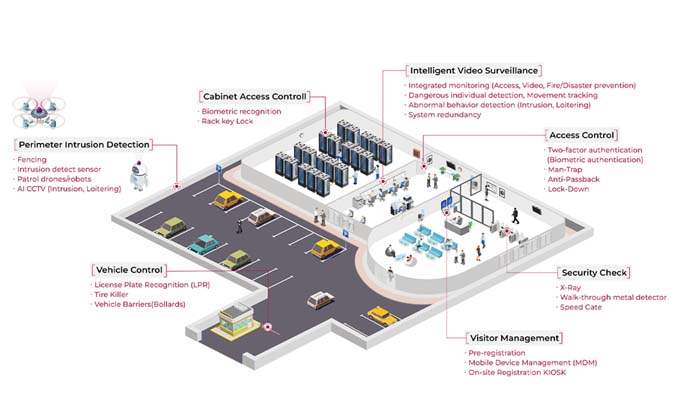
A single security system is not enough. True resilience comes only from a comprehensive, integrated, multi-layer defense strategy. Suprema proposes a 6-layer framework for ensuring complete physical security in data centers.

Layer 1: Site and Surroundings – Establishing the Foundation
Security begins with location. Choosing a site with minimal natural disaster risks (e.g., flooding, earthquakes) and strong public safety conditions sets the foundation for reliable operations.

Layer 2: Perimeter Protection – Building the First Barrier
The outer perimeter must deter and delay intrusion attempts. Effective defenses include vehicle barriers, bollards, high-strength fencing, and well-positioned security lighting. Thermal and infrared cameras, supported by motion and ground sensors, provide 24/7 detection. Advanced tools such as X-ray vehicle inspection systems further strengthen perimeter integrity.

Layer 3: Access Control and Authentication – The Core Security Layer
Access control is the centerpiece of data center protection. Multi-factor authentication (MFA) using RF cards, PINs, fingerprint recognition, or facial authentication ensures only authorized personnel enter. To prevent tailgating, facilities should employ mantraps and speed gates, with anti-passback settings enforcing strict access policies.

Layer 4: Video Surveillance and Intelligent Detection – From Passive to Proactive
AI-powered surveillance elevates video from passive monitoring to proactive defense. Intelligent cameras continuously analyze footage, using facial authentication and behavioral analytics to trigger instant alerts for unauthorized presence or suspicious behavior. This transforms video surveillance into a real-time threat detection system.

Layer 5: Visitor Management – Controlling External Personnel
Visitors for inspections or maintenance are unavoidable. Strong visitor management is therefore essential: advance registration, ID verification, escorted entry, temporary pass issuance and retrieval, and strict one-to-one escort policies all reduce the risk of external breaches.

Layer 6: Environmental and Equipment Protection – Ensuring Continuity
Data centers must be prepared for fire, flooding, and power failures. Disaster prevention systems and redundant infrastructure ensure continuity. When integrated into the broader security platform, these measures enhance resilience across both facility and IT infrastructure.

Integrating the Layers: Why a Unified Approach Matters
A truly secure data center is more than the sum of its parts. Even highly capable individual systems create blind spots if they operate in silos. Security must function as a cohesive, interoperable ecosystem.

Suprema highlights three enabling technologies for achieving this integration:

AI Video Analytics
AI-powered analytics detect intrusions and abnormal behaviors in real time, such as unauthorized access, loitering, violence, or smoke/fire. They also identify potential insider threats—like unauthorized movement in restricted zones during off-hours—enhancing situational awareness.

Advanced Biometrics and Access Control
High-security environments must move beyond cards and passwords, which are vulnerable to loss and duplication. Instead, MFA combined with biometric authentication (fingerprint recognition, facial authentication), mobile credentials, and PIN ensures secure, non-transferable access. Biometrics eliminate the risks associated with stolen or cloned cards, effectively blocking unauthorized entry.

Unified Security Operations and Future Strategy 
Modern hyperscale data centers increasingly adopt PSIM (Physical Security Information Management) platforms to centralize monitoring and correlate events across all security systems. Looking forward, open APIs integrated with VMS (Video Management Systems) and MDM (Mobile Device Management) extend capabilities to IoT sensors, autonomous robots, and drones. For example, the Novva Data Center in the U.S. deploys robot dogs for perimeter patrol, thermal detection, visitor guidance, and biometric verification, while unmanned aerial drones provide real-time external surveillance to eliminate blind spots.

Towards Total Confidence in Data Center Security
As data centers scale to meet the demands of AI and cloud services, physical security must evolve beyond basic controls. A 6-layer integrated strategy, powered by AI-driven analytics, biometric authentication, and unified security platforms, delivers complete, future-ready protection. Suprema’s approach ensures that data centers are not only compliant, but resilient—offering operators and customers total confidence in security, continuity, and trust.