Home Archive by category Vertical Solutions (Page 15)

Vertical Solutions

New Aperio® H100: easy-to-integrate wireless access control technology is now inside a stylish door handle

London, February 2018 — The new Aperio® H100 packs the power and flexibility of wireless access control into one slim, cleverly designed door handle. With easy retrofitting to almost any interior door and comprehensive RFID compatibility, the new Aperio® H100 handle makes extending access control to more doors cost-effective by integrating with a vast range of third-party systems.

The Aperio® H100’s stylish design is perfect for indoor office and facility doors. The Aperio® H100 can work within an online access control system or offline as a standalone device. A battery fits inside the handle, ensuring a minimal footprint and a discreet look to gel with any contemporary door style. The Aperio® H100 is easy to retrofit on existing doors, with no drilling and no wiring required. Any existing mechanical cylinder can still be used.

The Aperio® H100 is specified with maximum flexibility and designed to fit almost any format of interior door. The Aperio® H100 is compatible with most common European (DIN) and Scandinavian mortise locks, in wooden, steel, tubular frame or glass doors with standard lock cases. It comes in left- and right-hand versions for a door between 35mm and 80mm thickness, with optional U-handle and USB adaptor.

The Aperio® H100 is compatible with multiple RFID technologies, including iCLASS®/ISO14443B, iCLASS® SE, Seos®, MIFARE® Classic, Plus and EV1, and DESFire® SE.

“Like all Aperio® devices, our new handle can upgrade site security for a very affordable price,” says Matthias Weiß, Product Manager Aperio® at ASSA ABLOY EMEA. “The Aperio® H100 further extends a range which adds access control wirelessly to exterior and interior doors, from fire and safety doors with regulatory requirements to meeting rooms, labs and offices.”

The new Aperio® H100 handle completes a comprehensive range of Aperio® wireless access control devices that already includes online and offline Aperio® cylinders (C100/C900) and escutcheons (E100/E900); an online and offline lock (L100/L900); and a wireless lock for bringing server racks and cabinets (KS100) into the same access control system as doors. To discover more about how Aperio® enhances security and convenience at any premises, you can watch a short film at www.assaabloy.co.uk/aperiowirelesslocks.

5 ways SMARTair® brings your workplace into the 21st century

London, August 2018 – Most modern employers want to make their workplace into a more responsive, more flexible environment. Upgrading security offers a major quick win. While frustration is part of the package with old-fashioned locks and mechanical master-keys, wireless access control — including SMARTair® — is designed around security, control and convenience.

1. Be more productive. Adding wireless access control makes workplace security flexible and responsive. It’s easy to create access time schedules for different user groups. So, if your cleaners should access only after office hours, SMARTair® access control system can handle it. If a team relocates, it’s easy to change their access permissions en masse — and with zero interruptions to everyone’s workflow. The bundled SMARTair® admin software makes it easy to achieve all this (and more) from an intuitive interface.

2. Spend money wisely. How much of your budget gets eaten managing mechanical keys? With SMARTair®, you can forget about keys altogether, replacing them with easily programmable smart-cards. You don’t need to change your doors or pay for expensive cabling. Should the CEO lose her key-card, cancelling it and issuing a replacement is simple, almost free and instantaneous. Battery-powered, wireless locks also deliver ultra-low energy consumption compared to traditional wired access locks. And with SMARTair®, your investment is protected: you can expand your system at any time, or upgrade its functionality, without having to begin again from scratch.

3. Make staff happier. Happy staff are more loyal and more productive. With its focus on user experience, SMARTair® banishes everyday frustrations. It’s easy for managers to program just the right level of access for freelancers and contractors. Facilities staff could open doors remotely or get a real-time site security overview. Employees can use their SMARTair® access card for the canteen, vending machines, changing room locker locks and even the photocopier. And with the new Openow™ app from SMARTair®, you don’t even need a key-card (or to wonder where you left it).

4. Create the right impression. With SMARTair® and the Openow™ app, employees and visitors can open authorized doors with their mobile phone. Facility managers can issue virtual keys to anyone who needs them — and revoke them whenever they choose, or set them to expire automatically at a certain time. No more plastic key-cards means there’s no need for a card activation terminal on reception or elsewhere, and no need for your visitors to hang around waiting. You just send them a time-limited virtual key ahead of the visit. With Openow™, if you have your phone, you are already carrying your keys.

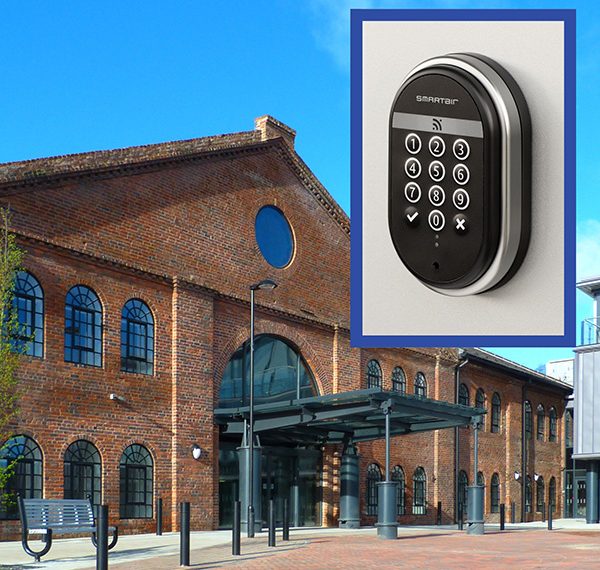
5. Maintain your aesthetics. There’s a SMARTair® wireless lock to fit pretty much any door. Battery-powered escutcheons and cylinders fit wood, glass, emergency exit and fire doors, and there are wall readers for high-traffic entrance doors, barriers and lifts. Because SMARTair® devices come in a subtle, contemporary design — no clunky wired doors — they have proved attractive enough for high-spec co-working spaces and prize-winning architecture; and robust enough for a hectic university campus.

The complete SMARTair® solution includes wireless escutcheons, cylinders, wall readers, locker locks and more; the intuitive SMARTair® TS1000 software; and the enhanced new Openow™ app management functionality. It’s all easy to install — and even easier to operate.

You can transform your workplace with SMARTair® wireless locks and download a free brochure at: campaigns.assaabloyopeningsolutions.eu/openow

Can phones challenge the resilient plastic card?

London, November 2018 – Mobile access control will increasingly keep pace with modern mobile working, says Thomas Schulz, Director Marketing and Communications, Digital and Access Solutions at ASSA ABLOY EMEA

In a world where we never stop moving, it makes sense that mobile technology is everywhere. This includes almost all workplaces. By 2016, 94% of European large businesses were providing workers with connected mobile devices, according to official EU statistics. And they are using them for more than just email. Recent Criteo research suggests 39% of online travel agency bookings now come via a mobile phone. I could cite many similar statistics: The growth of “mobile-first” cuts across industries.

Yet there is a workplace function where mobile phones are the exception: access control. The technology exists, for sure. Mobile seems a natural fit for convenient security. The device you carry everywhere — the smartphone — can replace a separate RFID card. The mobile phone is at the centre of many exciting innovations in access control.

So why does the physical credential still reign supreme in offices and commercial buildings?

Lift-off for mobile?

As a new report on the access control industry identifies, mobile phones have not made predicted progress in replacing the plastic smart-card — at least, not yet.

According to the Wireless Access Control Report 2018: “Where access control is concerned, security departments have historically been tasked with fulfilling two major tasks as inexpensively as possible: tracking time and attendance; and preventing unauthorised entry.

“Rightly or wrongly, cards, fobs and keycodes are seen as fulfilling these jobs adequately. Security professionals are unwilling to jeopardise security by adopting innovations perceived as unproven.”

Research supports the notion of wary security managers. One European Commission Digital Transformation Monitor report suggests 51% of businesses with a BYOD policy believed they had suffered some kind of mobile security breach. Device manufacturers including Lenovo note the growth of CYOD as a potential remedy.

These reservations about mobile phone access are well rehearsed. Yet using a mobile phone instead of a smart-card also has advantages. How quickly would you notice if you lost your work access card? Everyone is more careful with their precious handset. And if a phone is stolen, password, pattern and fingerprint ID security can prevent a thief from gaining entry to premises, or even to the phone itself.

Student halls of residence, for example, can expect a significant uptick in site security from mobile phone credentials. Few students would instantly notice a missing smart-card; almost none survive for long without their mobile.

Phones can also be protected with biometrics much more cheaply than whole premises. “Rather than having to add biometric capture devices in or alongside readers, the phone itself can easily be used as a capture device for face or voice (or both), with comparison and matching done locally on the phone or centrally,” David Anthony Mahdi, research director at Gartner, said in 2017. “This approach also mitigates the risks from an attacker who gains possession of a person’s phone.”

Phones open new possibilities for keeping credentials up-to-date without the need for separate readers or a return-to-base. To take one example, the new SMARTair® Openow™ solution enables security managers and site users to manage virtual keys inside a secure app. If a security admin cancels a virtual key, it vanishes immediately from a user’s Openow™ app. These virtual keys can be created and sent from anywhere. Facility managers can check and amend every virtual key’s access rights whenever they want, and wherever they are.

Students and staff at the new $100 million Arkansas State University campus in Queretaro, Mexico, are already reaping the benefits of Openow™. With no access cards to collect or validate, every user installs and validates their app and collects keys virtually. It’s secure and convenient.

Getting rid of physical credentials has these concrete advantages. It also helps to project a contemporary image for your business — perhaps why the SMARTair® solution attracts major interest from the fast-growing, design-conscious co-working and shared office sector. When Openow™-equipped phones replace plastic key-cards, there’s no need for a card activation terminal at reception. Access feels slicker.

Mobile solutions for mobile workers

These advantages foreshadow a brighter future for phone-based credentials. By 2020 Gartner predicts 20% of organisations will use smartphones for access, in place of plastic smart-cards. These same positives outweigh those surmountable issues with mobile access. Perhaps, too, they explain why mobile solutions keep winning industry awards. ASSA ABLOY’s mobile solution CLIQ® Connect has been a winner at the Detektor International Awards, recognizing outstanding innovation in security alarms, access control and CCTV. It also won the Gold Trophy at France’s APS Awards and Protector & Wik’s Golden Protector Award 2018.

In many sectors, mobile credentials are now expected to spread fast. IHS Markit’s senior analyst Jim Dearing writes: “The end users most likely to transition to a full mobile credential-only system are those who have to deal with large numbers of temporary visitors or who experience exceptionally high card turnover rates. Examples include building sites at which contractors require access to varying locations, as well as universities and hotels where large numbers of cards have to be replaced each year.”

Solutions for mobile workers are amenable to smartphone-based access; this exact constituency is a focus for CLIQ® Connect. With this mobile-first extension to the CLIQ® mechatronic access control system, a key-holder no longer needs to update access rights physically in person. All they need is a smartphone and the CLIQ® Connect app. To change a key-holder’s access permissions, an admin accesses the CLIQ® Web Manager — from anywhere — and updates it. A key-holder makes an encrypted connection between their programmable Bluetooth® key and the app to instantly update permissions from the cloud.

As well as saving companies’ administration costs, CLIQ® Connect boosts security, because in the event of a lost key, access authorizations can be deleted instantly. Shorter (i.e. safer) access validity timeframes no longer disrupt everyone’s work.

Only mobile technology gives facility managers the ability to react at such speed. Hats off to the longevity of the RFID card. But the future’s brighter and faster… and mobile.

You can download the full “Wireless Access Control Report 2018” from https://campaigns.assaabloyopeningsolutions.eu/wacreport2018

SMARTair® and co-working make perfect partners at a new Barcelona business centre

London, November 2018 – In the booming workspace market, a professional welcome is crucial to success. At Barcelona’s Gran Vía Business Centre, 2,500m2 of offices and shared collaborative workspaces in the heart of the city, managers chose SMARTair® wireless access control system — because it protects and manages their premises, and also projects the right image for a contemporary co-working environment.
Gran Vía is a flexible and well-equipped home for companies from international corporates to local start-ups. Fibre optic broadband, LED lighting, an on-site restaurant and adjacent rental apartments are also part of Gran Vía’s high-end service. This is why they sought an upgrade and replacement for an existing, out-of-date access control system.

Gran Vía needed more flexibility and control over access to their premises; a system to seamlessly manage diverse access needs of permanent versus temporary users, and that would cope with rapid personnel turnover. Locking devices must complement the professional, modern image of the workspace, which attracts high-profile, design-savvy business clients. On top of these demands, any new system would have to be fitted without disrupting day-to-day business.

SMARTair® delivered
SMARTair® access control locks now control access to Gran Vía’s six floors of offices, meeting spaces and communal areas. Access requirements change all the time at the business centre, and security managers now have a system where programming and reprogramming access rights is fast and easy. Thanks to the slick, flexible management software behind SMARTair®, everything works in the background — keeping site users safe almost without anyone noticing.

“SMARTair® is an effective solution that is easy to use,” says Esther Portillo, Marketing Director at Gran Vía Business Centre.

Over 50 new SMARTair® wireless escutcheons are operated with RFID smart-cards, so security is not compromised if an office user loses their credential. Security administrators simply cancel the lost credential’s access rights — much quicker, cheaper and more professional than replacing a traditional mechanical lock. The user gets their new smart-card validated at one of five SMARTair® wall updaters: it is the perfect combination of contemporary image and efficient user experience for Gran Vía’s clients.

Importantly, SMARTair® wireless door and wall devices complement Gran Vía’s contemporary aesthetic. “SMARTair® has a modern design and suits our installations perfectly,” confirms Esther Portillo. Bringing more doors into any installed SMARTair® system is straightforward, because SMARTair® escutcheons fit wood, glass, emergency exit and fire-resistant doors.

Gran Vía now has an access control system they can reconfigure and expand to suit both their needs and their clients’.

Dahua Technology Cameras Provide Winning Video Surveillance

When the Olympic Games come to town, the welfare of people and property are of paramount importance in both the planning process and during the event. The 2016 Summer Olympics in Rio de Janeiro draws 500,000 foreign visitors and sells$7.5 million tickets to people who will watch 10,500 athletes compete. There are 85,000 security personnel on hand, and the overall budget for security totals $895 million.*

Challenge

To ensure a secure environment for the 2016 Summer Olympic Games, Rio de Janeiro government officials sought a comprehensive video surveillance solution to monitor a wide expanse of areas inside and around the Olympic Park in Rio de Janeiro—Copacabana, Maracanã, Deodoro, and Barra da Tijuca. Other venues that required monitoring included the Olympic Stadium, Sambódromo, Maracanãzinho Olympic Centre BMX, Beach Volleyball Arena, Olympic Village and Paralympic, as well as the surrounding roads that are for exclusive use by the Olympic officials, athletes, and official press.

The Olympics security project required cameras that could produce high definition (HD) images and be capable of supporting intelligent video analytics, which is key when monitoring events with a high flow of foot traffic.

Solution

Rio de Janeiro government officials selected Dahua Technology, a high-value, total security solutions provider with the second largest market share worldwide (according to research firm IHS), because it fulfilled all bidding requirements and was regarded as the best solution that offered the highest performance.

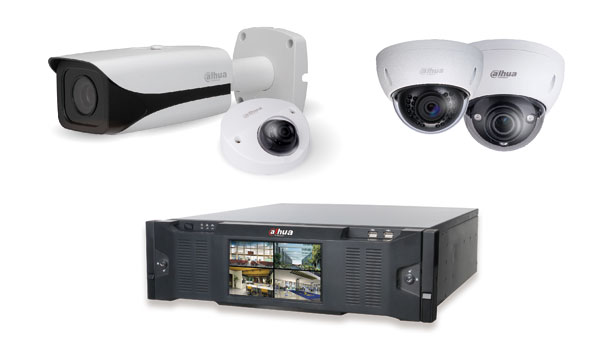
Dahua provided 1823pcs high-resolution IP, dome, and 30x optical zoom pan-tilt-zoom (PTZ) cameras for the project. The Dahua cameras were installed in strategic locations where security personnel could observe the Olympic complex and its environments. The video feed was transmitted through a private network to the central monitoring stations inside Olympic Park and the Rio de Janeiro Operation Center, where people and objects could clearly be identified to help safeguard athletes and visitors. The Dahua total security solution assisted authorities in identifying medical emergencies, vandalism, and other situations where a response team was required.

The video surveillance system was designed to capture high quality HD images. The cameras have advanced technology to support embedded intelligence functions, such as sending an alert to central monitoring when it detects abandoned or missing objects, unauthorized entry into a prohibited area, and other defined activities. The cameras also supported multi-streaming that allows images to be recorded and monitored in real-time high resolution, so that operators had a clear and well-defined view of both live and recorded footage.

Benefits

In addition to its video surveillance products, Dahua also contributed to the 2016 Rio Olympics security project by providing full technical and commercial support that included training operators and managing settings adjustments. Dahua also coordinated a partnership between the integrators and the Rio de Janeiro government to provide comprehensive integration between the cameras and third-party platforms deployed in this project.

“The Dahua Technology products were amazing during the entire operation. Their image quality is much better when compared to other brands,” said Rio de Janeiro City Hall Security Officer Thompson Peixoto. “We look forward to other opportunities to cooperate with Dahua in the future.”

Dahua Delivers an Elite Security Solution for a Luxury Hotel in Italy

HANGZHOU, CHINA / September 10, 2015 —The Villa d’Este has been nestled in Cernobbio for almost 150 years. It was built in 1568 as a private residence and was transformed into a hotel in 1873. The Villa itself is a great example of Renaissance architecture and its luxurious rooms are located majestically along the shore of Lake Como. For years, many international awards have been bestowed upon Villa d’Este as the most wonderful hotel in the world. It has received numerous prestigious international awards for excellence.
Through the centuries, countless celebrities have stayed in this beautiful hotel, including kings and queens, presidents, Hollywood stars, writers, musicians, singers, designers, politicians, etc. The first important guest was Giorgio Ricordi who invited famous composers Giuseppe Verdi e Giacomo Puccini. Additionally, celebrities like Alfred Hitchcock, Frank Sinatra, Leopold, King of Belgium, King Vittorio Emanuele, the Princess of Monaco, Barbara Streisand, Madonna, Mick Jagger, Bruce Springsteen, John Kennedy, Gorbachev, Churchill, the Shah of Persia, Maria Callas, Onassis, just to name a few have all been guests at the Ville d’Este. Also, each year the hotel hosts internationally cultural events like the “Workshop Ambrosetti”, a benchmark for the highest levels of politics, finance and industry; and the “Concorsod’ Eleganza Villa d’Este”, an annual world-wide event for classic cars with custom bodywork.

Dahua, in conjunction with Videotrend, was paid the highest compliment as it was asked to secure this spectacular venue. The challenge was to set up a highly professional video surveillance system with the specialist installer Emit di Lecco for its property protection, while ensuring the most absolute privacy for the celebrity guests. The security system exerts strict monitoring for the entrances, parking lots and other outdoor areas to greatly eliminate possible unsafe factors. In total, the hotel has installed 75unitscomprised of different camera types from the Dahua Eco Savvy 2.0 series.

Dahua’s latest 2.0 series features a 4-megapixel progressive-scan CMOS, which delivers high quality images at 20fps.The end result is an image twice as clear as a traditional 1080p camera. The series features an impressive range of smart detection features, including face detection, tripwire detection, and intrusion detection. These features mean that users are equipped with more precise video analysis and, as a result, greater security efficiency. Eco-savvy 2.0 also boasts WDR image enhancement technology, triple video streams, and Intelligent Video Surveillance (IVS). The wide dynamic range (120dB) ensures the cameras offer impressively high performance in scenes that are backlit as well as those situated in dark areas, which has traditionally been challenging for surveillance cameras.

The majority ofthe cameras are installed mainly in the primary areas for monitoring. The camera is equipped with CMOS progressive scan sensor, featuring 4MP resolution which provides high quality images at 20 fps. Thanks to the powerful sensor, images are twice as clear as traditional cameras 1080p (2MP) which affords the hotel better protection with finer details.

In addition to these cameras, Dahua also upgrades the NVRs for the hotel which is NVR6000. It supports max 128 channel IP cameras input with 1080P real-time live view. It is able to provide smooth video streams as well.

Moreover, the hotel has simultaneously installed Dahua VDP system for the interior of the villa. Dahua video door phone is specially designed for the modern intelligent Villa. It features outdoor visual intercom, face recognition access control, card unlock, indoor monitor unlock, and camera surveillance. The outdoor station is made with an aluminum alloy panel with an ultrathin machine. The indoor monitor is very sleek looking and easy for installing and removing. A complete parking guidance system solution, including monitoring, recording, analysis and license plate reading was also installed. All the information is recorded and classified for rapid access of information when searching for a particular event.

“We delivered the most advanced comprehensive product series to secure Ville d’Este. Compared to other suppliers, Dahua’s products offer the great advantage of high definition viewing, which enables users to see the details of the scenes and ensures safety as well,” said Elmer Zhang, Sales Director of Europe at Dahua Technology.” The proper use of our products in Ville d’Este has proven to be a great success, which we hope will encourage the installation of our products to serve more customers in the hospitality field.”

Valuable medical equipment is in safe hands with SMARTair™

London, October 2018 – Genuine real-time access management, fast deployment and energy efficiency during operation: these were the key demands of the Maimónides Biomedical Research Institute of Cordoba (IMIBIC), part of the city’s university campus. To handle daily traffic of around 270 people, IMIBIC chose SMARTair™ Wireless Online electronic access control to secure the centre’s interior and exterior doors. The flexibility of a SMARTair™ system makes it easy for facility managers to program access rights tailored to each individual user, ensuring only the right people get access to the right areas, and only at the right times. The same system also comfortably manages much greater numbers of temporary visitors, during the Institute’s frequent external events.

“Using SMARTair™, the facilities and maintenance coordinator can supervise the state of building security in real time, and control who accesses the building and when,” says Jose Luis Torres Garcia Key Account Manager SMARTair™ Sur-Levante.

A single wireless system protects the main entrance; radioactivity, cytometry and genomics labs; operating rooms; and other sensitive areas, where trustworthy access management is critical. Authorised staff can also access another IMIBIC facility, inside the Reina Sofia University Hospital, with their credential.

Efficient and user-friendly

Because there’s no wiring, installation was fast and unobtrusive. Battery-powered devices are much more energy efficient than mains-powered access control. Maintenance is minimal; just a new standard battery every 40,000 cycles. Plus, there was no need for IMIBIC staff to swap their existing access card, because SMARTair™ is compatible with all major RFID technologies.

The powerful functionality of SMARTair™ Wireless Online management enables facilities managers to admit staff remotely, from anywhere, should someone lose or forget their credential. Using the intuitive Wireless Online system software, a real-time overview of access system status is easily generated at any time. It’s also simple to issue timed access control permissions tailored to the needs, responsibilities and profile of every individual site user.

With two years’ use — and several fire drills successfully completed — SMARTair™ has been thoroughly and successfully tested in IMIBIC’s demanding security environment.

A leading mental health treatment centre in France puts its trust in Aperio® wireless access control

London, February 2018 – Like many inpatient health facilities around Europe, the Centre Psychothérapique de Nancy (CPN) in France had a persistent problem with lost physical keys. If a key went missing — lost or misplaced, by a resident or staff member — multiple cylinders in a unit would need to be replaced. The expense in terms of staff time and money was significant, and never-ending. And like many other health centres, CPN turned to Aperio® wireless technology for a solution.

Over 160 Aperio® wireless escutcheons have been installed across the CPN premises integrated with the access control system from Delta Security Solutions, most on the doors to patients’ rooms. Now everyone the ability to circulate freely without needing to carry a cumbersome key.

Because the Aperio® integration at CPN is online, security staff can now keep track of all door security in real time — which was not possible with the old mechanical master-key system. If a resident loses their credential, facilities staff simply cancel it instantly and reissue another, ensuring security at the site remains intact.

Some dorm-style rooms at CPN have multiple beds; in these, Aperio® escutcheons secure cupboards for every inpatient, so their personal belongings are kept safe without physical keys or needing to remember PIN codes. The old key-operated safes have been removed, saving CPN the recurring cost of re-keying or replacing safe locks.

“Previously when a unit key was lost, we would have to change every cylinder it opened — which for some keys would be very expensive,” says Cédric Marchal, technical services engineer at CPN.

At CPN, Aperio® devices also secure areas where residents are not permitted, including staff rooms, offices and sensitive zones like the pharmacy and medicine store.

Alongside the escutcheons deployed at CPN, the Aperio® device range includes online and offline Aperio® cylinders; an online security lock; a wireless lock for bringing server racks and cabinets into the same access control system as doors; and the new Aperio® H100 handle, which packs the power and flexibility of Aperio® wireless access control into one slim interior door handle.

Every year since 2011, CPN have budgeted for an expansion in their Aperio® system. Every year, more doors at their site are covered — enhancing the safety and well-being of patients. Enabled by Aperio® wireless access control technology, the upgrading process continues.

To discover more about how Aperio® enhances security and convenience at any premises, you can watch a short film at www.assaabloy.co.uk/aperiowirelesslocks.

About Centre Psychothérapique de Nancy (CPN): The Centre Psychothérapique de Nancy is a public health institution in north-eastern France. It specializes in the treatment of mental health conditions in both children and adults. For more information, see www.cpn-laxou.com.

Make your university into a welcoming and secure environment — and keep costs down — with a wireless access system

With an ever-shifting staff and student population, and lots of daily visitors, universities need a flexible access system like Aperio®, as Thomas Schulz explains

In an ideal world, university estates managers could monitor and control access throughout their premises. They would know who came and went from computer rooms and classrooms. Conference rooms, teaching rooms and staff areas would be open to only the right, authorised site users: lecturers during the day, cleaning and other contractors after hours. The main entrance and even server racks would all be connected to one system, and controllable from a single point.

Everyone knows mechanical security can’t do all this — at least, not without placing a huge admin burden on facility and security managers. Electronic access control can, but wired locks are prohibitively expensive to distribute so widely through a site. New wireless access control technologies are the answer. They make it all possible, as universities across Europe have discovered by choosing Aperio®.

Replacing mechanical locks with Aperio® battery-powered devices ensures all your locks integrate seamlessly with access control and security systems from over 100 different manufacturers. Aperio® locks are wireless, easy to install and manage, and cost-effective to run. They are scalable and easily upgradable. Crucially, they add all the functionality university facilities managers need to stop unauthorised access — cost-efficiently and without an exponential increase in key management hassle. The ROI is easy to see.

Trusted track record

“With Aperio®, we were able to quickly and easily install a complete online system,” says

Magnus Svensson, Infrastructure Manager at Lund University in Sweden.

The security upgrade for Lund staff and students was practically invisible. Aperio® locks work with the university’s existing MIFARE® smart cards, so there was no need for 42,000 students and around 7,500 staff to return their smart-cards for reprogramming, or even to visit update readers to reactivate their permissions. Every door or card is still managed centrally from a single administration interface.

“Aperio® has proven to be very cost effective and is really appreciated by staff and students,” adds Magnus Svensson.

At Hamburg’s HafenCity University (HCU) a landmark new building accommodates around 2,400 students and 460 staff. It incorporates flexible-use spaces such as a media centre and library, seminar rooms, laboratories, and offices for research groups. Its SIEMENS access control system has been extended seamlessly with Aperio® wireless locks.

The flexibility of Aperio® means HCU’s facility managers now have greater control. They can respond to organizational changes in real time, only needing to monitor one unified security system. And they no longer deal with the daily hassle of physical key management.

Aperio® = control, compatibility + cost-effectiveness

Key management weighs facilities staff down with a huge, unnecessary burden. Plus physical keys are easily lost. Among a student body, lost keys plus the time and expense of replacing them are an everyday hazard.

Aperio® wireless access control eliminates the security risk posed by a lost key. Rather than the expensive and laborious task of replacing a lock, administrators simply de-authorise a lost credential to reinstate the campus’ secure status. It takes a few seconds of system admin to issue or revoke any smart-card’s access rights. Reprogram an RFID card and you have a new key — instantly. Cut the number of physical keys and you save time and money on key management.

“We have been able to reduce the time we spend on user management and system administration radically,” confirms Lund’s Magnus Svensson.

Aperio® wireless locks work as a new installation, or they can extend existing access control capability without the need for a total system overhaul.

At an existing installation, site users will open both wired doors and new Aperio® wireless doors with the same smart-card, employing standard high- and low-frequency RFID technologies like iCLASS®, MIFARE® DESFire and LEGIC. Laundry rooms, photocopy services, library loans… all can be incorporated on the same smart-card that opens an Aperio®-secured door.

Installing wireless locks to prevent unauthorised access is much cheaper than adding more hard-wired doors, because there’s no cabling or invasive building work needed. There is no need to change door hardware: visit YouTube (www.youtube.com/watch?v=Ta8J6vW9Zy4) and you can watch a technician complete one installation, from start to finish, in under 2 minutes. Maintenance is simple, too. An Aperio® device’s standard battery needs replacing every 2 years. That’s it.

Devices for every campus door

There are Aperio® devices for almost any opening or security level in a university, and integration can be Online or Offline. Because Aperio® is built using open architecture, seamless online integration enables a single admin interface to control both hard-wired doors and all additional Aperio® battery-powered devices. Facility managers can survey the whole campus at a glance.

Aperio escutcheons and cylinders enable robust, keyless, trackable access to classrooms and conference rooms. The new Aperio® handle (H100) packs the flexibility and affordability of Aperio® into a slim, cleverly designed, battery-powered door handle — perfect for meeting rooms, staff rooms and offices. For sensitive doors — management offices, IT, science labs, or the main entrance — the Aperio® security lock (L100) transmits door status and meets fire regulations (EN1125 / EN179). At a building entrance, it’s easy to combine the security lock with a panic bar. An Aperio® server lock (KS100) secures server racks and cabinets, either onsite or in a co-located data centre, and brings physical server security into the same system as site doors.

Aperio® saves university money without compromising the security of staff or assets. With Aperio®, managers can prevent unauthorised access and bring detailed audit trails to far more doors. If needs change — say, a new building comes onstream — Aperio® is scalable. It’s quick to install as many Aperio® devices as needed to keep the campus secure.

“Providing integrated solutions at complex university sites, working closely with integrators… this is something we understand better than anyone,” says Mathias Weiß, Product Manager, Aperio® at ASSA ABLOY EMEA.

Why choose Aperio® for your university?

  • Wireless locks are a cost-effective way to upgrade an existing access control system: Aperio® integrates seamlessly with almost 100 leading access control systems, so there’s no need to issue new smart-cards or start from scratch
  • The Aperio® range has cylinders, escutcheons and security locks to prevent unauthorised access to all kinds of doors, interior and exterior, as well as server racks
  • Wireless locks are quick to install, easy to manage from a single admin point, and much cheaper to run than wired electronic locks
  • Aperio® is fully scalable: you can add new doors or buildings whenever you want
  • Aperio® wireless access control is deployed and trusted in universities all over Europe

To discover why universities Europe-wide choose Aperio®, visit www.assaabloy.co.uk/aperioforuniversities.

SMARTair® is improving student life across Europe — and this is just the start

London, September 2018 – Ask a student, or pretty much anyone, what they think about “access control” and you’ll get a shrug. Conversely, all of us are enthusiastic about security and convenience. Students across Europe are discovering SMARTair® wireless access control gives them both.

Adding SMARTair® access control to a door involves just replacing a standard cylinder or escutcheon with a digital, smartphone- or smart-card–operated electronic lock. It’s hassle-free to make the switch to to SMARTair®. And with a system design focused on user experience, SMARTair® takes some of the everyday pain out of student life.

Wherever you fit SMARTair®, it’s easy to configure access cards to enable payments in the canteen or at vending machines; for changing room locker locks; and for the photocopier or library loans. You can’t do that with a metal key.

At Madrid’s prestigious Colegio Universitario de Estudios Financieros (CUNEF) students now open doors with smart MIFARE® RFID cards instead of keys. CUNEF fitted escutcheons to monitor and ease access to different areas of the university for 1,600 students, without the need for expensive wired door locks. If a student loses their card, there’s no threat to campus security. A manager issues a new credential which automatically cancels the lost card — much faster than changing a lock.

When Mezzino took ownership of Rialto Court — apartments for students attending Durham University and Teesside University — they replaced a mechanical master key system with SMARTair®. From the company’s point of view, the high annual tenant turnover and a need for scheduled cleaning and summer shutdown were becoming difficult to manage with physical keys.

Students also reaped the benefits of their new, user-friendly access system. They have the confidence no previous resident of their flat has copied a physical key.

At Funway Academic Resort in Madrid, student rooms are also locked with SMARTair® escutcheons. Energy-saving wall devices inside rooms regulate electricity use, and students each have their own safe locked with a SMARTair® cabinet lock. The Funway gym, study rooms, games rooms, swimming pool and changing rooms, spa and staff areas are also locked with SMARTair® escutcheons — and open with the same smart-card.

A mobile generation
There’s more to come from SMARTair®. The recent launch of the SMARTair® Openow™ solution puts credentials on a mobile phone. With SMARTair® and the Openow™ app, students can open their rooms and authorized doors with a smartphone. If you have your phone, you’re already carrying your keys.

Student services or facilities managers issue virtual keys over-the-air — and can revoke them whenever they choose — so there’s no need for a key-card handover meeting, at the beginning or end of term. A time-limited virtual key arrives ahead of the first day and automatically expires when it’s time to vacate your halls.

Mobile credentials will be a big hit. Student life goes on inside the handset, as much as IRL (“In Real Life”, for the uninitiated). Last year’s Deloitte Mobile Consumer Survey found a fifth of 18- to 24-year-olds even check their phone for messages in the middle of the night*.

From a security standpoint, phone-based credentials have another advantage. Checking our phones is “habitual”, “unconcscious” and “repetitive”, according to one study**. We know very quickly if it is missing. How soon would you notice a missing plastic card, especially if you were enjoying yourself on a night out?

Plus a virtual key on every student’s smartphone potentially provides an extra layer of biometric protection for every controlled university door. Fingerprint, and even face and iris, scanners are commonplace on smartphones.

The next step
”Generation Z students were raised as digital natives,” says Felix Moran, SMARTair® Product Manager at ASSA ABLOY. ”They expect convenience as a standard feature, not a mechanical solution used in Ancient Egypt.

”In Europe’s increasingly international, marketized higher education ecosystem, attracting these tech-savvy students is critical, as is keeping them satisfied with the campus experience.”

The complete SMARTair® solution includes wireless escutcheons, cylinders, wall readers, locker locks and more; the intuitive SMARTair® TS1000 software; and the enhanced new Openow™ app functionality. It works out the box and is easy to install — and even easier to operate.

You can manage a campus more efficiently — and make students happier — with SMARTair® wireless access control. Learn more about the Openow™ app at https://campaigns.assaabloyopeningsolutions.eu/openow