Manchester Fire and Rescue relies on the software for communication
The Greater Manchester Combined Authority (GMCA) is made up of the ten Greater Manchester councils and the Mayor’s office, all of which work with other local services, businesses, communities and partners to improve the city-region. The authority focuses on issues that affect everyone in the region, including transport, regeneration, investment, and public services.
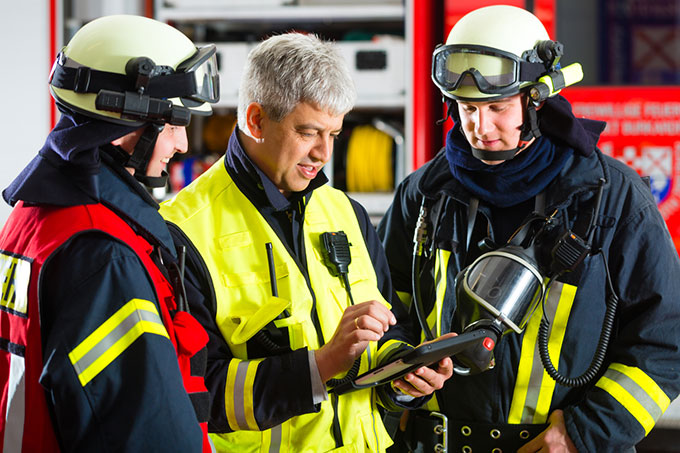
The Greater Manchester Fire and Rescue Service (GMFRS), part of the GMCA, is one of the largest fire and rescue services outside of London with more than 1,637 members of staff and 41 fire stations covering an area of around 500 square miles.
Mark Scoales, Digital Services Manager at GMCA, and his team of 35 staff are responsible for ensuring frontline firefighters and their support staff have all the tools they need to carry out their roles, responding to incidents and keeping citizens safe. This involves being able to communicate with colleagues clearly, accurately and quickly across the city-region.
When the pandemic hit in Spring 2020, this need became even more acute and Scoales and his team undertook a project to upgrade audio-visual equipment across the region’s fire stations. The desire was to increase digital functionality and improve remote communications between colleagues across all sites.
With communications rooms used daily by almost 3,000 staff members, usability was essential when it came to looking for a solution. In addition to facilitating easy access to their video conferencing tools, Scoales wanted to make it easy for staff to access the apps and tools that are regularly used by firefighters and their support teams.
After going out to tender, GMCA began a project to install 65-inch interactive touch display screens in the community rooms in each fire station throughout the GMCA region. The decision was then made to install DisplayNote Launcher on each screen across GMCA’s 47 sites.
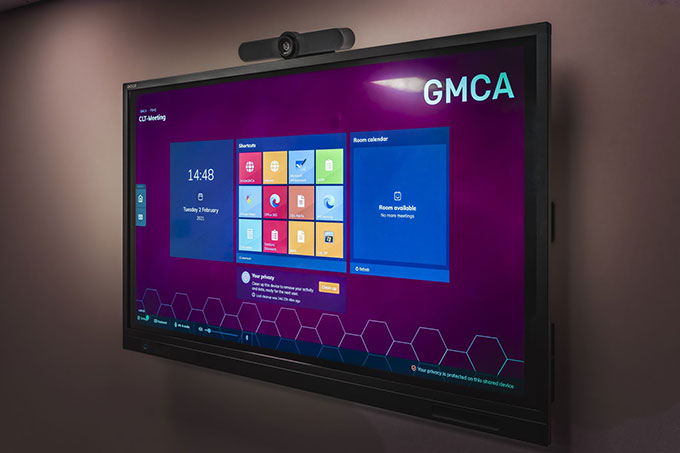
Launcher is a simple interface for meeting room displays that gives users easy access to calls, content and apps while maintaining the highest levels of security. All settings are PIN protected, and with Automatic Cleanup, one tap clears the user’s footprint, closing apps, removing sign-in information, and clearing any browsing history.
This simplicity, security and consistency were crucial factors in the decision to standardise on Launcher. Firefighters rely on repetitiveness and uniformity. The layout of fire stations is uniform to ensure firefighters can walk into any station and know where to find what they need. Scoales and his team were keen to replicate this across the digital offering.
Before using Launcher, Scoales describes the communication and collaboration experience as being “clunky”. Laptops were connected to projectors, making it difficult to create a smooth user experience across the rooms.
He adds: “It was hard to manage the devices and technology in the rooms and difficult to control what users were downloading. We knew that if we were going to find a new way of doing things, it had to be a simple, easy-to-use solution as this was the only way it would be adopted across the 47 sites.”
Launcher’s Kiosk Mode provides an entirely uniform experience to all users. They also now have full control over what apps and tools can be accessed, keeping the screens secure.
Scoales adds: “When we discovered Launcher, there was nothing else out there that came close. With Launcher installed, we are reassured that every screen is exactly the same no matter which station you go to; the same apps and icons are always there.
“Having a screen that looks exactly the same in every station has made a massive improvement. We don’t have any issues with users not knowing how to use it.”
The teams at GMCA now have one-touch access to their most frequently used video conferencing platforms and tools across the 47 sites. And, because Launcher makes the screens so easy to use, it has improved adoption, usability, and engagement with all the tools accessed via the screens.
Another area that has seen huge improvements thanks to Launcher is training. Previously, delivering training to each watch in every station would have taken around 2-3 months. With the upgraded AV set up, however, training has been provided remotely using MS Teams to 4-5 fire stations at a time, reducing the overall delivery time.
The fire service’s learning portal has also been set up as a shortcut on the screens. This means firefighters can now access the regular mandatory training that they must complete via this shortcut. Training can also be conducted in small groups rather than individually, which they have found to be more effective.
Scoales notes the positive impact this has had on the overall organisation: “Launcher has made a significant difference to how we deliver training. Because it makes the interactive displays so simple to use, our staff use it a lot. We’re getting the full return on the investment of our equipment.”
He concludes: “Onboarding new partners can be difficult for us. We always push the boundaries of what technology can do and what we expect as an organisation. The initial conversations we had were enlightening. Any suggestions we had, DisplayNote was happy to assist, happy to develop. This was a big positive for us.
“This is probably the best software I’ve seen for functionality. I would recommend Launcher to anyone.”