The new facility, located under 16 kilometers from Amsterdam Airport Schiphol, was opened with a launch event attended by OPTEX senior management including CEO Toru Kamimura and Executive Officer and Head of Security business Mac Kokobo, as well as sales, marketing and technical teams from across Europe.
The new office will provide account management, service and support base in Europe for new and existing customers, and will be managed by Masaya Kida, Managing Director for OPTEX EMEA.
“Europe represents a hugely important security market for us,” says Masaya. “And this new facility helps support our commitment to further growth and expansion throughout the region, ensuring we have the right resource in the right location to support our customers, service new business and deliver exceptional customer support at every stage.”
Additionally, Mark Cosgrave, OPTEX Divisional Manager for Western Europe, Ryotaru Shimizu, Product Manager for Security EMEA, and Eelko Griepink, Area Sales Manager for Benelux will also be based in the new office.
“We’ve enjoyed substantial growth in Europe over the last few years, and we will continue to grow our team to ensure to sustain this,” Masaya adds. “This new office will help ensure we can continue to meet the ever-changing needs of integrators, distributors and end users alike with our leading security technologies and solutions.”
The new office adds to OPTEX’s existing network of European security offices and stocking facilities already in operation in France, Poland, United Kingdom and Germany, as well as representatives based in Italy, Spain and Romania.
ASSA ABLOY has acquired Caldwell, a manufacturer of fenestration hardware for window manufacturers.
“I am very pleased to welcome Caldwell into the ASSA ABLOY Group. This acquisition delivers on our strategy to add complementary products and solutions to our core business,” says Nico Delvaux, President and CEO of ASSA ABLOY.
“Caldwell is an excellent addition to the Pacific & North East Asia Division and provides complementary growth opportunities. The acquisition will strengthen our position with fenestration manufacturers and I look forward to working with the experienced team to continue Caldwell’s successful journey,” says Simon Ellis, Executive Vice President and Head of Asia Pacific ASSA ABLOY Opening Solutions Pacific & North East Asia.
Caldwell was established in 1888 and has some 800 employees. Sales for 2021 amounted to about MEUR 93.7.
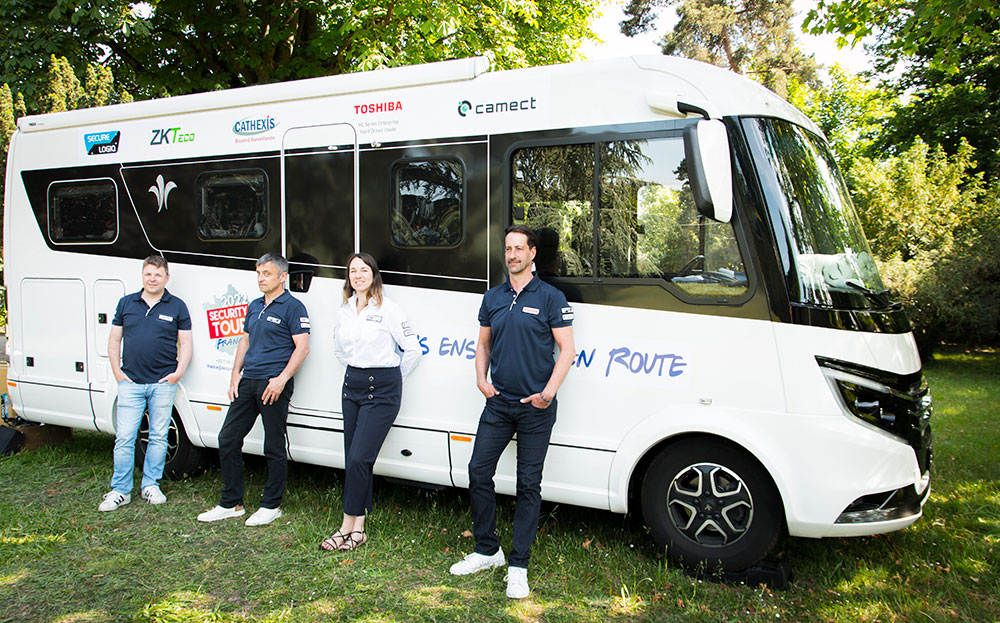
Secure Logiq, Toshiba, Cathexis, ZKTeco, and Camect went on an atypical two-week tour of France. We joined them in the suburbs of Paris to witness the first-hand test of the functionality of a complete integrated solution that these spirited competitors offer in the security market
We caught up with the Niesmann + Bischoff iSmove camper in Chatou, a beautiful town whose looks are sculpted by traditional French architecture and nature. Picturesque houses with high narrow windows, stone and brick facades in the colors of earth minerals, and dark roofs can be found, fittingly, only in this place – the one with much green and quiet. The chirping of birds is the area’s native sound tapestry, and occasional vehicles are just intruders that disturb its peace. While being close to the most visited tourist city in the world, life out there takes place in a completely different timeline: one reserved for yourself and your loved ones, at a bistro surrounded by friends, in intimate gardens surrounded by hedges. Even the hotel where we stayed, although tiny and fused with the panorama of the place, has a small inner stone courtyard, where you can smell the tradition while enjoying your croissant and coffee.
Watch the video reportage:
Integration in practice
We met our hosts in that mini square: Ivan, Jessica, Dominique, and Pierre. Contrary to expectations, thousands of kilometers and a number of visited cities did not leave a noticeable trace on their appearance: we were greeted by a cheerful, open-minded and – as it turned out – a pretty interesting team of people, the memory of who, even now, brings a smile to the face of the author of this text. The four of them work for different companies, which have a variety of products in their portfolio, but which are united by the challenges and willingness to cooperate. Wanting to offer something new to their potential partners and customers, they decided to go on a tour of France together. They branded the camper, equipped it with products, and brought with them their years of experience in business development, sales, and technology with the intention to demonstrate both the individual strength of their companies and the strength that stems from the relationship between various technologies. This is a value that is important to the world of security because the protection of any major facility or location depends on the functionality and reliability of a number of parts that constitute complex security systems. Dedicated servers by Secure Logiq, Toshiba’s hard drives, Cathexis’ VMS, ZKTeco’s access control and Camect’s hub with multiple outputs for multiple cameras, monitors and video walls in fact represent stacked layers of one security croissant of sorts that customers can study on their doorstep as part of a unique tour in this industry.
Dedicated CCTV servers
The entire presented system relies on Secure Logiq’s dedicated servers, the specifics of which we wrote about in one of our earlier issues. A group of experts with many years of experience gathered while working for all well-known manufacturers of video management software came up with the idea to fill in the missing piece on the security puzzle. These are servers specifically designed and built for video surveillance because the use of generic servers did not provide the quality of the recording that could be obtained in the field. The systems were simply not optimized. Secure Logiq has therefore developed a unique Benchmark Pro system to simulate the system that operates in real circumstances. It enters all the specifications that the client submits, from the number and type of cameras to the analytics used. The software then creates virtual streams and simulates what it will look like before the hardware production, i.e. whether the server will withstand the load or not. “Clients often ask us how we can guarantee that our servers will work. The answer is our unique Benchmark Pro software. Since each video system has its own needs, the client provides us with what they need, we make a calculation and deliver a server that is guaranteed to work 100%. If we make a mistake, and so far we haven’t, we’ll fix it at our own expense. And as an added value included in the price of the server, for each client who submits a template and to whom we send a recommendation for the server, we will also provide a complete design. In it, we will describe how many frames per second they get for each camera, what the percentage of the recording is, etc. With that document they can go to the client and ask for a quote”, says Ivan Sval, Secure Logiq’s Regional Sales Manager.
Four-pitched roof
Secure Logiq has several types of servers in its portfolio: from input models 1U with 42 TB, through 2U and 4U, to large workstations of up to 384 TB. The biggest project they completed involved a 1.4 PB server in a single housing. Secure Logiq’s vision is based on four pillars: the largest archive, the fastest data flow, the highest resilience, and the best value for money. “All of our components come with a three to five-year warranty. All servers have two SSDs, with the operating system mapped to both by default, while a redundant power supply is optional. We can run recording servers, workstations used for recording and viewing, or workstation clients used just for viewing recordings,” explains Mr Sval, adding that servers can be upgraded with GPUs and that the last one they worked on had as many as 30 GPU ports.
In addition to Benchmark Pro, Secure Logiq offers two other value-added pieces of software. One of them is Healthcheck, to which the user can connect via the cloud and immediately get information about the status of their server. This does not require an application, but rather online access via any browser. Thresholds can be set in the software, the crossing of which activates the sending of notifications. All communication is protected by SSL encryption and 2-factor authentication. There’s also the Logical Core which allows you to make a copy of one server to another without using licenses for a VMS manufacturer’s redundancy services. The complete Windows is mapped to another server. When the first one fails, the second takes over at no extra cost.
A new challenger in the storage market
Secure Logiq buys all hard drives used in its servers from Toshiba. This is a seemingly unusual move because those who follow this industry know that this renowned Japanese manufacturer, although globally known for its quality, hasn’t operated in the video surveillance market until recently. Toshiba entered the global security industry only five years ago, while its presence in the European security industry was established in 2019. For this purpose, Toshiba had to design completely new products. “We had to develop a special technology because all-day work is demanding for this type of disc. In order to withstand a workload of 180 TB per year, the device must be of great quality. Although we faced strong competition from Seagate and Western Digital, Toshiba is an established Japanese manufacturer which can offer high value in terms of quality, design, price-quality ratio, and investment in research and development. Of course, we had to start from scratch, present our solutions and products and convince customers to trust us,” says Pierre Andrieux, Key Account Manager. It is with this goal that they embarked on this tour in order to establish themselves on the French market together with other brands.
Toshiba has developed a special series of hard drives, firmware, and designs for video surveillance applications so that their products can record videos 24 hours a day, every day of the week. The new series of 3.5-inch discs optimized for storing video with 64 cameras have been named the S300 and is rounded off with the S300 Pro model with a capacity of up to 10 GB. At the same time, they promote an even more resilient and reliable, but more expensive enterprise MG series of hard drives, which can withstand an annual load of 550 TB. It is intended for industrial servers, data centers, and cloud infrastructures. All Toshiba discs come with a five-year warranty, be those the cheapest or the most expensive ones.
Multipurpose open architecture software
The “mind” that manages the entire system backed up by Secure Logiq’s and Toshiba’s hardware is the video management software by the South African company Cathexis. It is software with sophisticated open architecture with multiple possibilities, used for a number of projects around the world. From single installations with over 4000 cameras to customers with over 65,000 cameras spread over 1,500 locations. CathexisVision is not just a VMS in the classic sense: it integrates and manages other 3rd party systems, from intrusion detection and access control to fire alarms, elevators, etc., which makes it very flexible and multifunctional. It comes in several editions: Lite, Core, Professional, and Premium. The difference is in the number of cameras it supports (a maximum of 48 in the first two versions, 150 in Professional, and an unlimited number in Premium), and single servers for Lite and Core and no restriction on servers in the remaining two editions. The cost of the required server platform is considerably lower than the main competitors. In this way, the company can adapt the software to the needs of an individual project. If, for example, you have 10 cameras, one of which is ANPR-enabled, and the two come with on-board analytics, it is not necessary to upgrade to a more expensive version, but rather keep the basic server licence and merely purchase additional camera licenses. There is no limit on the camera functionality supported. Subsequent changes are also easy to make, e.g. moving analytics from one camera to another.
Find objects quickly
The CathexisVision interface is classic, with a video display, timeline, playback and search controls, a feature resource tree,, etc. As we have seen, the software is easy to use and helps you find the clips you need. “Personally, I think that the most important thing in VMS is to quickly find the segment in the video that we need. In our software, this is made simple. We display various activities and other useful information on an intuitive timeline. It includes a graph, often referred to as a Manhattan, which is indicative of the motion throughout the image. The timeline also includes information from other triggers and time based recordings.
If, for example, you want to know when the vehicle entered the parking lot, you can click on the time when it probably did not arrive, e.g. early in the morning, and load that image, and then you go to a time when it’s already there and share the frames between those two time points until you get the one we need,” explains Dominique Debusschere, Cathexis’s Business Development Manager for Europe. Another useful feature is the Activity Trail, which employs different colors, similar to heat maps, to represent movements in the monitored area in relation to the time when they occurred. There is also Adjacent Camera Mapping which offers ease of navigation from one camera to another and by using arrows similar to those in Google Street View.
Easier addition of analytical functions
One of the strengths of CathexisVision is the rapid deployment and fine tuning of multiple types of analytics. The ease of configuration was one aspect of the VMS that helped Cathexis win the Innovation award from the UK security magazine, Benchmark, three out of the last four years. “Once the threat has been identified, one or multiple analytics in the library, including artificial intelligence based object classification, can be used to combat the intrusion,” says Mr Debusschere. The real challenge with intrusion analytics is the large number of false alarms, usually solved by having a technician go to the site and adjust all the parameters, potentially multiple times, requiring both time and money.
To avoid this, Cathexis developed an analytics simulator were recorded footage from the false alarm can be processed remotely allowing an “off-line” inexpensive way of fine-tuning analytics. Integration provides an expansive connection with multiple types of 3rd party devices. For example, a camera detects movement, it would be possible to set the lights to turn on immediately, play an audio warning, check if all the doors are locked, etc. Cathexis now offers a completely revamped, feature rich and highly configurable Android and iOS mobile app. Everything is visible to the mobile security and which can be tailored to their needs. As a novelty for our readers, we learned that just before our arrival, Cathexis launched their new Carbon user interface, an improved and modernised user app with great new functionality. We have also found out that they are currently working on an Enterprise app that will give an estate owner visibility of all his assets, how they are performing, what’s working and what isn’t and be able to control in detail who access to what resources via the corporate Active Directory.
Focus on a new strategy and partner selection
After staying at the European headquarters of ZKTeco in Madrid, which I wrote about in detail in issue No. 178 in May, I was not surprised by the presence of this multinational company on this tour. Back then, I asked them about their development plans in Europe and learned that they opened a number of new offices and were planning for more, that they operated profitably and actively even during the pandemic and that they significantly expanded their product portfolio compared to 10 years ago when they had celebrated their first presentations at local security fairs in a more modest manner. The European market is their focus now and they will maintain that course in the coming years, given the growth in all countries. “Large European market is traditionally a great challenge. Since we have so far been oriented towards project tenders in Europe, we now want to focus on strategy and partner selection, not trying to focus on everything but rather on a few key needs. We want to build a relationship based on trust, so my job is to train our partners to more easily find their partners, bring them in and help them grow,” says Jessica Perret, the company’s Business Development Manager whose goal is to strengthen its presence in French and Belgian markets and draft accompanying strategy.
Client’s trust, among other things, will be built by demonstrating the ability to integrate, and this tour across France is just a great opportunity to do so. “The reason we are participating in this mobile presentation is to show the extent to which we can integrate with all brands. Here, we not only play the role of an independent company but rather show that we are available for integration and communication with other solutions. It’s a new way of marketing. The idea of this presentation is to attract customers, find new partners, and present new ways of getting to know the brand. This type of communication is much more comprehensive. I think that top brands joined together in this way make this presentation stronger and better,” explains Mrs Perret.
A solution for small and medium enterprises
In the park, the “green” company presented us with an affordable and comprehensive Atlas series of access control devices, intended for small and medium enterprises. It is a simple solution, consisting of the main controller to which up to 20 secondary controllers can be connected, together with two types of readers – RFID cards and fingerprints – that can be used simultaneously. The system also supports contactless reading of QR codes from mobile phones, as well as PINs and bar codes. Atlas comes with Linux software installed, which does not require a license. Just enter the IP address of the controller as the URL of the web page. On the main screen of the software, you can monitor the activities of the controller, e.g. how many devices are connected, and how many doors are controlled, with real-time monitoring supported. “You can easily determine if someone is a user and if that person has the right to access a specific door. If you enter a random code, the system reports that someone is trying to enter at a certain time. You can, for example, identify individual doors and readers and connect to the desired door. Also, with the help of the menu, you can get a map of the installation, the location of the controller, as well as information about which door is connected to which type of reader,” ZKTeco’s business development manager told us.
The simplicity of the Atlas series is reflected in its plug & play connectivity, which makes it easier for installers, because they no longer have to spend time connecting, configuring, and explaining the system. The same goes for the users because it is now easy to create new users and give them access. Of course, ZKTeco also offers solutions for much larger installations, such as ZKBioSecurity, which supports more than 200 doors and an unlimited number of users, whereby ANPR, elevator control, time & attendance, etc. can be added to the software. The system can be integrated with any third-party product. They offer communication via SDK to other companies, so they can use the information stored in the controllers and communicate with third-party software.
All analytics in one device
Although their representative could not join us, our interlocutors eventually presented us with a solution from the American company Camect, which is used in more than 30 countries. It is a smart camera hub that offers high-precision object detection in a compact and affordable local system that requires minimal configuration. As obtaining accurate video analytics from a surveilled location remains a challenge, Camect has created a platform that sends detailed and informative notifications about a detected object, which it can send to a monitoring center or other application. This way, it eliminates false alarms caused by smaller moving objects, animals, shadows, or weather conditions. Even simple adjustment makes it possible to detect objects over long distances, which is suitable for construction sites or car parks, for example. The Camect hub is compatible with all IP cameras that support ONVIF profiles or the RTSP protocol, and by combining analytics in one hub, excellent results can be obtained even with cheaper cameras. Integrators can also unlock advanced analytical settings such as increased sensitivity or detecting loitering or unauthorized tampering with the device. The hub itself also has 1 TB of internal memory, where it stores and processes video data, so only alarm notifications are sent to the monitoring center. This significantly reduces bandwidth compared to cloud analytics services for filtering false alarms.
Suprema has successfully integrated its Biostar 2 security platform with Mantech Continuous Cluster Server(MCCS), a high availability(HA) solution provided by Korean IT service provider Mantech.
Biostar 2 is a comprehensive access control management platform that manages mission-critical security data. Through integration with MCCS, Biostar 2 is able to enhance system stability and expand service continuity. This also ensures greater cost-efficiency, productivity, and availability for Biostar 2 customers by minimizing unnecessary waste of resources to manage failure, such as manpower, applications, and extra storage.
MCCS, the failover system of Biostar 2, uses automated failover and real-time replication to help prevent server downtime, data loss, and system failure. It can detect the failure of servers, storage, networks, application services, and operating systems. When failure occurs, it automatically switches to a backup system and replicates data in real-time so the company can protect mission-critical data 24/7 with no downtime.
“Integrating with MCCS has enabled Biostar 2 to provide an even safer and more secure platform service than ever for our enterprise customers,” said Suprema CEO Hanchul Kim, “Suprema will continuously make efforts to enhance Biostar 2 capabilities, meeting the needs of all our customers, from small offices to the largest organisations.”
SALTO and Kohost technology announced partnership that enables contactless smart access and guest room control on guest phones without downloading an app.
SALTO hospitality solutions and Kohost combines easy access, digital key and smart guest rooms, with unified property management systems that protect individuals and assets. With the addition of the SALTO network dongle, older SALTO locks integrated with the Kohost app can become digital keys without having to replace the locks.
Smart-hotel convenience. Provide the modern, easy access option guests increasingly expect with digital keys or key cards giving convenient, instant and safe access.
Seamless keyless experiences. Extend smart access beyond the guest room across your property. Provide seamless access from back-of-house to entrances, perimeter access doors, elevators, gyms, business areas, parking and any other hotel facilities.
Exceed expectations. Enable guest service innovations creating value-add opportunities to drive business for your hotel, enhancing guest experiences and delivering operational efficiencies.
“With over 40 million daily users of SALTO smart locks worldwide, we are providing a safe and secure environment for guests while at the same time delivering energy savings, safe and efficient lodging when combined under the SALTO- Kohost platform. Offering our customers integration with the innovative Kohost Guest Experience “GX” App is an easy way for those properties to add the conveniences their guests want, right in the palm of their hand,” said Beth Kahwajy, SALTO Director of NA Hospitality.
In addition to providing the smartphone interface to the SALTO locks and access controls, Kohost and SALTO new integration and technology partnership delivers remote digital room keyless access on a guest’s phone, total room control together with smart guest room systems, including HVAC, Lighting, Window Shades and TVs in addition to concierge guest services, two-way communications and local F&B ordering.
The global physical security market size is expected to reach USD 137.99 billion by 2028 according to a new study by Polaris Market Research in a new report which gives a detailed insight into current market dynamics and provides analysis on future market growth.
Significant factors of the market such as increasing smart city projects by the government deploying various physical security systems coupled with the improving infrastructural development with the robust access control measures are impelling the market demand. In addition, growing awareness regarding the availability of numerous IP-based cameras for video surveillance is further boosting the market demand across the globe.
Based on end-use, the residential segment holds the largest share globally. This is, according to Polaris, due to rising concern for safeguarding lives and protecting assets from any potential risks. The transportation segment is projected to rise at the second-fastest CAGR over the forecast period due to the growing demand for the equipment to be deployed in the overseeing of traffic congestion and monitoring crowds.
G4S, Anixter, Axis Communications, Cisco Systems, Dahua Technology, Genetec, ADT, Hikvision Digital Technology, Stanley Convergent Security Solutions, Honeywell International, Pelco, Dahua Technology, Robert Bosch, Johnson Controls are some of the key players operating in the global market.
Securitas has established a new global entity called Securitas Digital – it will be led by Martin Althén. Hillevi Agranius will be appointed Chief Information Officer (CIO) and added as a new member of the Group Management team. The changes are set to be effective from July 1, 2022.
It is planned that the Securitas focus on client centricity, digitalisation, and innovation will now further increase as the company creates this new, global function: Securitas Digital, focusing on the accelerated growth of the digital products and services from the Group.
“I am excited that we now have reached the point where we are ready to accelerate our digitalisation and client experience journey. Martin has been instrumental in building our digital foundation, and I am confident that he will succeed in leading Securitas Digital,” says President and CEO Magnus Ahlqvist.
“At the same time, I couldn’t be more excited to promote one of our successful leaders to CIO. Hillevi has extensive experience, both during her years in Securitas and as the previous CIO at Husqvarna.”
As the President of Securitas Digital, Martin Althén will own Securitas’ digital business strategy, drive innovation and grow the digital business. He will ensure that Securitas’ overarching technology strategy enables the business optimally.
As CIO, Hillevi Agranius will continue to drive and refine the IT transformation and efficiency agenda throughout the Securitas Group. She will take on the overall responsibility for Global IT, including Divisional IT operations, Digital Security, Platform teams and Enterprise Architecture.
According to the latest research information from Marketsandmarkets, the contactless biometrics market is projected to grow from USD 19.7 billion in 2022 to USD 39.8 billion by 2027, at a CAGR of 15.1% during the forecast period.
The major driving factors contributing to the high growth rate of contactless biometrics market include increased use of contactless biometrics technology post the pandemic, government initiatives that support the adoption of contactless biometrics solutions, smartphones and tablet adoption, and growing security concerns and hygiene issues among users due to touch-based systems.
Based on offerings, contactless biometrics services have witnessed a growing demand in recent years. Contactless biometric services deliver biometric onboarding and authentication capabilities, and it eliminates the cost associated with the database, network, and storage components. Contactless biometrics services include professional services and managed services. Professional services are further classified into training and consulting services, feasibility assessment services, analysis, and advisory services.
Criminal identification & forensics is strongest application
Contactless biometric solutions can be very useful during criminal investigations, for example, forensic biometrics uses fingerprints, palm prints, hand vasculature, hand shape, face, DNA, face, voice, iris, etc. In February 2022, Edmonton Police Service (EPS) in Canada adopted Neoface Reveal facial recognition solution by NEC Corporation for identifying suspects in investigations through CCTV footage and photos. The software will help the police force with their databases that include criminal photos charged earlier for heinous crimes. Also, the software enables the detection of false information of the individuals in custody through facial recognition abilities.
North America holds the major share
In the US, rising security concerns due to abrupt terrorist activities as well as illegal immigrants entering the region have increased the demand for contactless biometric technologies to maintain high-level security. As identified by the US Federal Trade Commission, identity theft problems could drive the adoption of advanced authentication methods. The emergence of various government regulations and standards for the protection and security of personal data and to regulate its collection and use of biometric data has led to the promotion of biometric technologies for authentication and verification purposes. Contactless biometric vendors in North America are helping companies, organisations and government entities implement safer work environment solutions.
Key market players
Key and innovative vendors in contactless biometrics market include Aware, Fingerprint Cards, Fujitsu, HID Global, Idemia, M2sys, NEC, Nviasoft, Touchless Biometrics Systems, Thales, Veridium, Bioconnect, Innmovatrics, Cognitec, Dermalog Identification Systems, Secugen, Neurotechnology, Shufti Pro, Fidentity, Daon, Nviso, Noldus, Blue Biometrics True Face, Veridos, annd ID R&D.
In the past year, Dahua Technology has adhered to its mission of “enabling a safer society and smarter living.” With the core information technologies such as software, big data, artificial intelligence, and AIoT, Dahua continues to contribute to urban road accident reduction, environment protection, the improvement of green energy utility efficiency, etc.
In 2021, the number of Dahua products that obtained China Energy-saving Product Certification reached 126 – a 39% increase compared to 2020. The number of materials that received RoHS Certification reached 95,520.
In order to strengthen the compliance of business operations and improve the efficiency of recycling, Dahua developed a refund & return management platform, transitioning its traditional business model into digital information management. It realizes online management of material return, material reception, treatment scheme evaluation and treatment scheme execution to realize the visibility and traceability of the whole process. At the same time, it utilized the data to reduce returned products from the source, prevent environmental pollution, reduce waste generation, and reduce operating costs.
In packaging material management, Dahua mainly uses paper, plastic, wood and metal packaging materials and other packaging auxiliary materials, in accordance with the principle of lightweight, recyclable and sustainable. Meanwhile, the packaging is also in strict accordance with the EU 94/62/EC packaging and waste packaging directive for hazardous substances control, ensuring the total content of lead, mercury, cadmium, and hexavalent chromium in packaging materials does not exceed 0.01% (100ppm). Carton products strictly comply with the relevant requirements of GBT 39084-2020 Green Product Evaluation Express Packaging Products.
Through technological and design innovation, Dahua promotes energy saving and consumption reduction in the upstream and downstream of the packaging industry chain, realizes standardized and intelligent packaging design, reduces the use of packaging materials, decreases the proportion of plastic applications, and improves the utilization of storage and transportation space.
It is worth mentioning that Dahua developed an EHS paper pallet to substitute for plastic, which improves the recycling and degradation of packaging, achieves more than 50% weight reduction and reduces production energy consumption. Moreover, the new film composite packaging technology developed by Dahua Innovation uses 100% recyclable and green environmental protection materials, which can reduce the use of packaging materials by 40%, increase production capacity by 30%, and increase storage and transportation space utilization rate by 50%.
VIVOTEK is a company originally from Taiwan, which has been producing video surveillance cameras and solutions for over 20 years. Complete production is in Taiwan, as well as a strong R&D department dedicated to developing new solutions and tracking needs on the job market.
Camera Link is a solution fully developed in our R&D department, and is completely revolutionary in the market, which no manufacturer can offer you.
The solution is intended for perimeter protection, which allows the user fully automatic perimeter protection, with advanced analytical solutions perimeter protection of the user is fully ensured.
The solution consists of bullet and PTZ cameras, bullet camera serves for fixed perimeter surveillance and threat detection via analytical solution based on artificial intelligence, while PTZ camera serves to monitor a specific object after bullet detection, PTZ camera also uses analytical solution based on artificial intelligence.
The solution is unique on the market because the cameras are directly connected to each other, and do not need a connection to the VMS (video management system). Which means the cameras are self-contained to perform their perimeter protection tasks.
In case of any loss of connection between the cameras and the server on which the VMS is located, the cameras will detect any threat perimeter and save the required video to the SD card, after the renewed connection with the servo can transfer to the server. So, with this solution the user is completely protected from material loss in case of loss of camera connection to the server.
The camera model IB9367-EHTV V2 is an ideal model for this application. It is a high processing power camera that can perform demanding perimeter protection actions. It is a 2MP resolution camera, 60 fps in 2MP resolution. It comes with two types of lenses, so all possible scenarios can be covered. The first is a 2.7-13.5mm motorized lens, while the second used to monitor remote areas, has a 5-50mm motorized lens. The camera still has strong WDR, and IR up to 50 meters for a 2.7-13.5mm lens, and up to 100 meters for a 5-50mm lens.
The camera is equipped with VIVOTEK Smart VCA analytics, which is based on artificial intelligence. VIVOTEK Smart VCA is a solution that detects people with a very high percentage. Detection is done in a 3D algorithm, thus completely ensuring protection against false alarms, because the analyst will only recognize the human form. Also, with a very high percentage can recognize various human movements, such as: walking, running. Can detect different scenarios (intrusion detection, loitering detection, line crossing detection, unattended object detection, missing object detection, face detection, crowd detection, running detection)
PTZ camera SD9368 EHL is a mobile camera with high processing power, which due to its performance can easily perform perimeter protection tasks. The camera has a resolution of 2MP, 60 fps in a resolution of 2MP. With a 4.25-170mm lens, which is a magnification of 40X. IR up to 250 m.
The PTZ camera is equipped with VIVOTEK SMART VCA analytics based on artificial intelligence, and with an auto-tracking function, which uses a 3D object tracking solution.